Parents weaning a baby under one
The first distinction is between using oat drink in food and replacing the baby’s main milk. NHS guidance says breast milk or first infant formula remains the main milk through the first year.


For a baby under one, do not choose oat drink to replace breast milk or first infant formula as their main milk: the NHS says to continue these until at least their first birthday. If you want oat drink for weaning recipes, check the exact carton’s fortification and allergens; if you are considering it as a drink for an older child, assess the label and the child’s overall diet before choosing a larger pack.
The first distinction is between using oat drink in food and replacing the baby’s main milk. NHS guidance says breast milk or first infant formula remains the main milk through the first year.
If you are considering an oat drink as a regular drink, compare the exact carton’s fortification and nutritional information in the context of the child’s diet and growth.
A multipack can supply several recipes, but its total volume is not the size of one bottle. Decide how the drink will be used for the child before choosing the pack format.
Start with the child’s age and whether the oat drink is for food or for drinking. Then compare the exact product label and the amount you can use.
| Priority | What to check | Your needs |
|---|---|---|
| Age and use | Decide whether the drink is an ingredient or the child’s main milk. The NHS says to continue breast milk or first infant formula until at least age one. | For a baby under one, I need an ingredient for weaning food, not a replacement for their main milk. |
| Fortification | Read the current carton for added calcium and its amount per 100ml. Check other declared nutrients on that same product rather than assuming all oat drinks are fortified alike. | If I am considering oat drink for a child aged one or over, I want to compare the labelled nutrients alongside their overall diet. |
| Allergens | Check the exact product’s ingredients and milk, oat and gluten-related warnings. The Food Standards Agency notes that oats remain an allergen even when a food is labelled gluten-free. | Where an allergy or coeliac disease matters in my household, I need the current pack statement, not an assumption based on the words “oat drink” or “vegan”. |
| Pack format | Separate the size of each carton from the number of cartons. A 3 x 1.5L multipack contains 4.5L across three cartons, not one 4-pint bottle, as the Sainsbury’s Oatly listing illustrates. | I want enough for household cooking, but a larger total volume does not tell me whether the drink is appropriate for my child’s intended use. |
For a baby under one, this would displace the breast milk or first infant formula that the NHS identifies as their main milk.
Keep oat drink for an appropriate food-preparation use during weaning; do not treat it as an interchangeable main drink.
Fortification differs between products. A vegan or organic description does not tell you how much calcium the carton contains.
For a child aged one or over, compare the current nutrition label, including calcium per 100ml, in the context of the child’s diet.
Product warnings differ: Marks & Spencer’s Plant Kitchen Whole Oat Drink page says it is not suitable for people with a milk allergy or for coeliacs, despite describing it as vegan.
Read the exact pack’s ingredient and allergen statements, particularly when managing milk or oat allergy or coeliac disease.
Several cartons may be convenient for cooking, but pack volume cannot establish whether a drink should be used as a child’s main milk.
Settle the age-appropriate use and check the product label first; then confirm the carton size and pack count.
These examples refer to specific listed products, not every drink made by each brand. Check the current carton before using any of them for a child.
Tesco lists Oatly Whole Oat Drink in a 1L carton with 2.7% fat; Sainsbury’s lists a separate Barista Edition multipack of 3 x 1.5L.
Sainsbury’s describes Alpro Original Oat 1L as dairy-free and a source of calcium and iodine.
Tesco lists its own-label Oat Drink in a 1L carton with added calcium, iodine and vitamins B12, B2 and D2.
Sainsbury’s lists its own Oat Drink in a 1L carton and describes it as fortified with calcium, iodine and vitamins D and B12.
Minor Figures lists gluten-free oats and added calcium, iodine and vitamins on its Everyday Oat product page.
Marks & Spencer lists Plant Kitchen Whole Oat Drink as a 1L product enriched with calcium, iodine and vitamins.
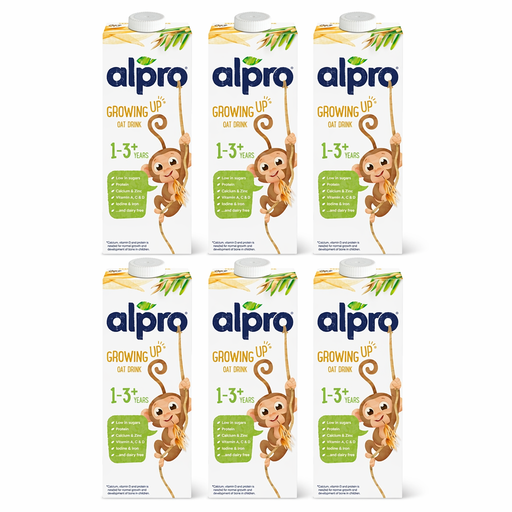
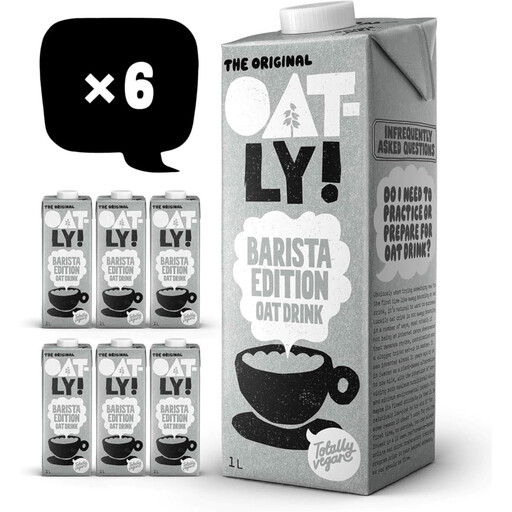
These oat drinks represent two different shopping needs: an Alpro Growing Up drink to assess for a child aged one or over, and an Oatly Barista drink to consider for household cooking. Neither product is a substitute for breast milk or first infant formula during a baby’s first year.
 No image available
For a child aged one or over, consider this Growing Up drink only in the context of their overall diet and growth; it must not replace a baby’s main milk during the first year.
Check the current carton’s nutrition and oat-allergen information. Confirm the quantity before ordering: the listing title begins with “6”, while its description gives a net quantity of 1L.
 No image available
For household cooking during weaning, keep this oat drink separate from the baby’s main milk; its product guidance also warns against using it as a complete milk substitute for infants or young children.
The title says 6x1L, but the pack wording differs elsewhere in the listing, so confirm the number of cartons before ordering. Check the current oat-allergen information on the pack.
No. The NHS says breast milk or first infant formula remains a baby’s main milk until at least age one. Oat drink considered for weaning food is an ingredient, not a replacement main drink.
Age one is the point after which a calcium-fortified oat drink may be considered as a main drink alongside a varied diet and normal growth. Check the exact product’s nutrition label rather than choosing by its pack size or plant-based description alone.
No. Alpro’s listed Original Oat drink is described as dairy-free, but Marks & Spencer’s vegan Plant Kitchen Whole Oat Drink page says that product is not suitable for people with a milk allergy. Follow the current allergen statement on the exact pack.
No. The Food Standards Agency identifies oats as an allergen even when a food is gluten-free. Check the product’s oat and gluten-related statements against the child’s specific requirements; Marks & Spencer’s Whole Oat Drink page, for example, says it is not suitable for coeliacs.
No. Sainsbury’s lists the Oatly Barista Edition pack as three 1.5L cartons, totalling 4.5L, rather than one 4-pint bottle. Check both the individual carton size and pack count when choosing a larger household supply.