What should you check before buying?
Start with the child’s age and how the drink would be used. Then compare the exact carton’s fortification and suitability statements.
| Priority | What to check | When it matters to me |
|---|
| Main drink before age one |
Keep breast milk or first infant formula as the main drink; ask the healthcare team about an appropriate formula if cow’s milk protein allergy is suspected or diagnosed. This follows NHS guidance. |
I’m looking for a dairy-free main drink for my baby. An ordinary oat drink does not fill that role before their first birthday. |
| Use in cooking |
Check that the drink is intended for the child’s age and use it as an ingredient, not a replacement main drink. Frimley Healthier Together NHS permits plant drinks in cooking from around six months. |
For porridge or a sauce during weaning, I need to distinguish an ingredient from the milk my baby usually drinks. |
| Calcium and iodine |
Read the nutrition panel and ingredients for fortification. For cooking use, Frimley Healthier Together NHS advises calcium and iodine fortification and specifies at least 120 mg calcium per 100 ml. |
I want to check the nutrients in this particular carton, rather than assume that an organic or dairy-free label means it is fortified. |
| Allergen warnings |
Read the current ingredients and allergen statement, including any product-specific milk or wheat warning. The Food Standards Agency notes that oats remain an allergen even when labelled gluten-free. |
If my child has an allergy or coeliac disease, I need a product whose specific warnings do not conflict with their needs. |
| Use after age one |
Check the exact variant’s main-drink age statement and nutrition panel. Sainsbury’s says its standard Oat Drink is not a main milk alternative for children under three, while its 1+ Years version says it is not one for children under two. |
My child has turned one, but I still need to check whether this particular drink is suitable for its intended role. |
Brand and own-label examples
These examples show why the variant matters; a brand name alone does not establish suitability for a baby or child.
Oatly
Oatly Organic Oat Drink illustrates why an organic claim is not a substitute for checking fortification.
- Oatly lists water, organic oats and sea salt as its ingredients.
- Oatly says this Organic variant is not fortified with vitamins and minerals, unlike the fortification advised by Frimley Healthier Together NHS for cooking during weaning.
Alpro
Alpro Oat No Sugars is an example to compare when checking fortification for cooking use.
- Alpro lists 120 mg calcium and 22.6 µg iodine per 100 ml for this variant.
- Those nutrient figures do not make a retail oat drink a main-drink replacement for a baby under one.
Minor Figures
Minor Figures Everyday Oat combines a gluten-free description with listed added nutrients.
- Minor Figures lists calcium, vitamin D, riboflavin, vitamin B12 and iodine in this product.
- Gluten-free does not mean oat-allergen-free; check suitability for the individual child.
Tesco
Tesco Oat Drink is an own-label example for checking an exact carton’s fortification.
- Tesco lists added calcium, iodine, vitamin B12, riboflavin and vitamin D2 for this product.
- Tesco advises reading the product label because food products may be reformulated.
Sainsbury’s
Sainsbury’s standard Oat Drink and 1+ Years Oat Drink carry different main-drink age statements.
- Sainsbury’s lists 120 mg calcium and 22.5 µg iodine per 100 ml for its standard Oat Drink.
- Its standard drink says it is not a main milk alternative under age three; the 1+ Years variant says it is not one under age two.
M&S
M&S Plant Kitchen Whole Oat Drink shows why an allergen warning must be checked alongside fortification.
- Marks & Spencer lists added calcium, iodine, vitamin D and vitamin B12.
- Its product information says this drink is unsuitable for people with milk or wheat allergy.
Joybuy oat drink option
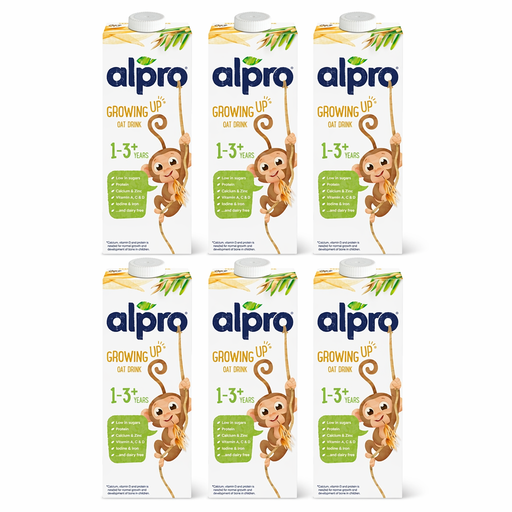
This growing-up oat drink is an option to assess for a child after their first birthday. Check its carton for the intended age and use; it does not replace the main-milk guidance for babies under one.
 No image available
Alpro Oat Growing Up Drink (6)
For a child after their first birthday, check the carton’s age statement before deciding how to use this oat-based growing-up drink. Compare its calcium and iodine information and read any milk-allergy warning; do not use a retail oat drink to replace breast milk or first infant formula as a baby’s main drink before age one.
View on Joybuy
Questions about oat drink and weaning
Can oat drink be my baby’s main drink while weaning?
No, not before their first birthday. NHS guidance says to continue breast milk or first infant formula until at least age one. If cow’s milk protein allergy is suspected or diagnosed, ask the healthcare team about an appropriate formula rather than substituting a retail oat drink.
Can I use oat drink in food from six months?
Yes, Frimley Healthier Together NHS says plant drinks can be used in cooking from around six months, but not as the main milk drink before age one. Its guidance favours calcium- and iodine-fortified products and specifies at least 120 mg calcium per 100 ml.
Is an organic oat drink automatically suitable for cooking during weaning?
No. Check the exact product’s fortification: Oatly says its Organic Oat Drink is not fortified with vitamins and minerals, whereas Frimley Healthier Together NHS advises choosing a calcium- and iodine-fortified plant drink for this cooking use.
Does vegan mean an oat drink is suitable for a child with milk allergy?
No. Read the individual product’s allergen statement and seek clinical advice for suspected or diagnosed cow’s milk protein allergy. Marks & Spencer says its Plant Kitchen Whole Oat Drink is unsuitable for people with milk allergy despite its plant-based description.
What changes when my child turns one?
An oat drink may be considered, but its exact age statement and intended role still matter. Sainsbury’s says its standard Oat Drink is not a main milk alternative for children under three, while its 1+ Years Oat Drink says it is not one for children under two; check the carton’s nutrition and allergen information too.


