Organic-first home bakers
You want an oat drink for cakes, pancakes, batters or sauces, and an organic claim and short ingredient list matter more to you than a barista-style formula.


For recipes that call for milk, a standard organic oat drink is a straightforward option if you want a short ingredient list; Oatly says its Organic Oat Drink can be used in cooking and baking. Compare an oil-containing organic barista drink if you also make hot drinks. If the carton is used regularly as a dairy alternative, check its fortification separately: an organic label does not tell you which nutrients it contains.
You want an oat drink for cakes, pancakes, batters or sauces, and an organic claim and short ingredient list matter more to you than a barista-style formula.
You would use the same carton in recipes and coffee or hot chocolate, so an organic barista formula containing oil may be worth comparing with a simpler drink.
When oat drink is more than an occasional baking ingredient, you also need to examine the exact carton’s nutrient and allergen information. Organic status alone does not answer those questions.
Decide how you will use the carton first, then compare its organic claim, formula and nutrition information.
Choose when: You want a short ingredient list for recipes calling for milk; Oatly says its Organic Oat Drink works in cooking and baking.
Bear in mind: Organic ingredients do not establish whether the drink is fortified.
Choose when: You also use oat drink in hot drinks and want to consider an oil-containing formula.
Bear in mind: Barista positioning does not establish better results in every bake.
Choose when: Added nutrients matter because the carton is also used regularly as a dairy alternative.
Bear in mind: Fortification does not establish an organic claim, and the nutrients differ by product.
| Priority | What to check | Your needs |
|---|---|---|
| Organic claim | Check the specific carton’s organic designation and certification information. The Department for Environment, Food & Rural Affairs’ UK guidance, updated August 2025, sets production, ingredient and approved control-body certification conditions for food labelled organic. | I want an organic product, rather than relying on words such as “natural” to mean the same thing. |
| Recipe and formula | Compare the ingredients and the product’s stated uses. Oatly lists water, 10% organic oats and sea salt for its standard Organic Oat Drink; organic barista formulas from Oatly and Minor Figures include rapeseed oil and potassium carbonate. | For a simple milk swap in a recipe, I would start with the standard formula. If I also make hot drinks, I may want to compare a barista carton. |
| Fortification | Read the exact nutrition panel for added nutrients rather than inferring them from “organic” or “barista”. Ocado lists calcium, iodine and vitamins B2 and D2 for Alpro Oat Long Life; other products can differ. | When a carton is used regularly as a dairy alternative, I want to know which nutrients that particular drink contains. |
| Gluten and allergens | Check the current gluten-free claim, any coeliac suitability statement and the allergen declaration. The Food Standards Agency states that “gluten-free” means no more than 20 mg/kg gluten and that oats remain an allergen even in gluten-free food. | I need a baking ingredient that meets the relevant gluten or allergen requirements; an organic oat label alone cannot establish that. |
An organic claim concerns how the product is produced; it does not identify the calcium, iodine or vitamins in the finished drink. This distinction matters more when the carton is used regularly, not just in a recipe.
Choose a baking ingredient by its recipe use and ingredients, but compare nutrition panels separately if it is also a routine dairy alternative.
Oatly’s standard Organic Oat Drink has a different ingredient list from the oil-containing organic barista formulas listed by Oatly and Minor Figures. A barista label is not a baking test result.
Choose according to the uses you have in mind, and try an unfamiliar formula in a small batch before relying on it for an important bake.
Organic status does not establish gluten content. The Food Standards Agency also notes that oats remain an allergen when a food is labelled gluten-free.
Check the exact product for a gluten-free claim, any coeliac suitability statement and its allergen declaration.
Ingredients and allergen information can change, so an earlier listing may not describe the carton you are about to use.
Read the current carton when organic certification, fortification, allergens or storage instructions affect your choice.
Oatly lists both a standard Organic Oat Drink and an Organic Barista oat drink, giving home bakers two different organic-labelled formulas to compare.
Minor Figures’ Organic Barista is another oil-containing oat drink to consider when the carton will also be used for hot drinks.
Alpro Oat Long Life provides a product-level comparison when fortification matters alongside baking use; it is not presented here as an organic option.
Two M&S oat drinks illustrate why a short ingredient list and added nutrients are separate buying considerations.
This organic-labelled barista option is presented for baking and hot drinks. Check the carton’s certification information if an organic claim is essential to your choice.
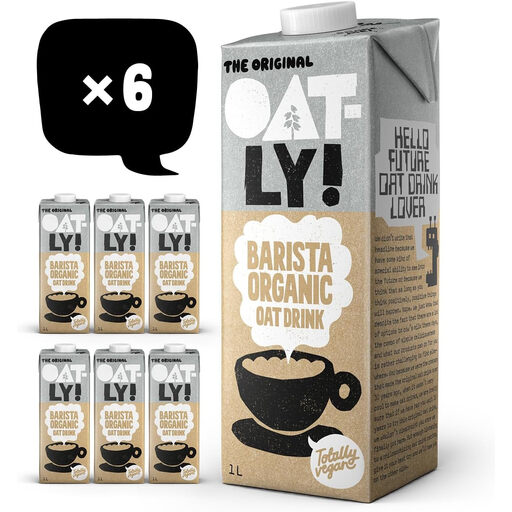 No image available
The product description presents this barista oat drink for baking, cooking and hot drinks. The pack contains six 1L cartons. Check the current carton for organic certification, nutrient fortification and gluten-free suitability where relevant.
According to Department for Environment, Food & Rural Affairs guidance updated August 2025, food labelled organic in the UK must meet organic production rules, and the product and suppliers must be certified by an approved organic control body. For processed food labelled organic, at least 95% of its agricultural ingredients must be organic; the guidance also sets conditions for other ingredients, additives and processing aids. Check the claim on the specific carton.
Oatly says its standard Organic Oat Drink can be used where a cooking or baking recipe calls for milk. Check the product you plan to use: an organic barista drink can have a different ingredient list, including oil, so try it in a small batch if the recipe is sensitive to changes in flavour or fat content.
No: an organic claim does not tell you which nutrients have been added. For comparison, Ocado lists calcium, iodine and vitamins B2 and D2 for Alpro Oat Long Life. Read the exact carton’s nutrition panel if fortification matters to your purchase.
No. NHS North West Knowledge Now guidance from February 2026, addressing children aged one or over with cow’s-milk protein allergy, notes that oat alternatives can be lower in protein and highlights calcium, iodine, vitamins D and B12 when considering fortified alternatives. Individual dietary requirements should be discussed with an appropriate healthcare professional.
No. The Food Standards Agency states that food labelled “gluten-free” must contain no more than 20 mg/kg gluten, and oats remain an allergen even in gluten-free food. Check the particular carton for a gluten-free claim, any coeliac suitability statement and allergen information.