Households sharing breakfast
If several people use oat drink with cereal and hot drinks, larger cartons can serve repeated breakfasts. Consider a barista formulation when foaming for coffee is part of the routine.


For shared continental breakfasts, a multipack of 1L or larger cartons makes sense when several people will use the oat drink; choose a barista formulation if foaming for coffee matters. A sealed individual carton is easier to pack for a lunchbox, but an individual 250ml format is not the same as a multipack of small cartons. Check the exact pack’s fortification and allergen wording before choosing.
If several people use oat drink with cereal and hot drinks, larger cartons can serve repeated breakfasts. Consider a barista formulation when foaming for coffee is part of the routine.
A sealed small carton is easier to carry than an opened 1L carton. Oatly describes its individual 250ml oat drink as lunchbox-friendly; that does not establish a multipack of those cartons.
Compare the exact pack’s added nutrients and allergy statement rather than assuming oat drinks have the same formulation. This matters particularly when an oat drink is being used in place of dairy or someone needs to avoid a specific allergen.
Start with the number of people using the carton and whether the drink is for coffee, cereal or a lunchbox; then check the exact formulation.
| Priority | What to check | Your needs |
|---|---|---|
| Pack format | Check the number and size of cartons, and whether each serving needs to stay sealed until use. Oatly’s 250ml lunchbox carton is an individual format; the Sainsbury’s-listed Oatly Barista multipack contains 3 × 1.5L cartons. | I need enough for breakfasts shared at home, or a small sealed carton that fits an individual lunchbox. |
| Hot drinks | Check whether the exact variant is intended to foam or mix with hot drinks. Oatly says its 250ml oat drink may separate in coffee, while Sainsbury’s describes the 3 × 1.5L Barista Edition as foamable. | Coffee is part of our breakfast, so its formulation matters. If I mainly pour oat drink on cereal, foaming is less relevant. |
| Fortification | Read the exact pack’s ingredients and nutrition information for calcium, iodine, vitamin D and vitamin B12. NHS North West Knowledge Now names these nutrients in its guidance on plant-based alternatives for children aged one and over with cow’s milk protein allergy. | When choosing an oat drink in place of dairy, I want to know which nutrients this particular variant contains. |
| Allergens | Read the current allergy statement for the exact variant, including any oat, wheat or milk warnings. The Food Standards Agency says oats remain an allergen even when a food is labelled gluten-free. | I cannot decide from the words “oat drink” or “plant-based” alone whether a pack meets my allergy requirements. |
| After opening | Check the carton’s refrigeration and use-after-opening instructions. Choose a carton size that fits how quickly it will be used. | A large carton works for repeated shared servings; for one packed drink, I would rather take a sealed individual carton. |
Oatly says its individual 250ml drink may separate in coffee, whereas Sainsbury’s describes Oatly’s 3 × 1.5L Barista Edition as foamable. The formulation matters more than the pack size alone.
If foaming matters at breakfast, check the exact variant’s hot-drink information. For cereal or cold use, do not choose a barista variant solely because it is labelled for coffee.
A case of 1L or 1.5L cartons provides shared servings, not individually sealed drinks to carry. Oatly’s lunchbox-friendly 250ml product is described as an individual carton.
Choose the carton size for where it will be used: larger cartons for shared breakfasts, or a sealed small carton for a single lunchbox.
Fortification and suitability statements are product-specific. For example, Marks & Spencer says its Plant Kitchen Whole Oat Drink is not suitable for coeliacs or for people with milk or wheat allergies.
Read the current label whenever you change brand, variant or pack size, particularly if fortification or allergen avoidance affects your choice.
These examples illustrate different carton sizes and formulations; a brand name alone does not establish the details of every variant.
Oatly describes an individual 250ml carton for lunchboxes, while Sainsbury’s lists a separate 3 × 1.5L Barista Edition multipack.
Joybuy’s oat-drink category listing includes Alpro Original and Barista long-life 8 × 1L formats.
Minor Figures lists its Barista Oat in a 6 × 1L format and describes it for coffee drinks.
Tesco lists a Long Life Oat Original 1L carton for household use.
Sainsbury’s lists its own 1L oat drink separately from the Oatly Barista multipack sold through its grocery site.
Marks & Spencer describes its Plant Kitchen Whole Oat Drink as enriched with calcium, iodine, vitamin D and vitamin B12.
These are large-carton oat-drink multipacks for repeated household breakfasts, including barista-labelled options for coffee. Their 1L cartons are not individually sealed lunchbox portions.
 No image available
This six-carton format is for shared breakfasts where a barista-labelled oat drink is wanted for coffee.
Each carton is 1L rather than an individual lunchbox portion. Check the carton’s instructions for storage after opening.
 No image available
This eight-carton format is for repeated shared breakfasts where a barista-labelled variant is preferred for coffee.
The 1L cartons are not individual lunchbox servings. Check the exact pack’s nutrition, allergy and after-opening instructions.
 No image available
This eight-carton format suits repeated household use, including oat drink poured on cereal.
Check the current nutrition label if sugar content affects your choice: the product information contains conflicting sugar wording. These 1L cartons are not individual lunchbox portions.
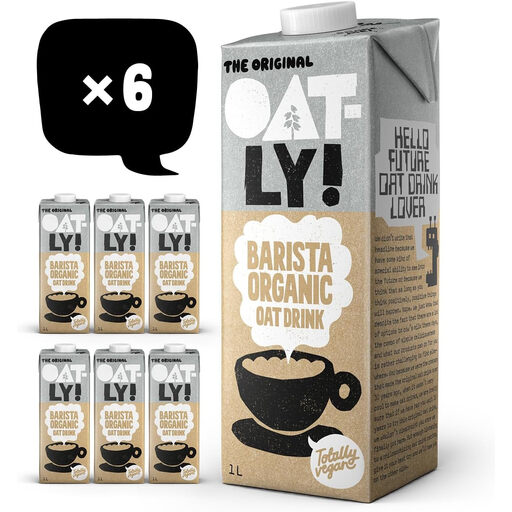 No image available
This six-carton barista-labelled format is for shared breakfasts that include coffee.
Check the exact label for added nutrients if fortification matters to your choice. Each 1L carton is larger than an individual lunchbox serving.
 No image available
This eight-carton format is for repeated shared use, such as pouring oat drink on breakfast cereal.
Check the current label if iodine fortification matters: the product information gives conflicting accounts. The 1L cartons are not individual lunchbox portions.
Choose a barista-labelled multipack if foaming for breakfast coffee matters to you. If the oat drink is mainly for cereal or cold drinks, check the standard variant’s ingredients and pack size rather than assuming coffee-oriented features are needed.
A sealed individual carton is easier to carry than an opened large carton. Oatly describes its 250ml oat drink as lunchbox-friendly, but that individual carton should not be mistaken for a multipack of small servings.
No. Oatly says its 250ml variant may separate in coffee, while Sainsbury’s describes Oatly’s separate Barista Edition multipack as foamable. Check the formulation of the exact variant you plan to use.
Check the exact pack for added calcium, iodine, vitamin D and vitamin B12. NHS North West Knowledge Now identifies these nutrients in its guidance on plant-based alternatives for children aged one and over with cow’s milk protein allergy; formulations vary between products.
No. The Food Standards Agency says oats remain an allergen even when a food is labelled gluten-free. Read the exact product’s allergy statement: Marks & Spencer, for example, says its Plant Kitchen Whole Oat Drink is not suitable for coeliacs or for people with milk or wheat allergies.