Parents packing individual lunches
A small, unopened carton can go into a lunchbox without pouring from a household pack. Oatly describes its 250ml oat drink as lunchbox-friendly and suitable for room-temperature storage before opening.


For a ready-to-pack school-holiday lunch, choose a small unopened oat drink carton rather than assuming a multipack contains individual portions. Larger cartons make more sense when you will serve the drink at home or can manage storage after opening. If a child uses oat drink as a dairy alternative, check fortification and the exact product’s age guidance as well as the pack size.
A small, unopened carton can go into a lunchbox without pouring from a household pack. Oatly describes its 250ml oat drink as lunchbox-friendly and suitable for room-temperature storage before opening.
When oat drink is used in place of milk, the child’s age, the product’s fortification and its stated use matter more than the number of cartons. Age guidance differs even between products labelled for children aged 1+.
Larger cartons or a pack of several cartons may suit drinks shared at home. They are a different proposition from individually packed lunchbox servings, particularly once a carton has been opened.
Start with how each lunch will be packed, then check the exact drink’s age, ingredient and storage information.
| Priority | What to check | Your needs |
|---|---|---|
| Individual portions | Check both carton count and volume per carton. Oatly calls its separate 250ml drink lunchbox-friendly; the Oatly Barista multipack listed by Sainsbury’s contains 3 × 1.5L cartons. | I need a drink that can go straight into each lunchbox, not several large cartons to pour from. |
| Storage | Distinguish storage before opening from instructions after opening. Oatly states that its 250ml carton can be stored at room temperature before opening; follow the directions on the carton you buy once it is opened. | Lunch may be eaten away from home, so I need to plan for any carton that has already been opened. |
| Fortification | For a child using oat drink as a dairy alternative, compare calcium, iodine, vitamin D, vitamin B12 and protein on the exact product. Norfolk and Waveney Integrated Care System guidance for children aged 1+ with cow’s-milk protein allergy discusses unsweetened, fortified alternatives and notes the lower protein content of oat drinks. | If oat drink replaces milk in a child’s diet, I need to look beyond pack size and check how the drink fits their wider diet. |
| Age guidance | Read whether the product can be included in the diet or used as a main milk alternative at the child’s age. Sainsbury’s standard oat drink says it is not suitable as a main milk alternative under 3; its separate 1+ drink gives an under-2 restriction. | A drink labelled for children aged 1+ may still carry a narrower instruction about use as their main milk alternative. |
| Allergens | Read the current ingredients, allergen panel and suitability statements for the particular carton. Marks & Spencer says its Plant Kitchen Whole Oat Drink is not suitable for people with coeliac disease or a wheat allergy. | For a child with an allergy or coeliac disease, I cannot judge suitability from the words ‘oat’ or ‘dairy-free’ alone. |
Sainsbury’s lists the Oatly Barista multipack as 3 × 1.5L. Oatly’s lunchbox-friendly 250ml drink is a separate product, so the two formats do not solve the same packing task.
Check the volume of each carton as well as the carton count. If you plan to pour from a larger carton, account for its instructions after opening.
Marks & Spencer states that its Only 3 Ingredients Oat Drink is not fortified and is not recommended as a dairy replacement for children under 36 months. A short ingredient list does not establish that a drink meets a young child’s dietary needs.
When oat drink is used as a dairy alternative, compare the exact product’s fortification, protein information and age statement. Seek appropriate dietary advice for a child with restricted intake or a medical diet.
Suitability statements vary between products. For example, Marks & Spencer identifies its Plant Kitchen Whole Oat Drink as unsuitable for people with coeliac disease or a wheat allergy.
Check the current pack’s ingredient and allergen information, including any manufacturing warnings, against the child’s specific requirements.
Alpro positions its Oat Growing Up drink for ages 1–3+, while Sainsbury’s says its separate 1+ oat drink is not suitable as a main milk alternative for children under 2. The intended use changes what an age label means.
Match the age statement and main-drink instructions on the exact carton to the child’s age and how the drink will be used.
Its 250ml oat drink addresses the ready-to-pack lunch, while its Barista Edition 3 × 1.5L multipack is a larger, coffee-oriented format.
Its Oat Original is a general 1L drink; Oat Growing Up is a separate product positioned for young children.
Barista Oat is presented by the manufacturer for coffee drinks and is listed in a 6 × 1L format.
Its standard 1L oat drink and separate 1+ oat drink have different age-related use statements.
Marks & Spencer lists a fortified Plant Kitchen Whole Oat Drink and a separate, unfortified Only 3 Ingredients Oat Drink.
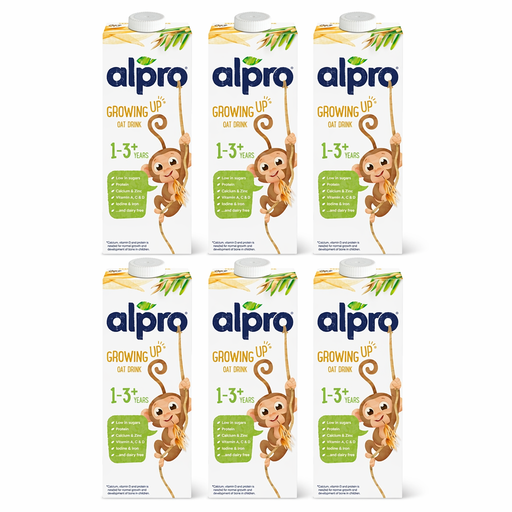
This six-unit Alpro option is relevant to households considering an age-specific oat drink. Check its carton configuration before treating it as a supply of individual packed-lunch portions.
 No image available
A six-unit oat drink option described for children aged 1–3. Check the volume of each unit and the current carton’s ingredients, nutritional information and age instructions before deciding whether it suits packed lunches or use as a dairy alternative.
No. Sainsbury’s lists the Oatly Barista multipack as 3 × 1.5L cartons, whereas Oatly describes its separate 250ml drink as lunchbox-friendly. Check the size of each carton, not just the word ‘multipack’.
Check the child’s age, the exact product’s main-drink instructions and their wider dietary needs. Norfolk and Waveney Integrated Care System guidance for children aged 1+ with cow’s-milk protein allergy discusses unsweetened, fortified oat alternatives as a second-choice option because of their lower protein content; individual dietary or medical needs warrant appropriate professional advice.
Compare calcium, iodine, vitamin D, vitamin B12 and protein on the exact carton. Norfolk and Waveney Integrated Care System guidance for children aged 1+ with cow’s-milk protein allergy identifies those added nutrients and notes that oat alternatives can be lower in protein.
No. Marks & Spencer states that its Plant Kitchen Whole Oat Drink is not suitable for people with coeliac disease or a wheat allergy. Read the current label and suitability statements for the specific drink.
No. Room-temperature storage before opening does not establish how an opened carton should be kept. Follow the refrigeration and use-after-opening instructions on the exact product, particularly if you plan to pour from a large carton over several lunches.