What should you check?
Decide how the household will use the drink, check the exact carton, then choose a pack quantity that works with its storage instructions.
| Priority |
What to check |
Your needs |
| Regular dairy replacement |
Check calcium, iodine, vitamin D and vitamin B12 on the exact carton. Compare protein and energy per 100 ml rather than assuming every oat drink has the same formulation. |
I use oat drink in place of dairy often, so the nutrients in the particular carton matter. NHS guidance for children aged 1+ with cow’s-milk protein allergy specifically advises checking fortification and notes that oat alternatives are lower in protein. |
| Meal and drink use |
Choose between an everyday, whole, no-sugars or barista product for the preparation you intend. Check energy and protein separately: University Hospitals Sussex NHS Foundation Trust notes that barista dairy-free drinks tend to have more calories than standard equivalents, not necessarily more protein. |
Some cartons will go into porridge or smoothies; others may mainly be used in hot drinks. I want the formulation to suit those uses rather than choosing on the word ‘barista’ alone. |
| Allergens |
Read the current product’s oat, gluten, wheat and milk-allergy statements where relevant. Do not use ‘vegan’ as a substitute for an allergen check. |
Someone in the household needs a specific allergen check, so I cannot assume that another variant from the same brand is interchangeable. M&S, for example, states that its Plant Kitchen Whole Oat Drink is unsuitable for coeliacs and for people with milk or wheat allergies. |
| Drink consistency |
Keep the food-texture plan separate from any instructions for fluids. If a person has swallowing difficulties or has been prescribed thickened drinks, confirm the required consistency with their clinical team. |
I am preparing soft food, but that does not tell me whether ordinary oat drink is appropriate to serve as a drink. Buckinghamshire Healthcare NHS Trust’s regular easy-to-chew guidance applies to people without swallowing problems or increased choking risk. |
| Pack and storage |
Confirm the number and size of cartons, whether they can be stored unopened at room temperature, and the instructions after opening. Check those details on the product you plan to buy. |
A multi-carton shop is useful only if we can store the unopened packs and use each opened carton as directed. |
Brand and product-line references
These product-line details help distinguish formulations; they do not mean every variant is represented in the Joybuy products below.
Oatly
Oatly offers Whole and No Sugars oat drinks with different uses to consider for household cooking and drinks.
- Oatly lists calcium, iodine and vitamins in its Whole oat drink’s ingredients; it says No Sugars can be used in cooking and baking and stored at room temperature before opening.
- Check the chosen variant’s own nutrition and allergen label rather than applying Whole’s ingredient details across the range.
Alpro
Alpro Oat Original and Oat Growing Up 1–3+ are distinct products, not interchangeable family-wide formulations.
- Alpro UK lists 120 mg calcium, 22.5 µg iodine and 0.8 g protein per 100 ml for Oat Original.
- Oat Growing Up 1–3+ has its own stated age positioning and nutrient profile; choose for a child’s circumstances rather than treating it as the default household carton.
Minor Figures
Minor Figures lists 6 × 1 L packs of Everyday Oat and Barista Oat for different everyday and hot-drink uses.
- The brand lists Everyday Oat for cereal, tea and smoothies, with 2.1 g protein per 200 ml.
- Its Barista Oat is listed at 0.7 g protein per 200 ml; a coffee-focused formulation should not be assumed to provide more protein.
M&S Plant Kitchen
M&S lists fortified oat drinks alongside a separate three-ingredient, unfortified oat drink.
- M&S says its Plant Kitchen Whole Oat Drink contains added calcium, iodine, vitamin D and vitamin B12.
- Its three-ingredient drink is not fortified, and M&S does not recommend it as a dairy replacement for children under 36 months. Check each variant’s allergen statement too.
Multi-pack product comparison
This is a compiled list of multi-packs described by Joybuy UK or Minor Figures, kept in the supplied order and differentiated by the product information available for each line. The numbers are list positions, not an independent quality ranking; these rows do not establish direct purchase links.
| No. |
Product |
Main specifications |
Why consider it |
Platform |
| 1 |
Oatly Oat Drink Whole 6 × 1 L |
Six 1 L cartons in the Joybuy UK listing. |
For a household considering Whole in a multi-carton format. Oatly lists calcium, iodine and vitamins in the Whole formulation; check the exact pack for its nutrition and allergens. |
Joybuy |
| 2 |
Alpro Oat Original Long Life Drink 8 × 1 L |
Eight 1 L cartons in the Joybuy UK listing. Alpro UK lists 120 mg calcium, 22.5 µg iodine and 0.8 g protein per 100 ml for Oat Original. |
Consider the larger carton count for routine use, while checking whether this formulation’s protein and fortification suit the household’s intended dairy replacement. |
Joybuy |
| 3 |
Oatly Organic Barista Oat Drink 6 × 1 L |
Six 1 L cartons in the Joybuy UK listing. |
A multi-carton barista option for shoppers comparing drinks for hot beverages. Check this organic variant’s own ingredients and nutrition rather than assuming they match another Oatly barista product. |
Joybuy |
| 4 |
Minor Figures Everyday Oat 6 × 1 L |
Six 1 L cartons; Minor Figures lists 2.1 g protein and 240 mg calcium per 200 ml. |
Minor Figures describes Everyday Oat for cereal, tea and smoothies, making those intended uses relevant when comparing household packs. |
Minor Figures |
Oat-drink packs on Joybuy
These multi-carton oat drinks offer everyday, no-sugars and barista options for a household comparing ingredients for soft meals and drinks. Check each variant against the meal, allergen and storage needs discussed above.
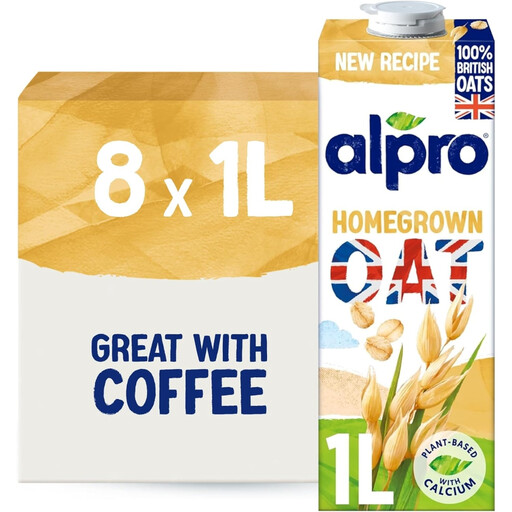 Image unavailable
Alpro Oat Original Long Life Drink 8 × 1 L
An eight-carton option for regular use in preparations such as porridge or smoothies. Alpro UK lists 120 mg calcium, 22.5 µg iodine and 0.8 g protein per 100 ml for Oat Original; check the current carton for the full nutrition and allergen details.
View on Joybuy
 Image unavailable
Alpro Oat No Sugars Long Life Drink 8 × 1 L
An eight-carton no-sugars option if that formulation suits the household’s drinks and meals. Compare its own fortification, protein, allergens and after-opening instructions rather than treating it as the same product as Oat Original.
View on Joybuy
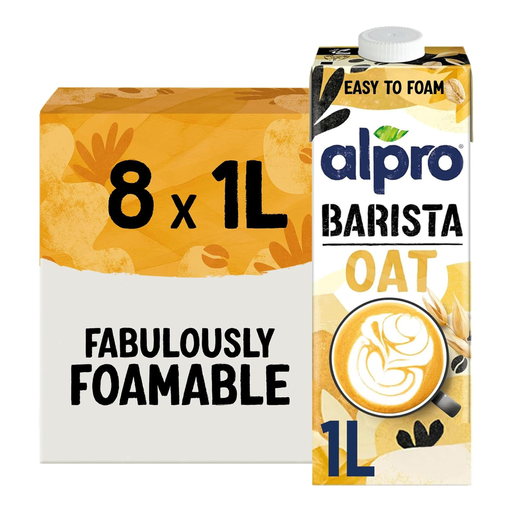 Image unavailable
Alpro Barista Oat Long Life Drink 8 × 1 L
An eight-carton barista option for a household also using oat drink in hot beverages. Check this variant’s own nutrient and allergen information if the drink will regularly replace dairy in meals.
View on Joybuy
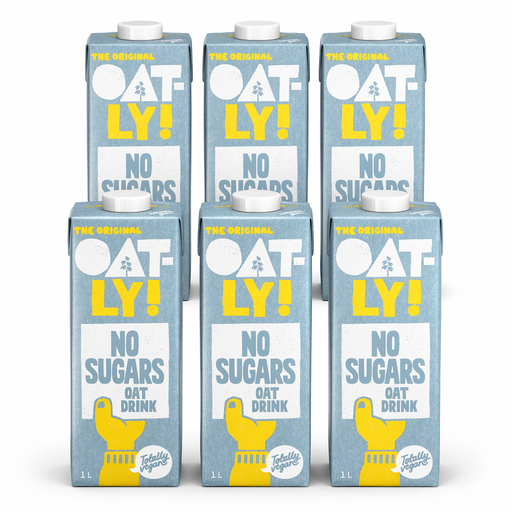 Image unavailable
Oatly No Sugars Oat Drink, 6 × 1 L
A six-carton no-sugars option to consider for cooking: Oatly says its No Sugars oat drink can be used in cooking and baking and stored at room temperature before opening. Confirm the pack contents and current carton details before choosing it for regular household use.
View on Joybuy
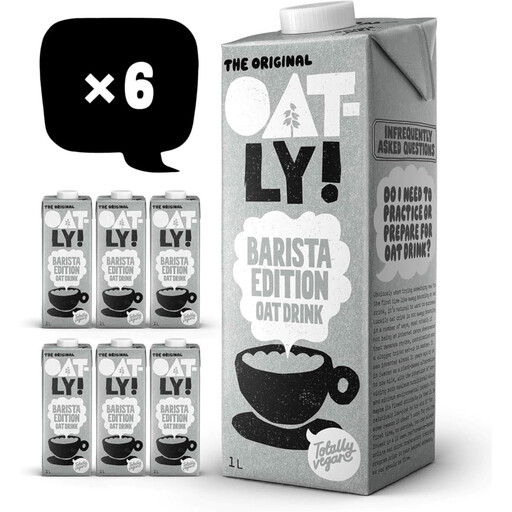 Image unavailable
Oatly Long Life Barista Oat Drink 6 × 1 L
A six-carton barista option for households using oat drink in hot beverages as well as meals. Check the exact carton’s nutrition and allergen information; a barista description alone does not establish its suitability as a regular dairy replacement.
View on Joybuy
Frequently asked questions
Can oat drink be used in an easy-chew meal?
It can be used as an ingredient in soft foods when that food texture is appropriate for the person. Buckinghamshire Healthcare NHS Trust says its regular easy-to-chew diet is for people who can chew soft or tender foods without swallowing problems or increased choking risk. If drinks must have a prescribed consistency, follow the individual clinical plan rather than assuming ordinary oat drink is suitable.
What matters if oat drink regularly replaces dairy milk?
Check the exact product’s calcium, iodine, vitamin D and vitamin B12 fortification, then compare protein and energy per 100 ml. NHS guidance on plant-based alternatives for children aged 1+ with cow’s-milk protein allergy highlights these fortification checks and notes that oat-based alternatives are lower in protein; a product name alone cannot establish nutritional equivalence.
Does a barista oat drink add more protein to porridge?
Not necessarily. Minor Figures lists 0.7 g protein per 200 ml for its Barista Oat and 2.1 g per 200 ml for its Everyday Oat. Compare the particular cartons’ nutrition panels rather than using coffee texture to judge their protein content.
Is every vegan oat drink suitable for coeliac disease or milk allergy?
No. Allergen statements are product-specific: Minor Figures markets its Barista Oat as gluten free, while M&S states that its Plant Kitchen Whole Oat Drink is unsuitable for coeliacs and for people with milk or wheat allergies. Check the current carton for the relevant requirement.
Should a toddler oat drink be the household’s default carton?
No; assess a child-specific product for the child’s stated age and dietary circumstances. Alpro positions Oat Growing Up for ages 1–3+, while NHS guidance for children aged 1+ with cow’s-milk protein allergy describes unsweetened fortified oat alternatives as a second choice to fortified soya or pea alternatives because oat options are lower in protein.


