Shoppers avoiding milk
If you tolerate oats but need to avoid milk, read the current ingredient list, highlighted allergens and any precautionary warning relevant to milk. A plant-based description alone does not cover every possible allergen risk.


Choose an organic oat drink by checking the allergens you need to avoid before considering its organic claim: every oat drink contains oats, and organic labelling does not establish suitability for a food allergy. If you need to avoid gluten but tolerate oats, look for an explicit gluten-free claim on the current pack; if the drink will replace dairy regularly, check its nutrition information as well.
The relevant label check depends on whether you need to avoid milk, gluten, oats or another ingredient; an organic claim answers a different question.
If you tolerate oats but need to avoid milk, read the current ingredient list, highlighted allergens and any precautionary warning relevant to milk. A plant-based description alone does not cover every possible allergen risk.
For coeliac disease or gluten intolerance, check for an explicit gluten-free claim on the particular oat drink. The Food Standards Agency notes that oats remain an allergen even in gluten-free oat products, so this route does not suit an oat allergy.
For a child over one with diagnosed cow’s-milk protein allergy, allergen information and nutritional suitability are separate checks. An NHS dietetics leaflet identifies fortified alternatives containing calcium and iodine for this group; compare the chosen drink’s nutrition panel with the child’s dietary advice.
Start with the current pack’s allergen information, then confirm any gluten-free or organic claim you require. Finally, match the formulation and nutrition information to how you will use the drink.
| Priority | What to check | Your needs |
|---|---|---|
| Relevant allergens | Read the current ingredients, highlighted allergens and any precautionary allergen warning that relates to your allergy. Check the particular carton rather than relying on a previous purchase. | I need to avoid milk or another ingredient, so a plant-based or organic description is not enough to choose this drink. |
| Gluten and oats | Look for an explicit gluten-free claim if you need to avoid gluten; check separately whether oats themselves are an allergen for you. The Food Standards Agency defines gluten-free as no more than 20 mg/kg gluten in food sold to the final consumer. | For gluten avoidance, I want a clearly labelled product. If I have an oat allergy, a gluten-free oat drink still contains the ingredient I must avoid. |
| Organic claim | Check the pack’s organic labelling and control-body details. The UK Department for Environment, Food & Rural Affairs says products marketed as organic must meet certification requirements; that certification does not assess allergy suitability. | I want an organic product, but I still need to make a separate decision about its allergens. |
| Dietary role | Compare ingredients and the nutrition panel, including any stated calcium or iodine fortification. An NHS dietetics leaflet identifies fortified alternatives containing those nutrients for children over one with cow’s-milk protein allergy. | If this drink will regularly replace dairy for my child, I need to check how it fits their dietary advice, not choose by ingredient-list length alone. |
| Coffee use | Check whether the particular drink is intended for foaming, then read its own allergen statement. Minor Figures Organic Barista Oat, for example, states that it may contain gluten. | I want an organic drink for coffee, but a barista formulation still has to meet my household’s allergen requirements. |
Organic certification and allergen information serve different purposes. GOV.UK explains that precautionary allergen labelling may warn of an identified cross-contamination risk that cannot be controlled.
Read the current pack’s ingredients, highlighted allergens and relevant precautionary warnings, even if you have bought the product before.
A gluten-free claim concerns gluten content, not the presence of oats. The Food Standards Agency says oats must still be emphasised as an allergen in gluten-free oat products.
If oats are the allergen, avoid oat drinks. If you need to avoid gluten but tolerate oats, check for an explicit gluten-free claim on the chosen product.
Ingredient simplicity does not tell you whether a drink contains added calcium or iodine. An NHS dietetics leaflet identifies fortified alternatives containing these nutrients for children over one with cow’s-milk protein allergy.
If an oat drink will be a regular dairy replacement for a child, compare its nutrition panel with the child’s dietary advice.
Formulations and warnings can differ between products. Minor Figures states that its Organic Barista Oat may contain gluten.
Check the exact barista carton you plan to use rather than relying on another drink in the range.
These product-specific examples show why the organic claim, ingredient list and allergen wording need to be considered together; a brand name alone does not establish suitability.
Tesco lists Plenish Organic Gluten Free Oat Drink for everyday use and a separate Organic Barista Gluten Free Oat Drink for coffee.
Alpro Organic Oat is an everyday oat drink whose UK product page lists water, 8.4% organic oats, organic sunflower oil and sea salt.
Oatly describes its Oat Drink Organic 1L as containing water, 10% organic oats and sea salt, and says it is made without milk or soy.
Minor Figures positions its Organic Barista Oat for preparing coffee.
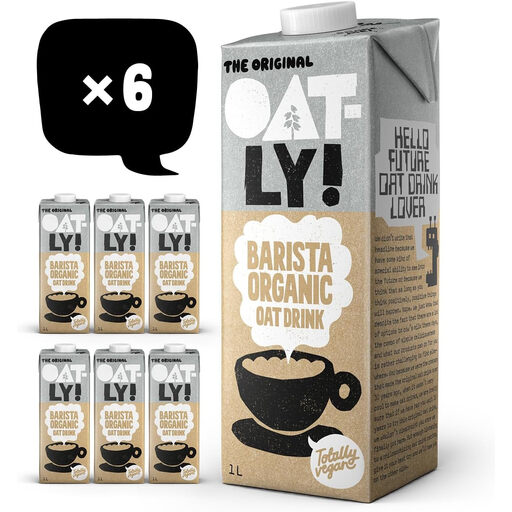
This Organic Barista oat drink is an option to consider for coffee use if oats are tolerated. Check the current carton against any other allergen requirements before choosing it.
 No image available
The Barista variant is an option for coffee use where oats are tolerated. This is a 6x1L pack; check the current cartons for relevant milk, soya and gluten information, organic certification details and nutrition information if the drink will regularly replace dairy.
No. UK organic labelling concerns certified organic production, not whether a drink meets an individual’s allergen requirements. Read the current pack’s ingredients, highlighted allergens and any relevant precautionary warning.
No: gluten-free oat drink still contains oats. The Food Standards Agency says oats must remain highlighted as an allergen even when an oat product is labelled gluten-free.
The Food Standards Agency defines gluten-free as no more than 20 mg/kg gluten in the food as sold to the final consumer. It does not settle a separate oat or other cereal allergy; check the particular product’s ingredients and relevant warnings.
No. For children over one with cow’s-milk protein allergy, an NHS dietetics leaflet identifies fortified alternatives containing calcium and iodine. Check the chosen drink’s nutrition panel and how it fits the child’s dietary advice rather than relying on its organic claim.