Biscuit bakers replacing dairy milk
If your recipe calls for cow’s milk, look for an instruction that applies to the exact oat drink rather than assuming every carton can be substituted in the same way.


For a biscuit recipe that calls for milk, an oat drink with an instruction for cooking and baking gives you a product-specific basis for substitution: Oatly says to use its Barista Edition where a recipe says milk. If you want the drink to contribute no sugars, consider a no-sugars formulation and check the whole recipe; if baking for someone avoiding gluten, check the exact carton’s claim and remember that gluten-free does not mean suitable for an oat allergy.
If your recipe calls for cow’s milk, look for an instruction that applies to the exact oat drink rather than assuming every carton can be substituted in the same way.
If the recipe measures its sweetener separately, the drink’s sugars declaration can help you choose between standard and no-sugars formulations.
If the intended eater avoids gluten but can have oats, check the exact pack for a gluten-free claim. The Food Standards Agency identifies oat as an allergen in its own right, including when oats are described as gluten-free.
Start with the recipe’s milk instruction, then check the drink’s sugars declaration and the exact pack’s allergen information for the people eating the biscuits.
| Priority | What to check | Your needs |
|---|---|---|
| Milk substitution | Look for a cooking-and-baking instruction for the exact drink, or a recipe that permits oat drink. Oatly says its Barista Edition can be used where a cooking or baking recipe says milk; that instruction does not establish identical results for every biscuit recipe. | My recipe calls for milk, and I want a product-specific reason to use an oat drink in its place. |
| Recipe sweetness | Read the sugars declaration per 100 ml and consider the recipe’s other ingredients. Alpro UK lists 3.2 g sugars per 100 ml for Oat Original and describes Oat No Sugars as containing no sugars or sweeteners. | The recipe measures its sweetener separately, so I want to know whether the drink contributes sugars. |
| Gluten and oats | Check the exact carton’s ingredients, allergen information and any gluten-free claim. The Food Standards Agency states that oat remains an allergen in its own right even when described as gluten-free or very-low gluten. | I’m baking for someone who avoids gluten, or I need to establish whether oats themselves are suitable for the intended eater. |
A dairy-free description alone does not tell you how a particular oat drink will work in a biscuit recipe. Oatly’s cooking-and-baking substitution instruction applies to its Barista Edition.
Check for an instruction covering the exact product or follow a recipe written for oat drink. Otherwise, try a small batch before relying on the substitution.
The Food Standards Agency identifies oat as an allergen in its own right, even when a food is described as gluten-free or very-low gluten.
Do not use an oat drink for someone with an oat allergy. For gluten avoidance without an oat allergy, check the claim and allergen information on the exact pack.
Alpro UK lists 3.2 g sugars per 100 ml for Oat Original, while it describes Oat No Sugars as containing no sugars or sweeteners. That distinction can matter when a recipe expects some sweetness from its milk component.
Consider the drink alongside the recipe’s other ingredients; if changing formulations, test the bake before adjusting the recipe.
Oatly gives a cooking-and-baking milk-substitution instruction for its Barista Edition.
Alpro’s Oat Original and Oat No Sugars offer distinct choices when considering the drink’s contribution to recipe sweetness.
Minor Figures describes its Barista Oat as gluten-free, a product-specific claim to check when buying for someone avoiding gluten.
These Oatly multipacks are options to consider when shopping for oat drink for biscuit baking. Check the exact edition before applying Oatly’s Barista Edition substitution instruction: the organic variant is a separate product.
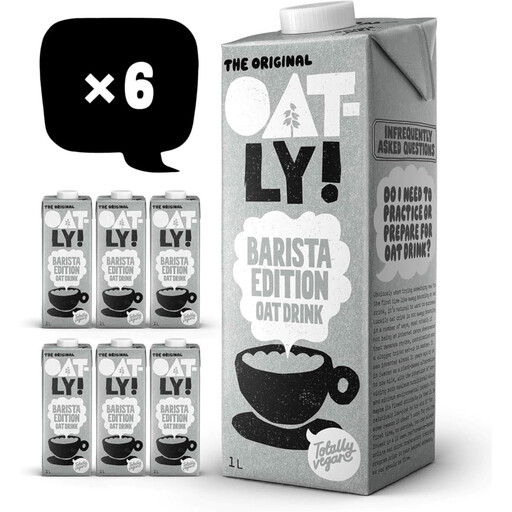 No image available
For a recipe calling for milk, Oatly’s instruction to use Barista Edition in cooking and baking is relevant if the carton is that edition. This is a long-life 6 × 1 L pack; the instruction does not promise identical results in every biscuit recipe. It contains oats, so do not use it for someone with an oat allergy.
 No image available
This organic barista oat drink comes in a 6 × 1 L pack. If your biscuit recipe calls for milk, check whether the recipe permits this variant or try a small batch rather than transferring the substitution instruction for another Oatly edition. It contains oats, so do not use it for someone with an oat allergy.
You can follow a recipe that permits oat drink or an instruction for the exact product. Oatly says its Barista Edition can be used where a cooking or baking recipe says milk, but that does not establish identical results for every oat drink or biscuit recipe.
No: the drink is only one ingredient. Alpro describes Oat No Sugars as containing no sugars or sweeteners, but the biscuit recipe may include sugar or other sugar-containing ingredients.
No. The Food Standards Agency identifies oat as an allergen in its own right even when a food is described as gluten-free or very-low gluten. Do not use an oat drink for someone with an oat allergy.
Check the ingredients and allergen information on the exact oat-drink pack, and any gluten-free claim relevant to the guest. Confirm that oats are suitable for the intended eater; a gluten-free claim does not answer the oat-allergy question.