Hosts serving coffee and plant-based drinks
If guests want lattes or cappuccinos, look for an oat drink intended for steaming. For cereal, smoothies or cold pouring, check whether a simpler organic drink covers the rest of the table.


For a brunch centred on steamed coffee drinks, choose an organic barista oat drink intended for that use; for cereal, cold drinks and a general table option, a simple organic oat drink may be the more relevant choice. If the carton will regularly replace dairy, check its fortification rather than assuming an organic claim tells you which nutrients it contains. For a guest with coeliac disease, check the exact carton for an explicit gluten-free claim and suitable allergen information.
If guests want lattes or cappuccinos, look for an oat drink intended for steaming. For cereal, smoothies or cold pouring, check whether a simpler organic drink covers the rest of the table.
An organic claim and a fortification declaration answer different questions. If oat drink often replaces dairy in your household, compare the nutrients listed on the exact carton; the NHS advises people following a vegan diet to include fortified dairy alternatives.
Check the current gluten-free claim and allergen statement before serving. Coeliac UK cautions that ‘organic’ or ‘100% oats’ does not establish whether an oat product is gluten free, and oats remain an allergen.
Start with how the drink will be served, then check organic labelling, nutrients and guest requirements on the carton you intend to open.
| Priority | What to check | Your needs |
|---|---|---|
| Organic claim | Look for organic labelling on the exact product and check its certification information. GOV.UK says food labelled organic in Great Britain must meet organic-production rules and certification requirements. | I want an organic oat drink, rather than treating a short ingredient list as proof that a product is organic. |
| Coffee use | Check whether the drink is intended for steaming. Minor Figures describes its Organic Barista Oat as designed to make microfoam, but that is the brand’s claim, not a guarantee for every coffee or machine. | When I am making lattes or cappuccinos for friends, the drink’s stated hot-coffee use matters more than its suitability for cold pouring. |
| Fortification | Read the exact carton’s nutrition panel for calcium, iodine, vitamin D and B12. Compare protein figures per 100 ml if that also matters to your choice. | If oat drink regularly replaces dairy at home, I want to know which nutrients this particular carton lists. The NHS advises people following a vegan diet to include fortified dairy alternatives. |
| Guest suitability | Check for an explicit gluten-free claim and read the current ingredients and precautionary allergen statement. The Food Standards Agency says a gluten-free claim means no more than 20 mg/kg gluten in the food as sold; oats must still be identified as an allergen. | For a guest with coeliac disease, I cannot use an organic claim as a substitute for gluten-free labelling. I also need to account for any oat allergy. |
| Opened cartons | Follow each carton’s refrigeration and use-after-opening instructions. Sainsbury’s lists different opened-life periods for its own long-life oat drink and Oatly Organic Oat Drink Long Life. | I want enough for the brunch without opening more cartons than we expect to use within their stated periods. |
An organic claim describes how the product is produced; it does not tell you whether calcium, iodine, vitamin D or B12 has been added.
If the drink will regularly replace dairy, compare the fortification declaration and nutrition panel on the exact product. Choose according to which requirement matters for that use.
Coeliac UK says ‘organic’ and ‘pure oats’ do not establish gluten-free suitability. Oats also remain an allergen even in a gluten-free product.
For a guest with coeliac disease, check for an explicit gluten-free claim on the current carton, read its allergen information and confirm that gluten-free oats are suitable for that guest.
A drink selected for cereal or cold pouring may not meet your expectations when steaming it for espresso drinks.
If lattes are central to brunch, look for a stated barista or hot-coffee purpose. Treat a brand’s microfoam description as a product claim, not a promise of identical results with every preparation.
Long-life cartons can have different instructions once opened. Sainsbury’s says its own long-life oat drink should be used within 3 days, while its listing for Oatly Organic Oat Drink Long Life says approximately 5 days; both call for refrigeration after opening.
Check each carton and open only what the table is likely to use, then follow that product’s stated storage period.
These examples help distinguish organic, barista and fortified options; a retailer’s inclusion here does not establish what a particular shop has in stock.
Oatly Oat Drink Organic 1L is a simple organic option for a mixed brunch table.
Alpro Organic Oat is another organic option with a stated four-ingredient recipe.
Minor Figures Organic Barista Oat is intended for brunches where steamed coffee drinks are prominent.
Tesco’s oat-drink category includes branded organic options.
Sainsbury’s provides examples of two different choices: a branded organic oat drink and a fortified own-label oat drink.
M&S illustrates the difference between a short ingredient list and a fortified formulation.
This Joybuy option is an organic-labelled barista oat drink for a brunch where coffee is a main use; check the carton for guest and nutrient requirements before serving.
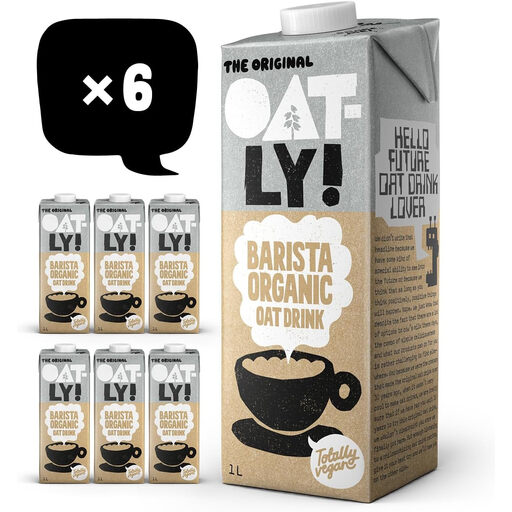 No image available
Listed for coffee as well as cooking and baking, this six-carton pack suits a brunch where several drinks may be prepared. Check the current carton for its organic certification information, gluten-free and allergen labelling, and fortification details if those affect your choice.
In Great Britain, GOV.UK says food labelled organic must meet organic-production rules, with the product and its suppliers certified by an approved organic control body. Check the organic information on the particular carton rather than relying on a simple ingredient list.
An organic claim does not establish fortification. Read the exact carton’s nutrition panel for calcium, iodine, vitamin D and B12 if the drink will regularly replace dairy; the NHS advises people following a vegan diet to include fortified dairy alternatives.
Choose a product with an explicit gluten-free claim and check its current allergen information with the guest. Coeliac UK says organic or ‘100% oats’ wording does not establish gluten-free status, and the Food Standards Agency notes that oats remain an allergen.
If you plan to steam oat drink for lattes or cappuccinos, a barista-labelled product has a stated purpose that matches the task. Minor Figures describes its Organic Barista Oat as intended to create microfoam, but that manufacturer claim does not guarantee the same result with every coffee or machine.
Follow the storage instructions on the exact carton. Sainsbury’s lists use within 3 days after opening for its own long-life oat drink, while its Oatly Organic Oat Drink Long Life listing says approximately 5 days; both specify refrigeration after opening.