Hosts serving a mixed brunch table
An everyday oat drink may cover cereal, fruit and cold drinks without making coffee foam the deciding feature. Check its fat declaration if a lower-fat option is the priority.


For cereal, overnight oats and cold drinks at brunch, start with an everyday or semi oat drink and compare fat values on the same nutrition-label basis. Choose a barista drink when lattes or cappuccinos make foam important, but check its own fat declaration and every guest’s allergen requirements rather than assuming the product type settles either question.
An everyday oat drink may cover cereal, fruit and cold drinks without making coffee foam the deciding feature. Check its fat declaration if a lower-fat option is the priority.
A barista formula is worth considering when you plan to froth drinks for guests. Its coffee-focused description does not tell you whether it meets your fat preference; read the nutrition panel too.
Ask about relevant allergies and coeliac requirements before serving. The Food Standards Agency distinguishes an oat allergy from gluten intolerance, and suitability wording differs between individual cartons.
Decide how the drink will be used at brunch, then compare the exact cartons for fat, coffee instructions, guest suitability and storage.
Choose when: Most of the carton will go into cereal, overnight oats or cold drinks, rather than frothed coffees.
Bear in mind: Fortification and allergen suitability vary between products, even within this route.
Choose when: You plan to make lattes or cappuccinos and want a product described for frothing.
Bear in mind: A barista label does not establish that the drink meets a lower-fat preference.
| Priority | What to check | Your needs |
|---|---|---|
| Fat declaration | Read the fat value and its stated basis: per 100 ml, per 100 g or per serving. Compare figures directly only when the bases match; also check how much you expect to serve. | I’m choosing an oat drink for a lower-fat brunch, so I want the exact carton’s nutrition panel to guide the choice, not the words “everyday” or “barista”. |
| Coffee preparation | Check whether the product is described for frothing and follow its hot-drink instructions. Oatly describes Barista Edition as micro-foamable; Sainsbury’s says to let a hot drink cool slightly before adding its Long Life Oat Drink to avoid separation. | If I’m making several cappuccinos, frothing matters. For cereal and cold drinks, it need not decide which carton I buy. |
| Added nutrients | Check the exact ingredients and nutrition panel for fortification. Oatly lists calcium, iodine and vitamins D2, B12 and riboflavin for its Semi drink; M&S states that its Only 3 Ingredients Oat Drink is not fortified. | I’d like to know whether the carton on the table has added nutrients rather than assuming all oat drinks are formulated alike. |
| Guest suitability | Read the ingredients, allergen statement and coeliac suitability wording on each carton. M&S says its Only 3 Ingredients drink is not suitable for coeliacs; its Barista drink has a milk-allergy warning. Sainsbury’s Long Life Oat Drink has a soya-allergy warning related to manufacturing methods. | Before I pour drinks for friends, I need to check the particular product against any allergies or coeliac requirements they tell me about. |
| Storage | Check whether the unopened carton needs chilling, then follow its refrigeration and consumption instructions after opening. Check the date label on the actual pack. | Several cartons may be useful for a group, but I also need space to store them and a plan for anything left after brunch. |
A per-100-ml figure, a per-100-g figure and a per-serving figure do not form a direct product ranking. The stated portion may differ from the amount you pour.
Compare cartons on the same declared basis, and use each pack’s serving information when planning portions.
Barista products focus on coffee texture and frothing. Those features may have little bearing on a carton mainly served with cereal or in cold drinks.
Choose around what guests will actually make: consider an everyday drink for general table use and a barista drink when frothed coffees matter.
Product warnings differ. M&S identifies coeliac and milk-allergy restrictions on particular oat drinks, while Sainsbury’s lists a soya-allergy restriction for its Long Life Oat Drink.
Ask guests about relevant requirements, then check the ingredients, allergen statement and suitability wording on the exact carton before serving.
Leftover drink may have a shorter usable period once the carton is opened, and instructions differ by product.
Plan how much brunch will use, then refrigerate opened cartons and follow each label’s stated consumption period.
These brand examples illustrate differences between specific everyday and coffee-focused products; a brand name alone does not establish fat content or guest suitability.
Its UK range includes Semi oat drink for everyday use and a separate Barista Edition for coffee.
Alpro has oat-drink products for everyday use and a separate Barista line.
Its Barista Oat is presented for lattes, cappuccinos and other coffee preparation.
Its Long Life Oat Drink is an own-label option distinct from its barista product.
Its range includes Only 3 Ingredients Oat Drink and a separate coffee-focused Barista product.
These cartons include everyday oat drinks for the brunch table and barista drinks for guest coffees. Compare each product’s label against the way you plan to serve it.
 No image available
An everyday oat drink to consider when several guests will have cereal or other unfrothed drinks. The pack contains eight 1 L long-life cartons. Check the carton’s fat declaration and oat-allergen wording against your guests’ needs; “No Sugars” does not describe its fat content.
 No image available
A coffee-focused option when brunch includes lattes or cappuccinos. The pack contains eight 1 L long-life cartons. If lower fat is also a priority, compare its nutrition panel with everyday drinks on the same stated basis, and check the carton’s allergen wording.
 No image available
An everyday option for a table where cereal and hot drinks are planned, supplied as eight 1 L long-life cartons. Compare its fat declaration with other cartons before choosing for a lower-fat preference, and read the oat-allergen and opened-carton instructions before serving.
 No image available
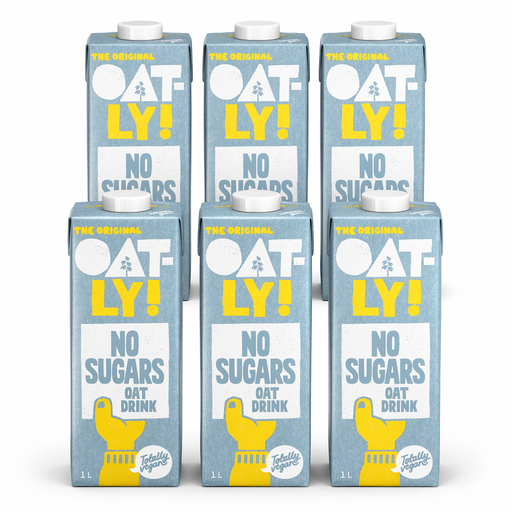
Consider this six-carton everyday pack for shared, unfrothed brunch drinks. Each carton is 1 L. Check its own nutrition panel for fat rather than inferring it from “No Sugars”, and read the oat-allergen and storage instructions before serving or keeping leftovers.
 No image available
A six-carton, 1 L long-life barista pack to consider for frothed guest coffees. Read the carton’s fat value and its serving basis before comparing it with lower-fat options. Check the oat-allergen wording and any age-related suitability instructions on the exact pack.
Choose one if frothing lattes or cappuccinos matters; the barista label alone does not settle a lower-fat choice. Oatly describes its Barista Edition as micro-foamable, while Minor Figures describes dense foam for its Barista Oat. Compare the exact products’ fat declarations on a matching nutrition-label basis.
Yes, if the particular product’s instructions suit how you make it. Oatly says its Semi drink works in coffee and tea without separating; Sainsbury’s advises letting a hot drink cool slightly before adding its Long Life Oat Drink to avoid separation.
Do not assume so from the words “oat drink” or “dairy-free”. The Food Standards Agency notes that oats remain an allergen even when described as gluten-free, while M&S states that its Only 3 Ingredients Oat Drink is not suitable for coeliacs. Ask the guest about their requirements and check the exact product’s ingredients and suitability statement.
Refrigerate it and follow the period stated on that carton. M&S says to consume its Only 3 Ingredients Oat Drink within three days of opening and its Barista Oat Drink within five days. Check the date label as well: the Food Standards Agency distinguishes safety-related use-by dates from quality-related best-before dates.