What to check before choosing
Start with the recipe’s milk requirement and the drink’s stated use, then compare formulations and check the current carton for dietary and allergen information.
| Priority | What to check | Your needs |
|---|
| Recipe use |
Look for an explicit cooking or baking instruction for the exact drink. Oatly gives one for its Whole and Organic oat drinks; an Alpro Oat Long Life listing describes use in cooking applications. |
I’m replacing the milk specified in a cake recipe and want a drink with product-specific guidance, not just an oat-drink label. |
| Formulation |
Compare the ingredient list and fat values using the same units. Whole-style drinks can include oil; a simple oat drink may list only water, oats and salt. These details do not predict a cake’s rise or texture. |
If the recipe normally uses whole milk, I want to consider a richer formulation. For another cake, a shorter ingredient list may matter more. |
| Vegan and milk-allergy information |
Check the current vegan statement or certification separately from the ingredients and any milk precaution. The Vegan Society says vegan claims, including its Vegan Trademark, do not automatically establish allergy suitability. |
I need the cake to be vegan; if someone eating it has a milk allergy, I must also check the exact carton’s allergen information. |
| Gluten and oats |
Check for an explicit gluten-free label where required, plus the product’s oat and wheat information. The Food Standards Agency says gluten-free foods must contain no more than 20 mg/kg gluten, while oats remain an allergen in their own right. |
For a baker or guest with a gluten, wheat or oat requirement, I cannot infer suitability from “vegan”. |
| Ingredients and fortification |
Read the current ingredients for oils, added minerals and vitamins. For example, Oatly Organic lists water, organic oats and sea salt, while the cited Alpro Oat Long Life listing identifies added calcium, iodine and vitamins. |
Sometimes I favour fewer ingredients; at other times I want to know what is in a drink I also use outside baking. |
Brand and product-line references
These examples show why the exact product matters more than the brand name when choosing an oat drink for cake baking.
Oatly
Oatly says its Whole and separate Organic oat drinks can be used in cooking and baking where a recipe calls for milk.
- Oatly describes Whole as its creamiest oat drink and lists oats and rapeseed oil among its ingredients.
- Its separate Organic drink lists water, organic oats and sea salt. Do not assume that description applies to an Organic Barista variant.
Alpro
The cited Alpro Oat Long Life listing describes a vegan drink for hot or cold cooking applications as an alternative to milk.
- That listing identifies added calcium, iodine and vitamins B2 and D2.
- Its cooking-use statement does not establish how a cake made with it compares in texture with one made using a whole-style drink.
M&S
The retailer lists both a three-ingredient oat drink and a separate Plant Kitchen Whole Oat Drink.
- Only 3 Ingredients lists water, oats and sea salt. Plant Kitchen Whole lists added ingredients and 3.0 g fat per 100 g.
- The cited cartons carry different allergen warnings. M&S says Only 3 Ingredients is not suitable for coeliacs or people with wheat allergy, while Plant Kitchen Whole also states that it is not suitable for people with milk allergy.
Minor Figures
Minor Figures positions its Barista Oat drink for coffee and describes it as vegan and gluten-free.
- The stated ingredients include oats and rapeseed oil, offering a formulation to compare if the same carton is also intended for coffee.
- Its cited product description focuses on foaming and coffee, not a cake-baking instruction.
Joybuy oat drink options
These two Oatly barista oat drinks are options to consider when the same carton may be used for baking and other purposes. They are distinct from the plain Oatly Whole and Organic drinks discussed above.
 No image available
Oatly Long Life Barista Milk 6 x 1L
Its product description mentions baking and cooking use, making that instruction relevant when a cake recipe calls for milk. This is a barista variant, not Oatly Whole; check the current carton’s vegan and allergen information for the intended eaters.
View on Joybuy
 No image available
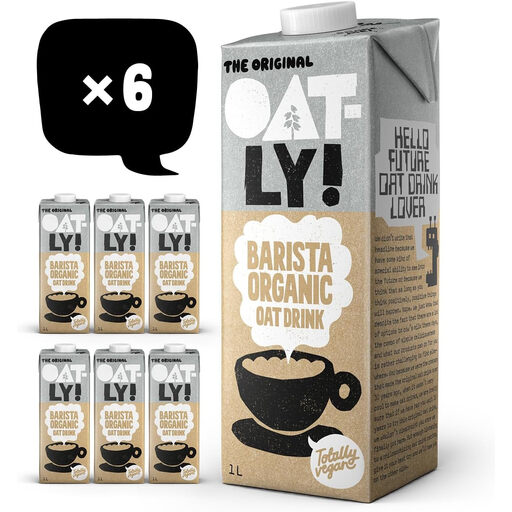
Oatly Organic Barista Oat Drink 6 x 1L
Its product description mentions baking and cooking use if an organic barista oat drink suits the recipe. Do not assume it has the three-ingredient formulation of Oatly’s separate Organic drink; check this carton’s ingredients, vegan statement and allergen declaration.
View on Joybuy
Cake-baking questions
Can I use oat drink instead of dairy milk in a cake?
Yes, when the particular drink is described for cooking or baking: Oatly gives that instruction for its Whole and Organic drinks, and the cited Alpro Oat Long Life listing permits cooking use as a milk alternative. That does not establish identical rise, texture or flavour in every cake recipe.
Should I choose whole, organic or barista oat drink?
Consider a whole-style drink when a richer formulation matters, and a simple or organic drink when its actual ingredient list is your priority. Choose a barista variant for its intended wider use only after checking its own baking instruction and ingredients; a coffee-focused description alone does not establish cake results.
Does a vegan label or Vegan Trademark mean it is safe for a milk allergy?
No. The Vegan Society says vegan claims do not automatically establish food-allergy suitability, and Vegan Trademark products may carry a milk precaution. Check the current carton’s ingredients, allergen declaration and any precautionary statement.
Are all vegan oat drinks gluten-free?
No. The Food Standards Agency says a gluten-free label requires no more than 20 mg/kg gluten, but oats remain an allergen in their own right. Check the exact product’s gluten-free claim and oat and wheat information rather than relying on its vegan status.


