Hosts making savoury Christmas dishes
For gravy, mash, soup or a savoury sauce, compare declared sugars and fat rather than relying on a mild-sounding name or a coffee-foaming claim. The result in a particular recipe may still need a small test.


For gravy, mash or a savoury sauce, start by comparing the sugars declared per 100 ml: Alpro Oat No Sugars lists 0.0 g, though that figure alone cannot predict how a finished dish will taste. If a recipe calls for a creamier milk substitute, Oatly presents its Oat Drink Whole as suitable for cooking and baking. Check the exact pack against guests’ allergy and coeliac-related requirements before serving.
The dish and the guests’ requirements determine which information on an oat-drink pack matters most.
For gravy, mash, soup or a savoury sauce, compare declared sugars and fat rather than relying on a mild-sounding name or a coffee-foaming claim. The result in a particular recipe may still need a small test.
If an oat drink is replacing milk in a recipe, look for a cooking or baking instruction for the exact product. Oatly gives that instruction for Oat Drink Whole; it does not establish the result in every Christmas recipe.
Ask about each guest’s specific requirement and check the current pack. A gluten-free claim does not answer every oat, wheat or milk allergy question, and suitability warnings differ between products.
Start with the dish: compare sugar declarations for a savoury recipe, cooking directions for a milk substitution, and pack-level allergy information for the people eating it.
| Priority | What to check | Your needs |
|---|---|---|
| Declared sugars | Compare sugars on the same per-100-ml basis. Alpro lists 0.0 g per 100 ml for Oat No Sugars; Tesco lists 3.2 g per 100 ml for its Oat Drink. A nutrition figure does not establish the flavour of a finished dish. | I want an oat drink for gravy or mash without relying on the word ‘mild’ to tell me how sweet the dish will taste. |
| Cooking use and richness | Check the exact product’s fat declaration, ingredients and cooking directions. Oatly says Oat Drink Whole can replace milk in cooking and baking; that is the manufacturer’s use guidance, not a test of a particular recipe. | For a bake or white sauce, I need a milk substitute intended for cooking, and I can try a small batch before making the full dish. |
| Guest suitability | Read the current ingredients, gluten-free claim and allergy statement. M&S states that its Only 3 Ingredients Oat Drink is not suitable for coeliacs; its Semi Oat Drink also carries a milk-allergy warning. | Before serving a guest with coeliac disease or an allergy, I need to check the precise requirement against the pack I will use. |
| Added nutrients | Check whether calcium, iodine or vitamins are listed for the exact drink. Tesco lists added calcium, iodine and vitamins for its Oat Drink, while M&S says its Only 3 Ingredients Oat Drink is unfortified. | If I will use the drink regularly beyond Christmas dinner, I want to know what it contains rather than assuming all oat drinks have the same additions. |
| Hot-drink handling | Follow the product’s own preparation directions. Tesco advises shaking its Oat Drink, adding it before hot liquid and not mixing it with boiling water; these instructions are specific to that product. | When I serve hot drinks, I want to prepare the chosen oat drink as its pack directs. |
A mild-sounding description does not tell you the declared sugars, fat, ingredients or intended cooking use.
For a savoury dish, compare the nutrition panels on the same per-100-ml basis, then check whether the exact product has cooking guidance.
Product warnings differ. M&S labels its Only 3 Ingredients Oat Drink as unsuitable for coeliacs, while its Semi Oat Drink carries a milk-allergy warning.
Ask guests about their specific needs and read the current pack’s ingredients, gluten-free claim and allergy statement before serving.
Coffee-oriented positioning does not establish how a drink will work in gravy, a white sauce or a bake.
Look for cooking-and-baking directions for the exact product, or try it in a small batch before preparing the meal.
Ingredients and allergy advice can change, so an earlier listing may not describe the carton being served.
Check that carton for its current ingredients, allergy advice and storage or preparation instructions.
These examples show how particular product lines differ; a brand name alone does not establish a drink’s flavour or suitability for a guest.
Alpro Oat No Sugars is a starting point when minimising declared sugars matters in a savoury recipe.
Oatly presents its Oat Drink Whole as a substitute for milk in cooking and baking.
M&S offers contrasting options for shoppers comparing a short ingredient list with fortification.
Tesco Oat Drink is an own-brand option for shoppers checking fortification and preparation directions.
Minor Figures Everyday Oat is relevant when an explicitly gluten-free oat drink is required.
These oat-drink options include no-sugars varieties to consider for savoury dishes and barista varieties to assess for recipes where texture matters. Check the exact carton and, for an important dish, try a small batch before relying on a substitution.
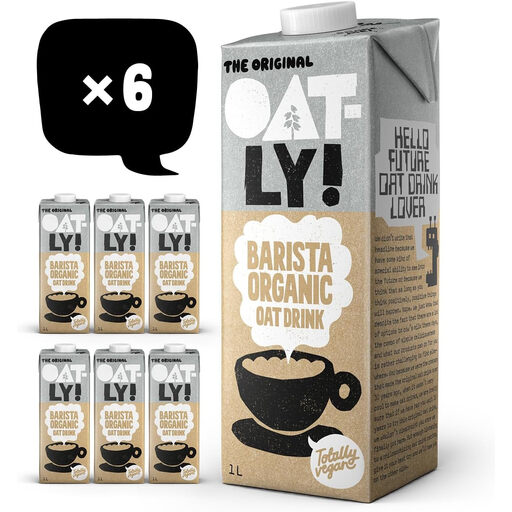 No image available
A six-carton organic barista oat drink to consider when a recipe calls for an oat-based milk substitute. The listing describes cooking and baking use, but that claim does not establish its flavour or result in a particular Christmas dish; check the current pack for allergy information.
 No image available
A no-sugars option to consider when minimising declared sugars is the priority for a savoury dish. The pack contains eight 1L cartons; test the drink in the recipe rather than assuming the label predicts its finished flavour, and check the current carton against guests’ requirements.
 No image available
Another no-sugars variety to assess for a savoury recipe, supplied as six 1L cartons. Confirm its suitability in a small batch if the dish matters, and read the current pack for ingredients and allergy advice.
 No image available
This barista-labelled oat drink is supplied as six 1L cartons, and its listing includes cooking among its uses. That does not establish how it will taste in gravy or a white sauce; try a small amount first if a neutral savoury result matters, and check the carton for allergy advice.
 No image available
An eight-carton original oat-drink option for general use. Its listing describes a naturally sweet flavour, so compare its nutrition panel with a no-sugars variety if you are choosing for gravy or another savoury dish; check the current pack for guest suitability.
Start by comparing declared sugars if limiting sweetness is your main concern. Alpro lists 0.0 g sugars per 100 ml for Oat No Sugars, but the figure cannot tell you exactly how gravy or mash will taste; try the drink in a small batch.
No. A barista label does not establish the result in a sauce. Look for cooking directions for the exact product; Oatly expressly presents Oat Drink Whole for cooking and baking, although that is the manufacturer’s guidance rather than a test of your recipe.
No. Check that the exact product carries a gluten-free claim and read its current suitability statement. M&S says its Only 3 Ingredients Oat Drink is not suitable for coeliacs; a gluten-free claim also does not resolve an oat allergy.
No. Check the exact carton’s ingredients and allergy statement against the guest’s requirements. M&S specifically labels its Semi Oat Drink as unsuitable for people with a milk allergy.
Follow the instructions for the product you bought. For its Oat Drink, Tesco advises shaking the carton, adding the drink before the hot liquid and not mixing it with boiling water; those directions should not be assumed to apply to every oat drink.