What should you check before buying?
Start with the child’s age and the drink’s intended role, then compare the exact cartons for storage, ingredients and nutrition. If the drink is going into tea, check tea-use information separately.
| Priority |
What to check |
Your needs |
| Age and fortification |
For a child aged 1 or over, look for an unsweetened, calcium-fortified drink, in line with NHS guidance. If it will be a regular dairy alternative, check the label for iodine and vitamins D and B12 too. |
I’m using this regularly with a child’s food or drinks, so I need to know what role the oat drink can play. For a child under 1, it must not replace breast milk or first infant formula. |
| Storage and tea use |
Confirm whether the unopened carton can be kept at room temperature, then read its instructions for use after opening. If appearance in tea matters, look for a claim about that specific product; Oatly says its Semi drink works in tea without separating. |
I’d like to keep an unopened carton in the cupboard for planned tea times. If I’m pouring it into tea, I also care whether that particular drink is described as suitable for the job. |
| Nutrition label |
Compare total sugars, salt, fat and saturates per 100ml on the cartons you are considering. “No added sugars” is not the same as zero total sugars: Alpro lists 3.2g sugars per 100ml for Oat Original. |
I want to compare what is in the drinks, not assume that similar front-of-pack wording means similar nutrition. |
| Allergens and gluten |
Read the ingredients, allergen statement and precautionary wording on the exact carton. Check for explicit gluten-free labelling if needed; the Food Standards Agency notes that oats remain an allergen even when a product is labelled gluten-free. |
Someone in my household needs clear milk-allergy or gluten information. I cannot use “vegan” or “oat” as a substitute for checking the pack. |
Relevant brand references
Brand ranges contain different recipes and storage formats, so use these examples to identify which product details to compare on the carton.
Oatly
Oatly’s UK range includes drinks for different uses. The manufacturer describes Oat Drink Semi as suitable for tea without separating.
- Oatly describes Semi as fortified with calcium, iodine and vitamins D2, B2 and B12, and suitable for room-temperature storage before opening.
- Tea-use and nutrition details for Semi should not be assumed to apply to every Oatly carton or a listing with conflicting variant details.
Alpro
Alpro offers distinct Original, No Sugars and Growing Up oat drinks; compare the named variant rather than treating the range as one recipe.
- Alpro Oat Original lists calcium and vitamin B12. Tesco identifies an Oat Original long-life product in its oat-drink range.
- Alpro Oat Original says “no added sugars” but lists 3.2g total sugars per 100ml. An ordinary oat drink is not infant formula.
M&S Plant Kitchen
The M&S range includes fortified Whole and Semi oat drinks as well as a separate Only 3 Ingredients drink.
- M&S lists calcium, iodine and vitamins B12 and D for its Semi Oat Drink.
- Its cited Whole Oat Drink is marked unsuitable for people with milk or wheat allergy. The Only 3 Ingredients drink is unfortified and is not recommended by M&S as a dairy replacement for children under 36 months.
Minor Figures
Minor Figures positions Barista Oat for coffee drinks and everyday brewing, rather than specifically for children.
- Its Barista Oat information lists calcium and describes the product as gluten-free.
- Coffee-focused positioning does not establish its suitability as a regular dairy alternative for a particular child; check the carton’s age, ingredient and nutrition information.
Tesco
Tesco’s oat-drink listings provide examples of long-life Original and Growing Up products alongside other oat-drink types.
- The Tesco category listing identifies Alpro Oat Original and Alpro Oat Growing Up as separate long-life products.
- A category listing does not establish the allergy or age suitability of an individual carton; check the named product’s current pack information.
Joybuy oat-drink options
These oat drinks include long-life options for planned cupboard storage and use with tea-time food or drinks. Compare the exact variant and carton before choosing one for a child, particularly where allergens or regular dairy-alternative use matter.
 No image available
Alpro Oat No Sugars Long Life Drink, 8 x 1L
The product description names tea and coffee use and gives cool, dry storage instructions before opening. It lists calcium, iodine and vitamins B2, B12 and D2; refrigerate after opening and use within five days. Compare total sugars on the exact carton, and check its allergen wording before serving it to a child.
View on Joybuy
 No image available
Alpro Oat Original Long Life Drink, 8 x 1L
This long-life variant names hot beverages among its uses and gives cool, dry storage instructions before opening. Alpro lists calcium, iodine and vitamins B2, B12 and D2 for Oat Original; its nutrition information gives 3.2g total sugars per 100ml despite the no-added-sugars claim. Check the carton’s allergen advice and refrigerate after opening as instructed.
View on Joybuy
 No image available
Oatly No Sugars Oat Drink, 6 x 1L
This listing describes storage at room temperature before opening and lists calcium, iodine, vitamins D2 and B12, and riboflavin. Its nutrition information states 0g sugars per 100ml, with refrigeration and use within five days after opening. If you plan to add it to tea, check the exact carton for tea-use information; also read its allergen and gluten advice.
View on Joybuy
 No image available
Oatly Long Life Barista Oat Drink, 6 x 1L
This long-life Barista drink is described for coffee, cereal, smoothies and cooking, with cool, dry storage before opening. Its listing gives 3.4g sugars per 100ml and says to refrigerate after opening and use within seven days. It also says the product is not suitable as a complete milk substitute for infants or young children. Check tea use, allergens and gluten status on the exact carton if those affect your choice.
View on Joybuy
 No image available
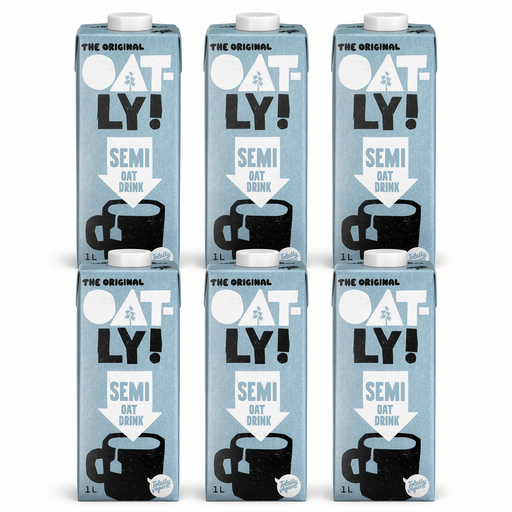
Oatly Semi Oat Drink, 6 x 1L
The listing title identifies a 6 x 1L Semi pack, but its description calls the drink a mini Barista variant. Confirm the product and pack size on the carton before applying the description’s tea-use or nutrition details to this purchase. Check storage instructions and allergen wording for the variant you receive.
View on Joybuy
Common questions
Can an oat drink be a baby’s main drink before age 1?
No. The NHS says to continue breast milk or first infant formula until at least age 1. From age 1, an unsweetened, calcium-fortified oat drink can be given as part of a balanced diet.
What matters if a child aged 1 or over has an oat drink regularly?
Start by checking that it is unsweetened and calcium-fortified, in line with NHS guidance. If it is used regularly as a dairy alternative, check the particular carton for iodine and vitamins D and B12, and compare its nutrition information per 100ml.
Does vegan or dairy-free wording establish milk-allergy suitability?
No. The Food Standards Agency says vegan labelling is not a substitute for allergen labelling. Read the exact carton’s ingredients and precautionary statements; some cited M&S vegan oat drinks are marked unsuitable for people with milk allergy.
Can someone who needs a gluten-free product use any oat drink?
No. Choose a carton explicitly labelled gluten-free if that is required, and check its other allergen advice too. The Food Standards Agency notes that oats must still be identified as an allergen even when a product is labelled gluten-free.
Does adding oat drink make ordinary tea suitable at children’s tea time?
Adding oat drink does not remove caffeine from tea. Wrightington, Wigan and Leigh Teaching Hospitals NHS Foundation Trust advises avoiding caffeine-containing drinks for children for four to six hours before bedtime; using the oat drink with food or in a caffeine-free drink avoids that particular tea concern.


