What should you check?
Decide whether the drink is an occasional snack ingredient or a regular milk replacement, then compare the exact variant’s organic claim, nutrition panel and allergen information.
Organic oat drink
Consider it when: Certified organic production is the priority for an occasional drink or recipe ingredient.
Check: Organic status does not establish fortification; Oatly says its Organic Oat Drink is not fortified.
Unsweetened fortified oat drink
Consider it when: The drink will regularly replace milk for a child aged 1 or over and its label confirms the relevant added nutrients.
Check: This choice may not meet an organic-only preference; NHS guidance also notes the lower protein content of oat alternatives.
| Priority | What to check | Your needs |
|---|
| Organic status |
Look for an organic claim on the exact product. UK government rules require at least 95% of its agricultural ingredients to be organic and certification by an approved organic control body. |
I want certified organic production, rather than treating “plant-based” or “natural” as an organic claim. |
| Regular milk replacement |
Check for calcium, iodine, vitamin D and B12 on the exact pack, alongside its protein and energy values. NHS guidance for children aged 1 or over describes unsweetened fortified oat alternatives as a second-choice plant option because of their lower protein content. |
If this will regularly replace milk for a child, I need to consider more than whether it is organic. |
| Exact variant |
Compare ingredient and nutrition panels within a brand. Oatly describes its Organic Oat Drink as unfortified, while its Semi variant contains added calcium, iodine, D2, riboflavin and B12. |
A familiar brand name is not enough for me to know which nutrients a particular carton contains. |
| Allergens and gluten |
Read the ingredients and allergen statement. For gluten-free suitability, look for an explicit gluten-free claim; the Food Standards Agency says oats remain an allergen even in gluten-free products. |
I may need to check milk, gluten or oats separately rather than relying on a dairy-free description. |
| Sugar wording |
Compare sugars per 100 ml and distinguish “no added sugar” from “no sugars”. Tesco lists Plenish Organic Gluten Free at 3.1 g sugars per 100 ml with a no-added-sugar claim, and Alpro Organic No Sugars at 0 g per 100 ml. |
For a snack drink, I want the nutrition declaration and the wording on the carton to be clear. |
Relevant brand references
These examples show why the exact oat-drink variant matters; a brand’s inclusion does not mean that every product in its range has the same ingredients or nutrition.
Oatly
Oatly lists both organic and fortified oat-drink variants in the UK.
- Its Organic Oat Drink lists water, 10% organic oats and sea salt, and Oatly describes it as made without milk.
- Oatly says that Organic variant is not fortified; its separate Semi variant contains added calcium, iodine, D2, riboflavin and B12.
Alpro
Tesco lists an Alpro Organic No Sugars Oat Drink.
- The Tesco listing declares 0 g sugars per 100 ml for that organic variant.
- If fortification matters, check the exact carton’s calcium, iodine and vitamin information rather than assuming it from the product name.
Minor Figures
Its Organic Barista Oat product is described by the brand for use in coffee.
- Minor Figures describes coffee-focused flavour and microfoam.
- Its product information says “may contain gluten”. Coffee texture is not a substitute for checking nutrition information when choosing a regular milk replacement.
Plenish
Tesco lists a Plenish Organic Gluten Free Longlife Oat Drink.
- The listing gives water, 12% organic gluten-free oats and sea salt as ingredients.
- Its no-added-sugar claim accompanies a declaration of 3.1 g sugars per 100 ml; check the nutrition panel if the distinction matters to you.
Joybuy oat-drink options
These options include an organic barista oat drink for snacks or recipes and two no-sugars oat drinks with listed added nutrients. Check each carton against the role it will play in your household.
 No image available
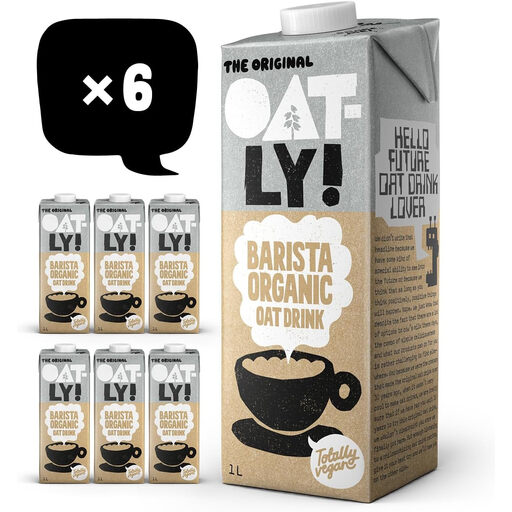
Oatly Organic Barista Oat Drink, 6 × 1L
Listed for uses including hot chocolate, cooking and baking. The supplied product information declares 2.2 g sugars and 1.0 g protein per 100 ml. If it will regularly replace milk for a child, check the current carton for fortification; check its allergen information and gluten-free suitability separately where needed.
View on Joybuy
 No image available
Alpro Oat No Sugars Long Life Drink, 8 × 1L
An option for cereal or smoothies when the listed sugar declaration and added nutrients matter. Its supplied product information states 0.0 g sugars and 0.9 g protein per 100 ml, with calcium, iodine, D2, B2 and B12 listed. Check organic status on the carton if it is essential; the product description identifies oats and gluten-containing cereals.
View on Joybuy
 No image available
Oatly No Sugars Oat Drink, 6 × 1L
Listed for chilled or everyday drinks. Its supplied product information states 0 g sugars and 1 g protein per 100 ml, with calcium, iodine, D2, riboflavin and B12 listed. If organic or gluten-free status is required, check the current carton rather than assuming either from the name.
View on Joybuy
Questions about organic oat drinks
What does “organic” mean on a UK oat drink?
Under UK government organic-labelling rules, a food labelled organic must meet the applicable production requirements, have at least 95% organic agricultural ingredients and be certified through an approved organic control body. The claim does not tell you whether the drink is fortified.
Does an oat drink contain milk?
Not necessarily: Oatly describes its UK Organic Oat Drink as made without milk and lists water, organic oats and sea salt. For a milk allergy, check the ingredients and allergen statement on the particular carton rather than relying on another product’s description.
Is an organic oat drink suitable as a child’s everyday milk replacement?
Organic status alone does not establish that suitability. For children aged 1 or over using plant alternatives in place of milk, NHS guidance advises choosing unsweetened products fortified with calcium, iodine, vitamin D and B12, while noting that oat alternatives are lower in protein. Check the exact product and consider its role in the wider diet.
Is dairy-free organic oat drink suitable for coeliac disease?
A dairy-free or organic claim does not establish gluten-free suitability. Choose a product explicitly labelled gluten-free and check its current pack. The Food Standards Agency says a gluten-free claim means no more than 20 mg/kg gluten; oats remain a separate allergen even when gluten-free.
Is “no added sugar” the same as “no sugars”?
No. Compare the claim with the sugars figure per 100 ml: Tesco lists Plenish Organic Gluten Free Longlife Oat Drink as no added sugar with 3.1 g sugars per 100 ml, while its Alpro Organic No Sugars Oat Drink listing declares 0 g sugars per 100 ml.


