For a child aged 1–3 who needs an alternative to cow’s milk, consider an age-specific fortified drink with advice appropriate to the child’s needs; an ordinary oat drink is not automatically equivalent. For an older child having oat drink with a tea-time snack or in a hot drink, an unflavoured fortified option is a starting point, but no label can tell you which flavour that child will find mild. Check the current carton’s age guidance and allergen warnings, especially when an allergy or school plan applies.
Who is this for?
The child’s age and the role the drink will play matter more than a general description of its taste.
Families with children aged 3 or over
If oat drink is for tea-time snacks or an occasional hot drink, look at unflavoured options and check fortification and allergen information on the carton. Trying a small carton first is more useful than assuming a description such as “subtly sweet” will match a child’s preference.
Families choosing a cow’s-milk alternative for a toddler
An oat drink used regularly as a milk alternative calls for closer attention to age guidance and fortification than one added to a snack. Frimley Health NHS Foundation Trust advises checking calcium fortification and says alternative milks should not be used as a main drink until a child is over one year old. Seek advice from the child’s clinician or dietitian where allergy or nutritional adequacy is a concern.
Families checking allergens for school
Use the exact carton and the child’s individual allergy or school plan, rather than relying on “oat”, “vegan” or “dairy-free” alone. The Food Standards Agency identifies oat as an allergen, and individual oat drinks carry different suitability warnings.
What matters when choosing?
Start with the child’s age and how the drink will be used. Then compare the cartons for fortification, ingredients and suitability before testing flavour in a small serving.
| Priority |
What to check |
Your needs |
| Age and use |
Read the age guidance and decide whether the drink is for food and snacks or as a regular milk alternative. Frimley Health NHS Foundation Trust says alternative milks should not be a main drink until after age one and advises checking calcium fortification. |
If I’m choosing a cow’s-milk alternative for a toddler, I need more than a drink that happens to taste mild. Alpro labels its Oat Growing Up Drink for ages 1–3+; an age-specific label does not replace individual advice where needed. |
| Flavour and tea use |
Choose an unflavoured variety, compare the current per-100 ml sugar declarations and try a small serving in the usual setting. Oatly says its Semi drink is formulated to work in tea without separating; that is a manufacturer statement, not a taste test with children. |
I’d like a flavour the child accepts in a tea-time drink or snack, without committing to several cartons before trying it. Descriptions such as “smooth” or “subtly sweet” cannot establish an individual child’s preference. |
| Allergen suitability |
Read the current ingredients, emphasised allergens and any “not suitable for” statement. The Food Standards Agency says oat remains an allergen even in food labelled gluten-free or very low gluten. |
For a child with an allergy or a school care plan, I need a carton that meets their specific requirements. M&S labels its Semi Oat Drink unsuitable for those with a milk allergy; Sainsbury’s gives a soya-allergy warning for its Long Life Oat Drink. |
| Fortification and ingredients |
Compare the listed added nutrients with the ingredient list. Tesco, Sainsbury’s and M&S list fortified everyday oat drinks, while M&S says its Only 3 Ingredients Oat Drink is unfortified and not recommended as a dairy replacement for children under 36 months. |
A short ingredient list may suit what I’m looking for in an occasional drink, but I wouldn’t treat it as interchangeable with an age-specific fortified option for a toddler. |
| Storage after opening |
Check whether the carton needs chilling, its use-after-opening instructions and any directions for hot drinks. Tesco says to refrigerate its Oat Drink after opening and use it within five days. |
If we use only a little oat drink at tea time, I want a carton size we can use within its stated storage period. |
Mistakes to avoid
-
Assuming a vegan label settles an allergy question
Suitability warnings differ between oat drinks. M&S labels its vegan Semi Oat Drink unsuitable for people with a milk allergy, while Sainsbury’s warns that its Long Life Oat Drink is unsuitable for customers with a soya allergy because of manufacturing methods.
Read the current carton and follow the child’s individual allergy or school plan before serving or sending a drink to school.
-
Using a simple oat drink as a toddler’s milk replacement
A short ingredient list does not establish that a drink is fortified. M&S says its three-ingredient oat drink is unfortified and not recommended as a dairy replacement for children under 36 months.
If the drink will replace cow’s milk for a young child, check its age guidance and fortification, and seek individual advice where allergy or nutritional adequacy is involved.
-
Buying several cartons on the promise of “mild”
Manufacturers’ flavour descriptions do not predict whether a particular child will like a drink, especially once it is mixed with their usual food or drink.
Try a small carton of an unflavoured option in the intended tea-time setting before choosing a multipack.
-
Overlooking the opened-carton instructions
Storage instructions affect how practical a carton is when only small amounts are used. Tesco specifies refrigeration and use within five days of opening for its Oat Drink.
Check the chosen product’s own storage period and hot-drink directions, and select a pack size that fits how quickly it will be used.
Opening more than can be used within the stated period may mean discarding the remainder.
Relevant brand options
These are references to specific oat-drink lines, not a claim that every product from a brand has the same ingredients or warnings.
Alpro
Oat Growing Up Drink 1–3+ is an age-specific option when a young child needs an alternative to cow’s milk.
- Alpro lists calcium, vitamin D, protein, iodine and iron in this product.
- Its age-specific formulation is not a substitute for individual advice about a diagnosed allergy or a child’s nutritional needs.
Oatly
Oat Drink Semi is a fortified everyday option for tea, cooking or drinking.
- Oatly lists calcium, iodine and vitamins D2, B2 and B12, and says Semi works in tea without separating.
- Tea performance does not establish that its flavour will be mild to every child.
Tesco
Tesco Oat Drink is a fortified everyday oat-drink option.
- Its product information lists added calcium, iodine and vitamins B12, B2 and D2.
- Tesco advises reading the current label for allergens because formulations can change.
Sainsbury’s
Long Life Oat Drink is a fortified option for ordinary meals and snacks.
- Sainsbury’s lists calcium, iodine, vitamin D and vitamin B12.
- Sainsbury’s says it is not a main milk-drink alternative for children under three and is unsuitable for customers with a soya allergy because of manufacturing methods.
M&S
Its Semi Oat Drink and Only 3 Ingredients Oat Drink serve different ingredient and fortification preferences.
- M&S lists added calcium, iodine and vitamins B12 and D in Semi; the three-ingredient drink contains water, oats and sea salt.
- The three-ingredient drink is unfortified and not recommended as a dairy replacement for children under 36 months. M&S labels Semi unsuitable for those with a milk allergy.
Minor Figures
Barista Oat is positioned by Minor Figures primarily for coffee and foam.
- The brand describes subtle oat sweetness and a dense foam texture.
- Coffee-focused descriptions do not establish child-specific suitability or how mild it will taste at tea time.
Oat drinks on Joybuy
These Alpro and Oatly multipacks are everyday oat-drink options to consider for an older child’s tea-time use. Their names do not identify them as age-specific toddler drinks; check each current carton before choosing one for a child with particular dietary requirements.
 No image available
Alpro Oat Original Long Life Drink 8 × 1 L
An everyday oat-drink option for tea-time use. The long-life pack contains eight 1 L cartons; try the flavour before committing to a multipack, and check the current cartons for ingredients, allergens and storage directions.
View on Joybuy
 No image available
Alpro Oat No Sugars Long Life Drink 8 × 1 L
An everyday oat-drink variant to consider for tea-time use. The long-life pack contains eight 1 L cartons; compare the current carton’s per-100 ml sugar declaration rather than relying on the variant name, and check its allergen information.
View on Joybuy
 No image available
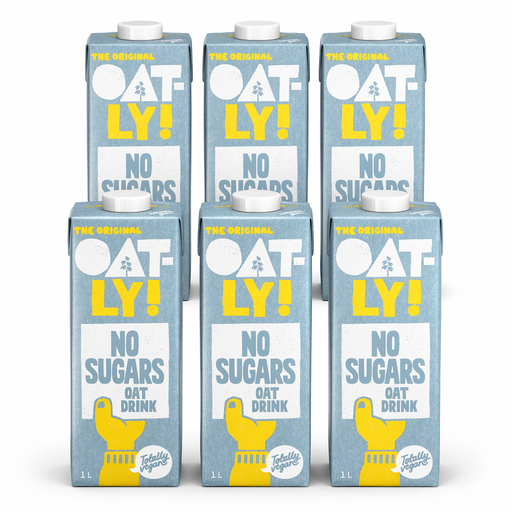
Oatly No Sugars Oat Drink 6 × 1 L
An everyday oat-drink option described for tea as well as other hot drinks. The pack contains six 1 L cartons; check the current carton’s per-100 ml sugar declaration and allergen statement, and try a small serving to judge the flavour.
View on Joybuy
Common questions
Is every oat drink suitable for a child with a milk allergy?
No. Check the current carton and follow the child’s individual allergy and school plan rather than relying on a vegan or dairy-free description. M&S labels its Semi Oat Drink unsuitable for people with a milk allergy, and Sainsbury’s gives a soya-allergy warning for its Long Life Oat Drink. The Food Standards Agency also identifies oat itself as an allergen.
Can an ordinary oat drink be a toddler’s main milk drink?
Do not assume an ordinary oat drink is suitable for that role. Frimley Health NHS Foundation Trust says alternative milks should not be used as a main drink until a child is over one year old and advises checking calcium fortification. If a toddler needs an alternative to cow’s milk, check age-specific options and seek individual advice where allergy or nutritional adequacy is involved.
Does a shorter ingredient list make an oat drink suitable as a dairy replacement?
Not necessarily. M&S says its Only 3 Ingredients Oat Drink is unfortified and not recommended as a dairy replacement for children under 36 months. Check the intended use and age guidance as well as the ingredients.
How can I check whether an oat drink will work at tea time?
Choose an unflavoured option and try a small serving in the way it will normally be used. Oatly says its Semi drink is formulated to work in tea without separating, but that does not establish whether a child will like its flavour. Read the current allergen statement before serving it.
Does gluten-free mean oat-free?
No. The Food Standards Agency says oat must still be emphasised as an allergen even when a food is labelled gluten-free or very low gluten. Check the exact product against the child’s requirements.


