Choose the oat drink around the ingredient each guest must avoid, not a general “plant-based” description. For a gluten-free requirement, look for an explicit gluten-free claim and check the carton’s full allergen wording; gluten-free oat drink still contains oats, while a vegan label alone does not establish suitability for a milk allergy. Once those needs are accounted for, compare the stated cooking or coffee uses, ingredients and fortification of the particular drink.
Who is choosing the oat drink?
The guest’s specific restriction comes before the drink’s intended kitchen use.
Hosts serving someone who needs gluten-free food
Look for an explicit gluten-free claim rather than relying on “oat”, “vegan” or “dairy-free”. The Food Standards Agency notes that oats must still be identified as an allergen in a gluten-free oat product.
Families avoiding milk or lactose
Check the claim and suitability wording on the particular carton. A drink intended for tea or cooking may meet a dairy-free preference, but “plant-based” alone does not settle a guest’s milk-allergy question.
Households comparing dinner and coffee uses
Decide whether the drink is for a recipe, pouring at the table or coffee after the meal. Then compare its stated uses and ingredients; a short ingredient list and added vitamins or minerals are different product choices, not interchangeable label claims.
What should you check first?
Settle each guest’s ingredient restrictions before choosing a formulation for the dish or drink.
| Priority | What to check | Your needs |
|---|
| Gluten and oats |
Look for an explicit gluten-free claim if needed. Read the oat allergen declaration and any precautionary wording; gluten-free does not mean oat-free. |
For a guest who needs gluten-free food, I need a clearly labelled carton they can assess. Coeliac UK Commercial reported in January 2026 that 74% of the 3,785 Coeliac UK members responding to its Shopping Habits 2025 survey trusted its Crossed Grain Trademark more than a gluten-free statement. That measures trust in labelling, not how many oat-drink shoppers need gluten-free food. |
| Milk and lactose |
Distinguish a lactose-free or dairy-free claim from the carton’s milk-allergy suitability wording. Check the current allergen and precautionary statements. |
If someone at dinner must avoid milk, I cannot use “vegan” as the only check. Marks & Spencer marks its vegan Plant Kitchen Whole Oat Drink as unsuitable for people with a milk allergy. |
| Wheat and other cereals |
Read suitability statements alongside the ingredients, especially where a guest has a wheat or cereal allergy. Do not treat a short ingredient list as a gluten-free claim. |
A guest’s wheat-allergy requirement means I need to check the exact carton, even if its ingredient list looks simple. Marks & Spencer marks its Only 3 Ingredients Oat Drink as unsuitable for people with a wheat allergy. |
| Kitchen use and formulation |
Compare the product’s stated cooking, pouring or coffee uses. Check the ingredients and whether the particular drink lists added vitamins or minerals. |
For a sauce, I want to check that cooking is a stated use; for coffee after dinner, I may prefer a barista-labelled drink. If added nutrients matter to the household, I need to compare the cartons rather than assume all oat drinks contain them. |
Label mistakes to avoid
-
Reading “gluten-free” as “oat-free”
The Food Standards Agency says oat remains an allergen that must be identified even when an oat product is gluten-free.
If a guest must avoid oats, choose an alternative that does not contain oats. For a gluten-free requirement where oats can be consumed, check the explicit claim and the rest of the carton’s allergen wording.
-
Using “vegan” to settle a milk-allergy question
Marks & Spencer labels its Plant Kitchen Whole Oat Drink vegan but also marks it unsuitable for people with a milk allergy.
Read the current suitability and precautionary statements for the exact drink before serving it to someone with a milk allergy.
-
Assuming three ingredients mean gluten-free
Marks & Spencer lists water, oats and sea salt for its Only 3 Ingredients Oat Drink, yet marks it unsuitable for coeliacs and people with a wheat allergy.
Where gluten-free food is needed, check for an explicit gluten-free claim rather than judging by the length of the ingredient list.
-
Expecting every oat drink to have the same uses or nutrients
Oatly describes its Whole drink for cooking and baking, while Minor Figures positions Barista Oat for coffee. Marks & Spencer says its Only 3 Ingredients drink is not fortified, whereas its Plant Kitchen Whole drink lists added nutrients.
Choose for the intended dish or beverage, then compare the exact products’ ingredients and fortification separately from their allergen suitability.
Brand and retailer references
These examples describe particular product lines or listings, not an allergy or availability claim for every item from a brand or retailer.
Alpro
Alpro’s Organic Oat and Oat Original have different label claims, so the variant matters.
- Alpro labels Organic Oat gluten-free, naturally lactose-free and dairy-free; Oat Original is labelled dairy-free and lists added calcium, iodine and vitamins B2 and D2.
- Organic Oat also says “May contain other cereals containing gluten”. The cited Oat Original information does not make a gluten-free claim. Check the current carton against each guest’s requirements.
Oatly
Oatly describes its Whole oat drink for cooking, baking and hot drinks.
- Oatly states that this Whole drink does not contain milk or soy and lists oats, rapeseed oil, minerals and vitamins among its ingredients.
- Those statements do not establish a gluten-free claim or settle suitability for every allergy; use the wording on the specific carton.
Minor Figures
Minor Figures positions Barista Oat for coffee, including lattes and cappuccinos.
- The manufacturer labels Barista Oat gluten-free and lists oats (11%) and rapeseed oil among its ingredients.
- A gluten-free claim does not make a drink oat-free. Check the carton’s full allergen wording for the person being served.
M&S
The two M&S oat drinks described here differ in ingredients, fortification and suitability statements.
- Plant Kitchen Whole lists calcium, iodine and vitamins D and B12. Only 3 Ingredients lists water, oats and sea salt and is not fortified.
- M&S marks Plant Kitchen Whole unsuitable for coeliacs and people with milk or wheat allergy. It marks Only 3 Ingredients unsuitable for coeliacs and people with wheat allergy, and does not recommend that product as a dairy replacement for children under 36 months.
Tesco
Tesco’s oat-drink category has listed standard drinks alongside products explicitly named gluten-free.
- A category listing can help identify which individual cartons warrant a closer label comparison.
- A category name or listing does not establish the allergen suitability of a particular carton; check its current product label.
Oat drinks on Joybuy
These oat-drink options cover multipacks for household use and drinks labelled for barista use. Check each carton’s allergen wording against your dinner guests’ needs before choosing.
 No image available
Alpro Oat Original Long Life Drink, 8 x 1L
An eight-carton option for a family table where the relevant free-from claims need checking. Alpro describes Oat Original as dairy-free and lists added calcium, iodine and vitamins B2 and D2. Do not assume it is gluten-free; read the current carton if a guest needs gluten-free food or has an allergy.
View on Joybuy
 No image available
Alpro Barista Oat Long Life Drink, 8 x 1L
A barista-labelled option to consider for coffee after dinner, supplied as eight 1L cartons. The name does not establish gluten-free or milk-allergy suitability; check the current carton’s claims, allergen declaration and precautionary wording for your guests.
View on Joybuy
 No image available
Oatly Long Life Barista Oat Drink, 6 x 1L
A six-carton barista option if an oat drink is wanted for coffee at the family table. Its name alone does not settle gluten-free or milk-allergy suitability, or establish its uses in a particular recipe. Check the current carton before serving it to a guest with a food restriction.
View on Joybuy
 No image available
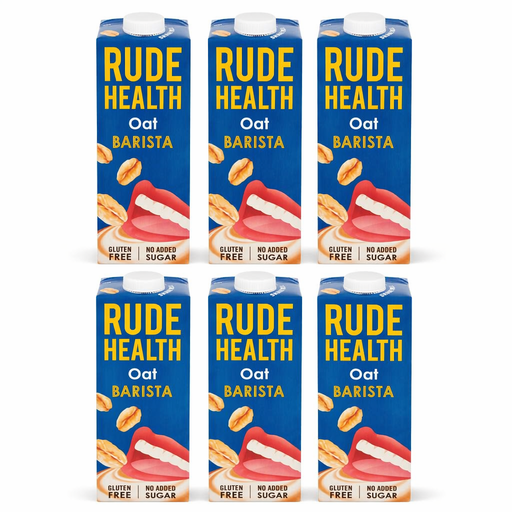
Rude Health Barista Oat Drink, 1L
A single 1L barista-labelled carton to compare with the multipacks if coffee is part of the dinner plan. An ingredient described as gluten-free oats would not, by itself, establish a gluten-free claim for the finished drink. Check the current drink label and its milk-allergy wording where relevant.
View on Joybuy
Frequently asked questions
Is every oat drink gluten-free?
No. Alpro notes that oats can come into contact with wheat, rye or barley during processing. When a guest needs gluten-free food, choose a drink with an explicit gluten-free claim and read the full label rather than relying on “oat” or “dairy-free”.
Does gluten-free oat drink suit someone who must avoid oats?
No: gluten-free does not mean oat-free. The Food Standards Agency says oat must still be identified as an allergen in a gluten-free oat product. Choose a non-oat alternative for someone who must avoid oats.
Does “vegan” establish suitability for a milk allergy?
No. Marks & Spencer marks its vegan Plant Kitchen Whole Oat Drink as unsuitable for people with a milk allergy. Read the current suitability and precautionary wording on the exact product rather than relying on the vegan description.
What does “may contain” tell me on an oat-drink carton?
It is precautionary allergen wording about possible unintended presence, not an ingredient or a free-from claim. The Food Standards Agency describes “may contain” statements as a way to communicate that risk; read the specific statement for the allergen your guest needs to avoid.
Can a three-ingredient oat drink replace dairy for a child under three?
Do not assume that the short ingredient list makes it a suitable replacement. Marks & Spencer says its Only 3 Ingredients Oat Drink is not fortified and is not recommended as a dairy replacement for children under 36 months. That warning concerns this product, not every oat drink.


