What matters when choosing?
Start with total fat per 100ml if you have a fat limit, then compare sugars and fortification according to how you use the drink.
| Priority | What to check | Your needs |
|---|
| Total fat |
Compare total fat per 100ml, not product names. Oxford University Hospitals advises avoiding drinks above 1.5g per 100ml under its 20g-per-day minimal-fat plan; follow your own clinical instructions if they differ. |
I need a drink that fits my prescribed fat limit, including the amount I actually pour. |
| Sugars |
Read sugars and total fat as separate per-100ml figures. Ocado lists Alpro Oat No Sugars at 0g sugars and 1.5g fat; Tesco Groceries lists Oatly The Original Semi at 3.4g sugars and 1.4g fat. |
If I also want to avoid sugars, I need to check that figure rather than assuming the drink with less fat has less sugar. |
| Fortification |
Check the current pack for calcium, iodine and added vitamins. The UK government’s SACN and COT assessment notes that plant-based drinks differ considerably in nutrient content. |
I use oat drink regularly in place of dairy milk, so the nutrients listed on the carton matter alongside its fat content. |
| Storage |
Check that the pack is long-life and read its refrigeration and use-by instructions after opening. Match the carton size and pack quantity to how quickly you use it. |
I want cartons I can store before opening without leaving an opened one unused for too long. |
Relevant brand references
These figures refer to the named products, not every oat drink made by each brand. Check the current carton before making a close comparison.
Oatly
Tesco Groceries lists The Original Semi Oat Drink at 1.4g fat and 3.4g sugars per 100ml.
- Its listed total-fat figure is below the 1.5g-per-100ml upper figure in Oxford University Hospitals’ specific minimal-fat guidance.
- The Original Semi is not a no-sugars option; check the exact Oatly variant rather than applying this panel to another product.
Alpro
Ocado lists Oat No Sugars Long Life at 1.5g fat, 0g sugars, 120mg calcium and 22.6µg iodine per 100ml.
- The named product combines a listed no-sugars formulation with a per-100ml fat figure.
- Its listed fat figure is at, not below, the 1.5g-per-100ml upper figure in Oxford University Hospitals’ specific guidance.
Tesco
Tesco Groceries lists Long Life Oat Original at 1.6g fat and 3.8g sugars per 100ml, with calcium and iodine listed.
- The named long-life drink has per-100ml figures that can be compared with other labelled products.
- At 1.6g fat per 100ml, it exceeds the drink figure Oxford University Hospitals advises avoiding under its 20g-per-day minimal-fat plan.
M&S
Marks & Spencer lists its Semi Oat Drink at 1.5g fat and 3.3g sugars per 100g, with calcium, iodine, vitamin B12 and vitamin D.
- The named product lists several added nutrients for shoppers checking fortification.
- Its supplied figures are per 100g. Check the carton for a per-100ml figure before comparing it directly with a drink limit expressed per 100ml.
Minor Figures
Morrisons describes the named Barista Oat drink in terms of mouthfeel and microfoam for coffee.
- Its coffee-focused positioning may be relevant if that is how you intend to use the drink.
- Coffee positioning does not establish whether a particular carton fits a total-fat limit; check its nutrition panel.
Long-life oat drinks on Joybuy
These Joybuy listings cover long-life oat drinks labelled No Sugars, Semi or Barista. For a prescribed fat limit, compare the exact carton’s total fat per 100ml with your own instructions before choosing.
 Image unavailable
Oatly No Sugars Oat Drink, 6 × 1L
If you are limiting fat as well as looking for a drink labelled No Sugars, check this Oatly carton’s total fat per 100ml and its ingredients before using it for a prescribed diet. The listing names a pack of six 1L cartons.
View on Joybuy
 Image unavailable
Alpro Oat No Sugars Long Life Drink, 8 × 1L
This long-life option is labelled No Sugars and comes as eight 1L cartons. If a precise fat limit applies, use the current carton’s per-100ml figure: differing fat figures are associated with this product, so a close comparison should not rest on one online value.
View on Joybuy
 Image unavailable
Alpro Barista Oat Long Life Drink, 8 × 1L
For coffee use, this is a barista-labelled long-life oat drink supplied as eight 1L cartons. Barista wording is not a fat classification, so check both total fat and sugars on the carton if either affects your choice.
View on Joybuy
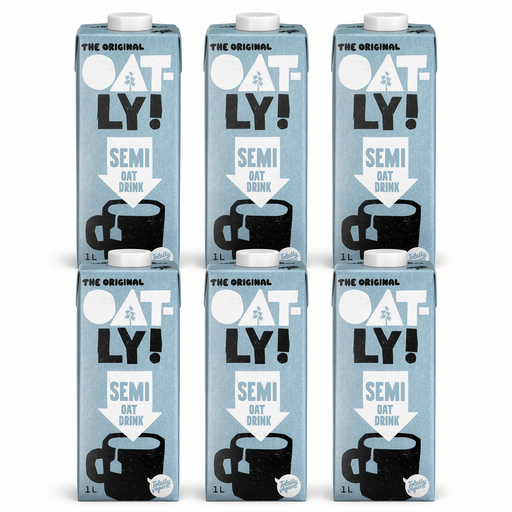 Image unavailable
Oatly Semi Oat Drink, 6 × 1L
If you are considering this for hot drinks, confirm the variant and carton size before ordering: the title says Semi and six 1L cartons, while the description calls it a mini Barista Edition. Check the exact carton’s total fat and sugars per 100ml rather than applying another Oatly variant’s figures.
View on Joybuy
Common questions
What fat figure should I check for a prescribed minimal-fat diet?
Follow the limit given by your clinical team and compare drinks using total fat per 100ml. For its specific 20g-per-day minimal-fat plan, Oxford University Hospitals advises avoiding drinks above 1.5g fat per 100ml; that figure is not a universal target for everyone reducing fat.
Does ‘no sugars’ mean less fat?
No: sugars and fat are separate figures. Ocado lists Alpro Oat No Sugars at 0g sugars and 1.5g fat per 100ml, while Tesco Groceries lists Oatly The Original Semi at 3.4g sugars and 1.4g fat per 100ml. Check the current pack of the exact variant you buy.
What should I check if oat drink regularly replaces dairy milk?
Check the individual carton for calcium, iodine and added vitamins as well as fat and sugars. The UK government’s SACN and COT assessment says plant-based drinks vary considerably in nutrient content, so one oat drink’s fortification should not be assumed for another.
How should I store long-life oat drink after opening?
Follow the exact carton’s refrigeration and use instructions once it is opened. Long-life storage before opening does not replace those instructions, particularly when buying several cartons at once.
Can I assume an oat drink suits my allergy requirements?
No. Check the ingredients and allergen statement on the exact carton before use, rather than relying on ‘oat’ or ‘plant-based’ in its name. UK government food-labelling guidance requires ingredients, including allergens, to be displayed on packaging.


