Late-night eaters who dislike sweet drinks
For sipping, cereal or porridge, an unflavoured no-sugars carton is a useful starting point. Oatly calls its No Sugars drink less sweet, but flavour preference is personal.


If mild means less sweetness, start by comparing unflavoured no-sugars oat drinks: Oatly describes its No Sugars drink as less sweet, and its listed sugars are 0 g per 100 ml; Alpro also offers a no-sugars version. If you use oat drink regularly in place of dairy, check fortification; choose a short-ingredient recipe for ingredient simplicity or a barista drink when frothing matters, without assuming that a sugar figure predicts exactly how mild it will taste.
For sipping, cereal or porridge, an unflavoured no-sugars carton is a useful starting point. Oatly calls its No Sugars drink less sweet, but flavour preference is personal.
If added calcium, iodine or vitamins matter to your choice, compare the exact cartons. Fortified drinks and M&S Only 3 Ingredients Oat Drink take different approaches: M&S states that its three-ingredient product is not fortified.
For a foamy coffee-based drink, a barista formulation may be relevant. For tea or a simple hot drink, compare sweetness and preparation instructions as well as whether the carton is labelled barista.
Decide what mild means for your supper, then compare the carton’s sugars, ingredients and intended use.
| Priority | What to check | Your needs |
|---|---|---|
| Sweetness | Compare sugars per 100 ml on drinks with the same labelling basis. Tesco lists 0 g per 100 ml for Oatly No Sugars, while Sainsbury’s lists 4.2 g per 100 ml for its standard Oat Drink; neither figure is a taste test. | I find some oat drinks too sweet with a late supper, so I would start with an unflavoured no-sugars carton rather than rely on words such as “smooth”. |
| Fortification and ingredients | Read the ingredients and nutrition panel for added calcium, iodine and vitamins. M&S lists water, oats and sea salt for Only 3 Ingredients and states that it is not fortified. | For a drink I use regularly instead of dairy, added nutrients matter to my choice. If a short ingredient list matters more, I would compare that separately rather than assume the drinks are nutritionally alike. |
| Hot-drink texture | Look for a barista formulation if frothing is important, then compare its sugars on the stated per-100 ml, per-100 g or per-serving basis. Minor Figures lists 5 g sugars per 200 ml for Barista Oat. | A foamy coffee-based drink calls for a different choice from oat drink poured over porridge. For a simple hot drink, I would also read the carton’s preparation directions. |
| Allergens | Check the current carton’s allergen statement and any gluten-free claim. The UK Food Standards Agency notes that oats remain an allergen even when labelled gluten-free; M&S identifies its Only 3 Ingredients drink as unsuitable for coeliacs. | If coeliac disease or a food allergy affects my purchase, the exact product label matters more than the general description “oat drink”. |
| Carton size and storage | Check the pack quantity, refrigeration instructions and time allowed after opening. Tesco’s listing for Oatly No Sugars says to refrigerate it after opening and use it within approximately five days. | I may use only a little at supper, so I want a carton size and opened-carton period that fit how often I will use it. |
Unflavoured cartons can list different sugars figures. Sainsbury’s standard Oat Drink lists 4.2 g per 100 ml, compared with 0 g per 100 ml on Tesco’s listing for Oatly No Sugars.
If low sweetness is your priority, compare the sugars line and the exact variant rather than choosing by brand or carton design.
A barista formulation is intended for hot-drink texture and frothing, which may add little to cereal, porridge or a drink served cold. Minor Figures lists 5 g sugars per 200 ml for its Barista Oat, so do not treat “barista” as a no-sugars description.
Choose for the drink you will actually make, and compare nutrition figures on the same stated quantity.
A product made with oats is not automatically suitable for every gluten-related or oat-allergy requirement. M&S states that its Only 3 Ingredients Oat Drink is not suitable for coeliacs.
Read the current carton’s gluten-free claim and allergen statement for the exact product you intend to buy.
An unopened long-life carton and an opened carton have different storage instructions. A multipack also leaves more cartons to store and use over time.
Check each product’s opened-carton directions and choose a pack size that fits your expected use.
An opened carton discarded before it is used adds food waste.
These examples show why the variant matters; a brand name alone does not tell you its sweetness, ingredients or hot-drink use.
Oatly describes its UK No Sugars oat drink as less sweet. That is the brand’s flavour description, not a guarantee about individual taste.
Alpro’s Oat No Sugars is a separate everyday-drink option from its Barista Oat range.
Minor Figures positions Barista Oat for coffee drinks and describes its foam as dense.
Tesco’s own Oat Drink is a fortified everyday option rather than a No Sugars variant.
Sainsbury’s lists a standard fortified Oat Drink and a separate Oat Barista drink.
M&S offers a three-ingredient oat drink alongside separately formulated Semi and Barista drinks.
These options include a No Sugars oat drink and barista oat drinks for different late-night uses. Check the pack quantity as well as the exact variant: several are multipacks.
 Image unavailable
For supper when low sweetness matters more than frothing, this variant lists 0 g sugars per 100 ml. It contains added calcium, iodine and vitamins. The six-carton pack requires refrigeration after a carton is opened and use within approximately five days; check its allergen statement if oats are a concern.
 Image unavailable
Consider this coffee-led variant when frothing matters in a hot drink. Its listed sugars are 3.4 g per 100 g, so it is not the zero-sugars route. The pack contains six 1L cartons; refrigerate an opened carton and use it within seven days.
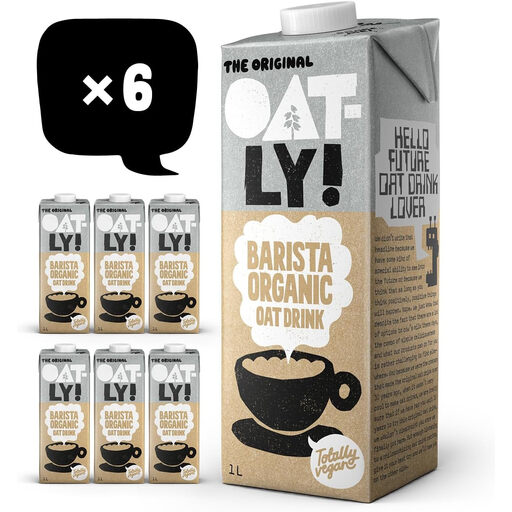 Image unavailable
This barista variant is described for hot drinks, including tea and hot chocolate. It lists 2.2 g sugars per 100 ml, rather than zero sugars. Its ingredients include oats and rapeseed oil; refrigerate after opening and use within five days.
 Image unavailable
Choose this variant for its stated frothing use, not as a zero-sugars drink. Although described as having no added sugars, its nutrition information lists 3.0 g sugars per 100 ml. The pack contains eight 1L cartons; refrigerate after opening and use within five days.
 Image unavailable
This eight-carton pack is described for everyday drinks and lists added calcium, iodine and vitamins. Its sugar descriptions conflict, so check the current carton’s nutrition panel before relying on it for a zero-sugars choice. It contains oats; refrigerate after opening and use within five days.
No: “no added sugar” does not mean zero sugars or guarantee a particular taste. If low sweetness is what you mean by mild, compare sugars on the nutrition panel and choose an unflavoured variant; Oatly describes its No Sugars drink as less sweet, but your taste may differ.
No. Check the exact product’s gluten-free claim and allergen statement rather than assuming all oat drinks are suitable. The UK Food Standards Agency notes that oats remain an allergen even when labelled gluten-free, and M&S states that its Only 3 Ingredients Oat Drink is not suitable for coeliacs.
Follow the individual carton’s refrigeration and use-by-opening instructions. For example, Tesco’s listing for Oatly No Sugars advises refrigeration and use within approximately five days after opening; an unopened long-life carton’s storage directions do not apply once it has been opened.
Choose a barista variant if frothing or a coffee-style texture matters; it is not automatically necessary for a simple hot drink. Check preparation directions for the exact carton: Tesco advises against boiling water with its Oat Drink, while Sainsbury’s advises letting hot water cool slightly to reduce separation.