Students with little fridge space
Long-life cartons can wait in a cupboard before opening if their storage instructions permit it. You will still need fridge space for an opened carton, so consider how quickly you will use each one.


For a low-fat oat drink during a move, compare total fat per 100 ml, then decide whether unopened cartons need to fit in a cupboard. Alpro UK lists 1.5 g per 100 ml for Alpro Oat No Sugars, Tesco lists the same for Oatly No Sugars, and Oatly lists 1.4 g per 100 ml for its Chilled Semi drink, which must stay refrigerated. Check the current carton’s storage instructions and fortification too: neither 'no sugars' nor 'barista' tells you its fat content.
Long-life cartons can wait in a cupboard before opening if their storage instructions permit it. You will still need fridge space for an opened carton, so consider how quickly you will use each one.
Read the total-fat figure rather than relying on 'no sugars' or 'barista'. Oatly lists 1.4 g per 100 ml for Chilled Semi; Alpro UK and Tesco respectively list 1.5 g per 100 ml for Alpro Oat No Sugars and Oatly No Sugars.
Check which nutrients are added as well as the fat figure. NHS guidance on vegan diets discusses fortified dairy alternatives and identifies calcium, iodine, vitamin D and vitamin B12 as nutrients to consider.
Start with a comparable fat figure, then match storage and pack size to your accommodation; check added nutrients or coffee use where they matter to you.
| Priority | What to check | Your needs |
|---|---|---|
| Total fat | Compare total fat per 100 ml, not sugars or saturated fat alone. The annex published by legislation.gov.uk specifies no more than 1.5 g per 100 ml for a 'low fat' claim on liquids. | I want a lower-fat everyday drink and need a figure I can compare across cartons, regardless of front-of-pack wording. |
| Storage | Check where unopened cartons can be kept, then read the separate instructions for refrigeration and use after opening. Check how many cartons are in a multipack. | There is little room in my shared fridge, but I can only use an opened carton as directed on its pack. |
| Added nutrients | Read the carton for added calcium, iodine, vitamin D and vitamin B12. NHS vegan-diet guidance discusses fortified dairy alternatives; the nutrients listed vary by product. | If oat drink regularly replaces dairy for me, fat is not the only part of the label I want to compare. |
| Coffee use | Check whether the drink is intended to froth, then compare its total fat on the stated per-100 ml or per-100 g basis. A barista label does not establish a fat level. | For lattes, frothing matters to me; for cereal or tea, I may prefer to choose by the everyday drink’s label. |
Sugars and total fat are different entries on the nutrition panel. A no-sugars drink is not necessarily fat-free.
Read total fat per 100 ml when comparing liquid oat drinks against the 1.5 g per 100 ml low-fat claim limit published by legislation.gov.uk.
Coffee-focused products have different nutrition figures. Marks & Spencer lists 3.3 g fat per 100 g for M&S Barista, while Minor Figures lists 4.3 g per 200 ml serving for Barista Oat.
If frothing matters, compare each barista carton’s fat figure with an everyday option rather than judging it by its name.
Unopened long-life cartons can be convenient during a move, but opening one changes its storage requirements.
Check the pack’s refrigeration and use-by-after-opening instructions, then choose a pack size that fits your fridge space and likely use.
An opened carton left unused beyond its stated storage period may have to be discarded.
Oat drinks are not interchangeable for every allergen requirement. The Food Standards Agency says gluten-free labelling has a limit of 20 mg/kg gluten and that oats must still be emphasised as an allergen.
If you require a gluten-free product, look for an explicit gluten-free label and read the current allergen information.
These product-line examples illustrate label and storage differences; a brand’s inclusion does not indicate that every one of its drinks has the same properties.
Its Chilled Semi and No Sugars drinks offer different storage arrangements.
Oat No Sugars is an option for comparing fat, sugars and added nutrients on one label.
Its chilled Oat Drink and Long Life Oat Original illustrate a storage-versus-fat decision.
Semi Oat Drink and Barista Oat Drink serve different everyday and coffee-focused comparisons.
Barista Oat is presented by Minor Figures as a coffee drink with a dense foam texture.
Its own-label Oat Drink is described by Sainsbury's as ultra-heat-treated; it also lists a separate branded Alpro No Sugar chilled drink.
These Joybuy options include long-life everyday oat drinks and a coffee-focused barista drink. Compare each current carton’s fat figure and opened-storage instructions before deciding which fits your move.
 No image available
This long-life multipack offers unopened cartons for a move-in cupboard. Alpro UK lists 1.5 g fat per 100 ml for Oat No Sugars; check this pack’s current carton for its fat figure and opened-storage instructions before buying eight cartons.
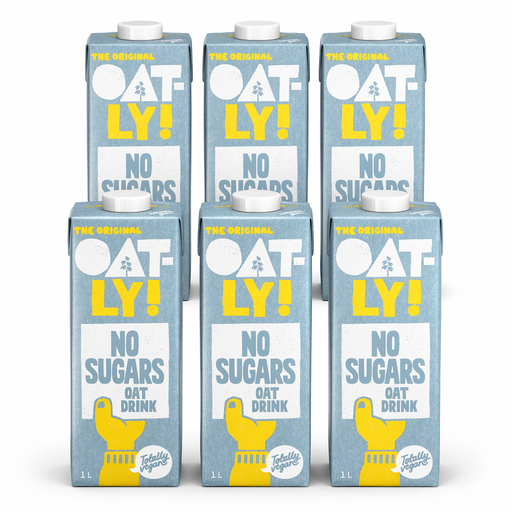 No image available
This multipack may suit cupboard storage before opening. Tesco’s listing for Oatly No Sugars gives 1.5 g fat and 0 g sugars per 100 ml; it specifies refrigeration after opening and use within approximately five days.
 No image available
This 8 × 1 L long-life pack is an everyday oat-drink option when unopened storage matters. Check the current carton’s total fat and sugars per 100 ml separately, along with its instructions after opening.
 No image available
This long-life 8 × 1 L option is aimed at coffee use. If low fat is also important, compare the current carton’s total fat per 100 ml rather than assuming that its barista description settles the question; plan fridge space for opened cartons.
Compare total fat per 100 ml for liquid drinks. The annex published by legislation.gov.uk specifies no more than 1.5 g per 100 ml for a 'low fat' claim on liquids; sugars and saturated fat are separate figures.
Choose by the space you have before and after opening. Tesco says its Long Life Oat Original can be stored cool and dry before opening, whereas its chilled Oat Drink needs refrigeration; both require refrigeration after opening and specify use within five days.
Check the carton for added nutrients as well as fat. NHS guidance on vegan diets discusses fortified dairy alternatives and identifies calcium, iodine, vitamin D and vitamin B12 as nutrients to consider; one carton’s nutrient list is not a measure of an entire diet.
No. It describes a coffee-oriented product, not a fat level. Marks & Spencer lists 3.3 g fat per 100 g for M&S Barista, while Minor Figures lists 4.3 g per 200 ml for Barista Oat; check each carton’s own nutrition panel.
No. If you require gluten-free food, choose a product explicitly labelled gluten-free and read its current allergen statement. The Food Standards Agency says gluten-free labelling has a limit of 20 mg/kg gluten and that oats must still be emphasised as an allergen.