Who is choosing an oat drink?
The choice changes depending on whether the drink is for a toddler’s regular breakfast, a household stock-up or a child with an identified food allergy.
Parents replacing dairy milk for a toddler
Compare fortification, protein and energy with the rest of the child’s breakfast and diet. The UK Office for Health Improvement and Disparities notes that plant-based drinks vary considerably in nutrient content.
Families stocking up for breakfast
Check the exact carton as well as the case size. Minor Figures lists Everyday Oat in a 6 × 1L pack, but a stock-up format alone says nothing about its suitability for an individual child.
Parents checking food allergens
Read the current ingredient and allergen statement for the child’s identified allergens. The Food Standards Agency says oats remain an allergen even when they are described as gluten-free.
What should you check before buying?
Start with the child’s age and the exact carton label, then decide whether the pack format works for your household.
| Priority |
What to check |
Your needs |
| Age and use |
Read the current pack’s age statement. Do not use oat drink in place of breast milk or first infant formula before 12 months; the NHS identifies first infant formula as the suitable alternative to breast milk during the first year. |
I’m choosing a breakfast drink for a child aged 1 or over, and I need the pack guidance to fit their age. |
| Nutrition label |
Compare declared calcium, iodine and vitamins D, B2 and B12, then protein, energy, sugars and salt for the same stated quantity. The UK Office for Health Improvement and Disparities notes considerable variation between plant-based drinks. |
If dairy milk is absent from breakfast, I want to consider what the drink contributes alongside the other foods my child eats. |
| Pack practicality |
Confirm the carton count and volume on the exact listing. Check unopened storage instructions and how the cartons will be used after opening. |
Several cartons would be useful for cereal or porridge, but I need to know what I’m buying and where I’ll keep them. |
| Allergens |
Read the full ingredient and allergen statement for milk, oats and any other allergens relevant to the child. The Food Standards Agency says a gluten-free description does not remove the need to identify oats. |
I cannot assume that an oat drink suits my child’s allergies from its dairy-free wording alone. |
Brand and product-line references
These examples show why the exact product line matters: drinks under different names and brands need not have the same ingredients, fortification or pack format.
Alpro
Alpro lists Oat Growing Up Drink as a 1L product with oat, pea protein, calcium, iron, iodine and vitamins among its ingredients.
- Its Growing Up line gives parents a toddler-targeted carton to assess.
- Alpro’s online age wording differs across the product page; check the current carton. The 1L listing does not establish a multipack.
Minor Figures
Minor Figures lists Everyday Oat as a general-use drink in a 6 × 1L pack, with calcium, vitamin D, riboflavin, vitamin B12 and iodine in its ingredient information.
- The stated 6 × 1L format gives a clear stock-up quantity.
- Everyday Oat is not presented as a toddler-specific drink; consider the current label and the rest of the child’s diet.
Oatly
Oatly lists calcium carbonate, potassium iodide and vitamins D2, B2 and B12 among the ingredients of Oat Drink Whole 1L.
- The named Whole product provides a specific ingredient list to compare with other cartons.
- Oatly’s product information establishes individual carton sizes, not the configuration of every retailer multipack.
M&S
M&S lists water, oats and sea salt for its Only 3 Ingredients Oat Drink.
- The short ingredient list makes this a useful example of why ingredients and fortification are separate checks.
- M&S states that this product is not fortified and is not recommended as a dairy replacement for children under 36 months.
Tesco
Tesco’s oat-drink category has listed its own oat drink alongside products from Alpro, Oatly and Minor Figures.
- A retailer range can provide different carton names and formats to compare.
- Read each product’s current label rather than applying one brand’s ingredients or nutrients to another.
Joybuy oat-drink options
These options include a Growing Up drink and two general oat drinks offered in 8 × 1L packs. For a toddler’s breakfast, compare the current cartons’ age guidance and nutrition information rather than treating the pack formats as interchangeable.
 No image available
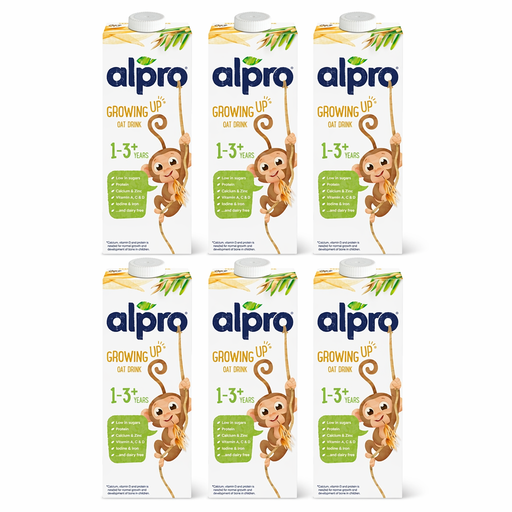
Alpro Oat Growing Up Drink
This Growing Up option is relevant when you want to check a toddler-targeted carton. Confirm its current age statement and carton count before choosing it as a family pack; the leading “6” in the listing name does not settle the pack configuration.
View on Joybuy
 No image available
Alpro Oat No Sugars Long Life Drink 8 × 1L
The stated 8 × 1L long-life format is a stock-up option. This is a general oat drink rather than a toddler-targeted one; check the current carton’s age guidance, fortification and sugars declaration before relying on it for the child’s breakfast.
View on Joybuy
 No image available
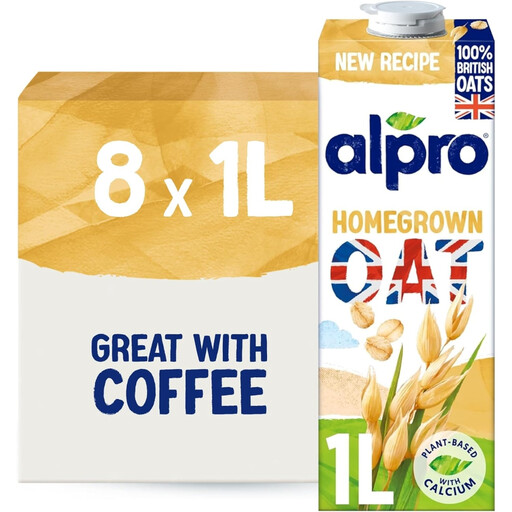
Alpro Oat Original Long Life Drink 8 × 1L
This general oat drink is listed in an 8 × 1L long-life pack. If iodine is an important part of your comparison, check its declaration on the current carton; also assess the drink’s other stated nutrients alongside the child’s wider diet.
View on Joybuy
Frequently asked questions
Can a toddler have an oat drink at breakfast?
For a child aged 1 or over, NHS guidance allows unsweetened, calcium-fortified alternatives such as oat drinks as part of a balanced diet. An oat drink must not replace breast milk or first infant formula for a child under 12 months.
What should I compare on the carton?
Check the stated calcium and iodine, vitamins D, B2 and B12, protein, energy, sugars and salt using the same quantity when comparing drinks. The UK Office for Health Improvement and Disparities notes that nutrient content varies considerably between plant-based drinks, so check the exact product rather than its category name.
Can a three-ingredient oat drink replace dairy milk for a toddler?
Do not assume it can. M&S says its Only 3 Ingredients Oat Drink is not fortified and is not recommended as a dairy replacement for children under 36 months; the ingredient count does not establish nutritional equivalence.
Does dairy-free mean an oat drink is suitable for every food allergy?
No. The Food Standards Agency identifies oats as an allergen even when they are labelled gluten-free. For a child with an identified food allergy, follow NHS advice to read the full label and avoid a product if its status for that allergen is unclear.
What if cow’s-milk allergy is suspected?
Seek advice from a GP or other appropriate health professional rather than using an oat drink to diagnose or manage a suspected allergy yourself. NHS Healthier Together distinguishes cow’s-milk allergy from lactose intolerance, and the right feeding option depends on the child’s age and circumstances.


