Teams buying for everyday service
For catering staff choosing cartons for tea, coffee, cereal, porridge and cooking. Compare the intended uses, pack size and current label before making one product the routine kitchen option.


For routine drinks, cereal and cooking, consider a fortified everyday oat drink only after checking its label against each resident’s care record; a no-sugars or barista version serves a different menu purpose, not every resident’s nutrition needs. Before ordering, clarify whether ‘6 pint’ means one container, six pints in total or a multipack: six 1L cartons are not a single six-pint bottle.
A care-home oat drink has to work in the kitchen and fit the requirements recorded for the people it is served to.
For catering staff choosing cartons for tea, coffee, cereal, porridge and cooking. Compare the intended uses, pack size and current label before making one product the routine kitchen option.
For teams offering an alternative while checking each resident’s documented dietary and allergen requirements. GOV.UK’s guidance for institutional caterers says dietary needs in a care record must reach the people serving the food.
For kitchens considering a barista or whole-oat variant for coffee or particular recipes. Its service role does not establish that it suits every resident; check the exact product against care records.
Settle the quantity and resident requirements before comparing cartons. Then choose a product for the drinks and dishes the kitchen will actually prepare.
Consider it: For routine drinks, cereal and cooking when the exact label and each resident’s care record permit it.
Bear in mind: Added nutrients do not make an oat drink a complete nutritional substitute for dairy milk; the British Dietetic Association notes that most plant-based dairy alternatives contain less protein than animal milk.
Consider it: When the menu or an individual plan calls for that specific label characteristic.
Bear in mind: A no-sugars label says nothing on its own about protein, allergens or suitability for a particular resident.
Consider it: For coffee service or recipes where the particular product’s texture is useful.
Bear in mind: Check the variant, not just the category: Marks & Spencer labels its Plant Kitchen Whole Oat Drink unsuitable for people with coeliac disease, milk allergy or wheat allergy.
| Priority | What to check | Your needs |
|---|---|---|
| Order quantity | Confirm whether ‘6 pint’ means one container, six pints in total or a recurring quantity. Read multipack counts and individual carton sizes separately. | I need the delivered format to match the kitchen’s storage space and expected use, rather than assuming six cartons equal one six-pint bottle. |
| Resident nutrition | Compare the exact product’s energy, protein and added nutrients with the resident’s assessed requirements. The Care Quality Commission’s guidance for care providers in England calls for nutritional needs to be assessed and met. | Where someone has an individual nutrition plan, I need a choice that follows that plan, not a general oat-drink substitution. |
| Allergens | Check the current pack’s ingredients, allergen statement and suitability wording against the care record. Recheck any substitute before service. | I cannot use ‘vegan’ or ‘dairy-free’ as a shortcut for a resident with a documented milk allergy, wheat allergy or coeliac requirement. |
| Menu use | Match an everyday, no-sugars or barista variant to the intended drinks and dishes. For a no-sugars choice, check the current nutrition panel rather than relying only on the product name. | Foamed coffee and routine cereal service may call for different products; I want the choice to reflect what the kitchen is making. |
| Storage | Read the exact carton’s unopened storage instructions, date and directions after opening. Plan fridge space and stock rotation around those instructions. | With several cartons in use, I need staff to know which must be refrigerated and when each opened carton should be used. |
Product-specific warnings still matter. Marks & Spencer states that its Plant Kitchen Whole Oat Drink is unsuitable for people with coeliac disease, milk allergy or wheat allergy.
Check the current pack against each resident’s care record and update the kitchen’s allergen information when a product or recipe changes.
Added calcium or other nutrients do not establish that a drink meets someone’s energy or protein needs. The British Dietetic Association notes that most plant-based dairy alternatives contain less protein than animal milk.
Use the resident’s assessed nutrition plan when deciding whether and how an oat drink can be served.
A 6 x 1L multipack describes six separate one-litre cartons, not one six-pint container. Confusing the formats can disrupt storage and stock rotation.
Confirm the required container size, total quantity and ordering frequency before selecting a pack.
An earlier ingredient list may no longer describe the carton being served. The Food Standards Agency says allergen information given by food businesses must be accurate and up to date.
Check the physical pack when stock arrives and update kitchen records after a product, recipe or supplier change.
These examples illustrate differences between particular oat drinks; a brand name alone does not establish the formulation or suitability of another variant.
Alpro UK lists Oat Original and Oat No Sugars as distinct 1L drinks.
Oatly describes its original oat drink for drinking and food preparation.
Minor Figures Barista Oat is a coffee-focused product; the brand lists a 6 x 1L pack.
Plant Kitchen Whole Oat and Barista Oat are separate 1L options for food and hot drinks.
Tesco Groceries’ oat-drink category lists 1L own-label and branded options, providing examples of standard carton sizes.
These packs offer everyday and barista-style oat drinks in six- or eight-carton formats for care-home catering. Check the requested quantity and each resident’s requirements before choosing between them.
 No image available
A barista variant to consider for coffee service when six separate 1L cartons are the intended supply. Check the current pack against residents’ allergen records; this multipack is not one six-pint container.
 No image available
An everyday oat-drink option to consider for routine drinks or cereal, subject to the current label and each resident’s care record. The eight 1L cartons do not match an order for one six-pint container.
 No image available
Consider this named variant when a no-sugars product is relevant to the menu or an individual plan. Confirm the sugars declaration on the current physical pack before relying on the name, and check whether eight 1L cartons match the order.
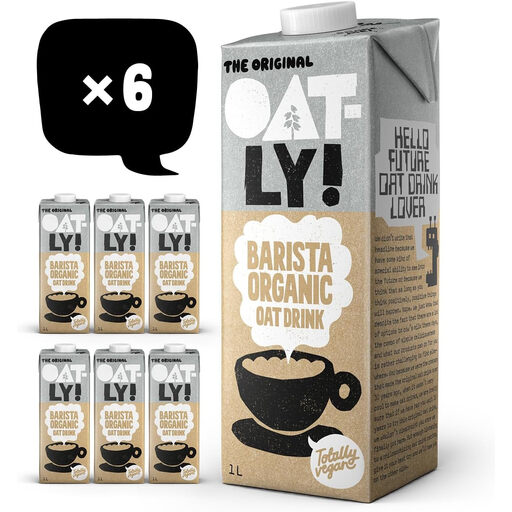 No image available
A coffee-oriented option where a six-carton order is intended. Check its current nutrient and allergen information against the menu and care records; six 1L cartons are not a single six-pint bottle.
 No image available
A barista-labelled option for coffee service in eight 1L cartons. Check the exact pack’s nutrients and allergens before using it for residents, and confirm that an eight-carton order matches the required quantity.
No blanket substitution follows from an oat drink’s name or fortification. The Care Quality Commission’s guidance for care providers in England calls for residents’ nutritional and hydration needs to be assessed and met; the British Dietetic Association notes that most plant-based dairy alternatives contain less protein than animal milk. Follow each resident’s assessed plan.
Check the exact carton’s ingredients, allergen and suitability statements, nutrition panel, date and storage instructions. Match relevant information to the resident’s care record and keep kitchen allergen records current when a product changes.
Not necessarily. Marks & Spencer states that its Plant Kitchen Whole Oat Drink is unsuitable for people with milk allergy or coeliac disease, as well as wheat allergy. Check the warning on the exact product against the resident’s documented requirements rather than relying on ‘vegan’ wording.
Not if the request means one six-pint container: a 6 x 1L pack contains six separate cartons. Ask whether the requirement is for a container size, a total volume or a recurring order before choosing a multipack.
Follow the instructions on the exact pack. For example, Marks & Spencer specifies refrigeration at 0°C to +5°C and use within five days after opening for its Plant Kitchen Barista Oat Drink; do not apply that product’s timing to a different variant.