Who is the oat drink for?
The age of the person drinking it changes the decision: a carton for an adult’s tea is not an infant feed.
Parents feeding a baby under 1 at night
North East London NHS Foundation Trust advises that plant-based drinks should not replace breast milk or formula as a baby’s main milk drink before age 1. If cow’s-milk allergy is suspected, NHS guidance says a baby who is not breastfed may need special formula; ask a health professional about the appropriate feed rather than substituting ordinary oat drink.
Families choosing a drink for a child aged 1–3
If oat drink will be a regular main drink, check the individual product’s age wording and declared nutrients before deciding how many cartons to buy. A label saying a drink can be consumed from age 1 does not necessarily say it is suitable as the child’s main milk drink.
Households buying oat drink for an adult carer
Long-life cartons can supply oat drink for tea, coffee, cereal or cooking during night-feeding routines. Choose a formulation for that use, then consider whether the household can use each carton within its labelled period after opening.
Relevant oat-drink brands
These product-line examples show why a familiar brand name cannot replace checking the particular carton’s intended use and label.
Alpro
Alpro sells general oat drinks and an Oat Growing Up drink labelled for ages 1–3+ years.
- Tesco lists calcium, iodine, iron and zinc for the Growing Up product.
- Alpro Oat No Sugars is a different product; its nutrient declarations do not make it an infant feed or equivalent to the age-labelled drink.
Oatly
Oatly’s Whole and Barista oat drinks offer distinct formulations for household drinks, including hot drinks.
- Sainsbury’s product information for Oatly Whole declares calcium, iodine and vitamins B2 and D2.
- A whole or barista label does not establish suitability as a baby’s main milk feed.
Tesco
Tesco lists a 1L long-life oat drink for general household use.
- Tesco’s Long Life Oat Original listing declares added calcium, potassium iodide and vitamins B12, B2 and D2.
- Its general-use description is not an age-specific main-drink recommendation for a young child.
Sainsbury's
Sainsbury’s long-life oat drink has explicit wording that distinguishes use from age 1 from use as a main milk drink.
- Its label says the drink can be part of a diet from age 1.
- The same label says it is not suitable as a main milk-drink alternative for children under 3; check its current allergen wording too.
M&S
M&S has both a three-ingredient oat drink and a separately fortified Plant Kitchen Whole Oat Drink.
- Marks & Spencer declares added calcium, iodine and vitamins D and B12 for Plant Kitchen Whole.
- Do not assume the Only 3 Ingredients drink has the same fortification.
Minor Figures
Minor Figures lists an Everyday Oat drink and a Barista Oat drink positioned for coffee.
- The Everyday Oat product information declares calcium, iodine and vitamins D, B2 and B12.
- Coffee-focused positioning for Barista Oat does not establish its suitability as an infant’s or toddler’s main milk drink.
Joybuy oat-drink options
These options include long-life oat drinks for adult household use and an Alpro Growing Up drink for the older-child question. Check the exact pack and label before buying for a child; none is a replacement for a baby’s main milk feed.
 No image available
Alpro Oat No Sugars Long Life Drink, 8 x 1L
An 8 x 1L long-life case for an adult household that wants a no-sugars oat drink. Alpro describes this formulation as having no sugars or sweeteners; Tesco’s listing for the 1L drink declares added calcium, iodine and vitamins. It is not a baby’s main milk feed. Follow the carton’s instructions after opening.
View on Joybuy
 No image available
Alpro Oat Original Long Life Drink, 8 x 1L
An 8 x 1L long-life oat-drink case for general household use during night-feeding routines. If considering it as a child’s regular main drink, check the current pack’s age wording and nutrient declaration first. It must not replace a baby’s main milk feed.
View on Joybuy
 No image available
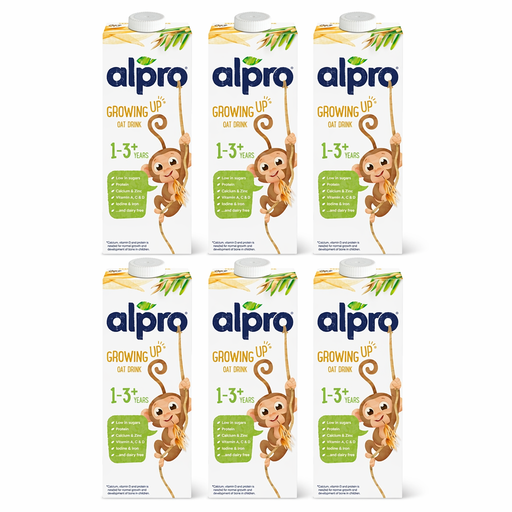
Alpro Oat Growing Up Drink
The Growing Up formulation is relevant when considering an oat drink for a child aged 1–3; Tesco lists the 1–3+ years product with calcium, iodine, iron and zinc. Confirm this listing’s carton count and the current pack’s age, nutrient and opened-storage instructions before ordering. It is not a substitute for breast milk or suitable infant formula for a baby under 1.
View on Joybuy
 No image available
Alpro Barista Oat Long Life Drink, 8 x 1L
An 8 x 1L long-life barista oat-drink case to consider for an adult carer’s coffee. Barista positioning describes its intended drink use, not suitability for a child’s main milk feed. Check the current carton for nutrients and opened-storage instructions if those affect your choice.
View on Joybuy
 No image available
Oatly Long Life Barista Oat Drink
A long-life barista oat drink to consider for an adult’s coffee during night-feeding routines. Confirm the carton count before buying, as the pack descriptions differ, and follow the current carton’s storage instructions. Do not treat a barista drink as a baby’s main milk feed.
View on Joybuy
Questions about night feeds and oat drink
Can ordinary oat drink be a baby’s night feed?
Not as the main milk feed for a baby under 1. North East London NHS Foundation Trust advises against replacing breast milk or formula with a plant-based drink before that age. Use breast milk or suitable infant formula, and seek professional advice if cow’s-milk allergy is suspected; NHS guidance says a baby with that allergy who is not breastfed may need special formula.
Can a child over 1 have oat drink at night?
An oat drink can be considered after age 1, but whether it suits a child’s regular main drink depends on the individual product and the child’s diet. Check the pack’s age and main-drink wording and its declared fortification; NHS dietetic guidance highlights calcium and iodine when choosing fortified plant-based alternatives.
What matters on the label if oat drink regularly replaces dairy?
Check for declared calcium, iodine and relevant vitamins, along with age wording and allergen information where applicable. Formulations differ: Marks & Spencer’s three-ingredient oat drink and its separately fortified Plant Kitchen Whole Oat Drink illustrate why a product name alone does not establish its nutrient profile.
Can an opened long-life carton stay in the cupboard?
No: long-life packaging does not remove the need to follow the carton’s instructions after opening. Refrigerate it and use it within the period stated on its own label. The Food Standards Agency gives a three-day refrigerated instruction as an example of product storage wording, not a universal period for every oat drink.
Is lactose-free dairy milk suitable for a cow’s-milk-protein allergy?
No. Milton Keynes University Hospital NHS Foundation Trust explains that lactose-free dairy products can still contain cow’s-milk protein. If allergy is suspected or diagnosed, seek professional advice about feeding and check the exact product label rather than relying on “lactose-free” wording.


