Teams serving residents with food allergies
Menu planners and kitchen staff need to check milk, wheat and oat requirements separately. A plant-based drink is not automatically suitable for every allergy.


Choose an oat drink against each resident’s documented dietary needs, not a general dairy-free or gluten-free claim: oats remain an allergen even when a drink is labelled gluten-free. If the drink regularly replaces dairy, consider an unsweetened calcium-fortified option that fits the resident’s nutrition plan. Check the exact supplied pack and the kitchen’s allergen controls before service.
The relevant free-from claim depends on the individual resident’s allergy or dietary plan, as well as how the kitchen will use the drink.
Menu planners and kitchen staff need to check milk, wheat and oat requirements separately. A plant-based drink is not automatically suitable for every allergy.
For cereal, drinks or cooking, compare the product’s nutrition label with the resident’s plan, alongside its ingredients and storage instructions.
Coeliac UK advises choosing oat products labelled gluten-free where oats are appropriate for the individual. That check is separate from an oat-allergy check.
Start with the resident’s documented restrictions, then check nutrition and storage for the way the drink will be served.
| Priority | What to check | Your needs |
|---|---|---|
| Individual allergens | Read the delivered pack’s ingredients, allergen declaration and precautionary wording. Check the kitchen’s controls against cross-contact. | I need a drink that fits this resident’s recorded allergies, not merely one described as dairy-free. The Food Standards Agency advises controlling allergen-containing ingredients and protecting other foods from cross-contact. |
| Gluten-free requirement | Look for an explicit gluten-free claim on the exact oat drink. Confirm that oats are permitted in the resident’s individual plan. | For a resident with coeliac disease, I need to distinguish gluten-free oats from ordinary oats. Coeliac UK notes that most people with coeliac disease can eat gluten-free oats, but individual sensitivity matters; gluten-free does not mean oat-free. |
| Regular dairy replacement | Compare the calcium declaration and other relevant nutrients on the label. Review sugar, fat and energy on a consistent per-100 ml basis where the nutrition plan calls for it. | If oat drink regularly replaces dairy at meals, I want its nutritional role considered. NHS guidance includes unsweetened calcium-fortified plant alternatives in the dairy-and-alternatives food group; not every oat drink is fortified. |
| Storage and service | Check whether unopened packs need chilling, then follow the exact temperature and post-opening instructions. Keep current allergen information available to serving staff. | Our kitchen needs a product it can store and serve according to its own pack instructions, whether it is bought for everyday drinks or coffee service. |
Marks & Spencer marks some of its plant-based oat drinks as unsuitable for people with milk allergy. The warning applies to those products, not every oat drink.
Check the delivered pack’s allergen and precautionary statements against the resident’s documented plan before serving it.
The Food Standards Agency identifies oats as an allergen in their own right. A gluten-free oat drink still contains oats.
Check oat allergy separately from coeliac disease and wheat allergy; do not use one free-from claim in place of another.
Oatly Organic and M&S Only 3 Ingredients Oat Drink are unfortified examples. Choosing by ingredients alone may overlook the role dairy played in a resident’s menu.
Where oat drink is a regular replacement, compare its nutrition label with the resident’s plan and the rest of the menu.
Storage instructions differ by product: Oatly says its Organic Oat Drink can be kept at room temperature unopened, while M&S says its Only 3 Ingredients Oat Drink must be refrigerated.
Follow the supplied pack’s temperature and post-opening instructions, and mark when a pack is opened.
These named products illustrate why ingredients, fortification and allergen warnings must be checked by variant rather than by brand alone.
Oatly Organic Oat Drink is an ambient-stored, minimal-ingredient variant; its details should not be assumed to apply to Oatly’s barista drinks.
Alpro lists Original, No Sugar and Barista oat-drink variants for different serving uses.
Minor Figures distinguishes Everyday Oat from its coffee-oriented Barista Oat.
M&S lists both minimal-ingredient and fortified Plant Kitchen oat drinks, with product-specific suitability statements.
Tesco’s oat-drink category includes own-label and other named brands.
These packs include oat drinks for regular serving and barista-style use. Assess each supplied pack against the resident’s allergen and nutrition plan; a coffee-use or dairy-free description does not settle gluten-free or milk-allergy suitability.
 No image available
For regular cereal or hot-drink service, compare the supplied pack’s fortification and allergen declaration with each resident’s plan. The product information identifies oats as a cereal containing gluten, so do not select it for a gluten-free requirement; follow the pack’s instructions after opening.
 No image available
A barista-style option for coffee service. Its product information identifies oats as a cereal containing gluten, so it is not a choice for a gluten-free requirement. Check milk-related allergen wording on the supplied pack before serving a resident with milk allergy.
 No image available
For coffee service, check the supplied pack’s allergen declaration before use: it contains oats, and a resident needing a gluten-free diet requires an explicit gluten-free claim on that pack. Review fortification if it will also replace dairy regularly.
 No image available
For a menu with a specific sugar requirement, check the supplied pack’s nutrition panel and wording rather than relying on the variant name alone. The product information identifies oats as a cereal containing gluten; also check milk-related allergen wording against the resident’s plan.
 No image available
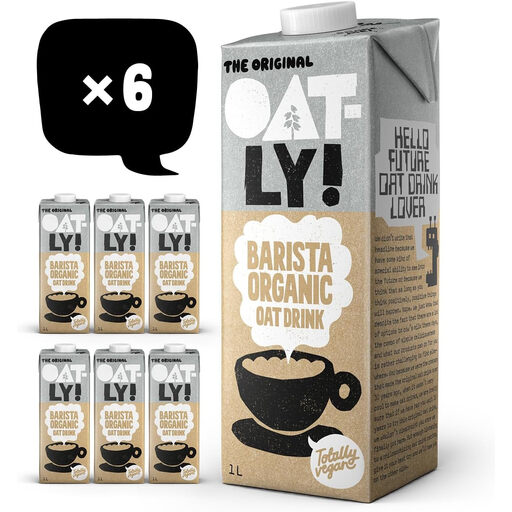
For coffee service where organic ingredients are part of the purchasing brief, check the supplied pack’s full allergen declaration and storage instructions. It contains oats; confirm an explicit gluten-free claim if the resident’s plan requires one, and compare fortification before using it as a regular dairy replacement.
Not automatically. M&S marks some of its vegan oat drinks as unsuitable for people with milk allergy, so check the exact supplied product’s allergen and precautionary statements against the resident’s plan.
No. Choose an oat drink explicitly labelled gluten-free only where oats fit the resident’s individual plan. Coeliac UK says most people with coeliac disease can eat gluten-free oats, but some remain sensitive, and ordinary oats can be contaminated by other cereals.
No. The Food Standards Agency identifies oats as an allergen in their own right. A gluten-free claim addresses gluten, not the presence of oats.
Consider an unsweetened calcium-fortified option if it fits the resident’s nutrition plan. NHS guidance includes unsweetened calcium-fortified plant alternatives in the dairy-and-alternatives food group, while some oat drinks are unfortified; compare the actual label and the rest of the menu.
Follow that pack’s storage and post-opening instructions, keep its current allergen information available to staff, and prevent cross-contact during preparation and service. The Food Standards Agency advises careful control of allergen-containing ingredients and protection of other foods.