Caregivers planning a baby’s night feed
If the drink would replace a milk feed for a baby under 12 months, standard oat drink is not the alternative to choose. The NHS advises continuing breast milk or first infant formula until at least age 1.


If the night feed is for a baby under 12 months, do not buy a standard oat drink multipack to replace breast milk or first infant formula: the NHS says to continue one of those feeds until at least age 1. For an older child or adult, check the exact carton’s age wording, ingredients and storage instructions before choosing between portable cartons and 1L household multipacks.
The intended drinker changes the decision more than the number of cartons in a pack.
If the drink would replace a milk feed for a baby under 12 months, standard oat drink is not the alternative to choose. The NHS advises continuing breast milk or first infant formula until at least age 1.
Check the exact product’s age statement and intended role before buying several cartons. For example, Sainsbury’s says its 1+ Years Oat Drink is not suitable as a main milk-drink alternative for children under 2.
A small carton may be easier to carry for a shift or lunchbox, while a 1L multipack is a different choice for shared household use. Check storage directions for both unopened and opened cartons.
Start with the drinker’s age and the role of the drink; then compare the carton label and pack format.
| Priority | What to check | Your needs |
|---|---|---|
| Age and use | Check whether the drink would replace an infant milk feed. For an older child, read the exact carton’s age wording and whether it is intended as a main milk drink. | If I’m preparing a feed for a baby under 12 months, I need breast milk or first infant formula, not standard oat drink, in line with NHS guidance. |
| Ingredients and fortification | Compare the ingredient list and the stated calcium, iodine and vitamin content. Check whether the carton is unsweetened or says no added sugars rather than assuming the formulations match. | For a child aged 1+ or a regularly used household drink, I want to compare the labels of the actual products I’m considering. |
| Carton size and storage | Compare portable carton size with the number and size of cartons in a household pack. Read the unopened and after-opening storage instructions. | A lunchbox needs a carton I can carry; for shared use at home, I may prefer a case of 1L cartons. |
| Allergens | Read the current oat and other allergen statements, including any relevant cross-contact warning. If gluten matters, look for a specific gluten-free claim on the product. | I cannot assume an oat drink suits coeliac disease or an allergy merely because it is sold as an alternative to dairy milk. |
For a baby under 12 months, a standard oat drink does not replace breast milk or first infant formula as a main feed. Buying more cartons does not change that distinction.
Confirm the baby’s age before choosing a drink. Follow NHS infant-feeding guidance and seek clinical advice before changing feeds because of a suspected or diagnosed allergy.
An age statement can permit one use while restricting another: Sainsbury’s says its 1+ Years Oat Drink is not suitable as a main milk-drink alternative for children under 2.
Read the wording on the exact carton, particularly if it would become a young child’s regular milk drink.
A case of 1L cartons serves a different purpose from a small lunchbox carton. An opened carton also needs to be handled according to its label.
Choose the carton size for the place it will be used, and check the after-opening storage instructions before buying a multipack.
The Food Standards Agency identifies oats as an allergen even in foods labelled gluten-free. Individual drinks can carry further suitability warnings; M&S says its Barista Oat Drink is not suitable for coeliacs or people with a milk allergy.
Check the current label for the specific product and allergen that matters, rather than relying on the drink’s category name.
These examples show why pack size and label wording matter; a brand name alone does not establish suitability for a child’s feed.
Oatly describes its 250ml Oat Drink as lunchbox-friendly. A separate Oatly Whole 6 x 1L format is listed on Joybuy for household purchasing.
Alpro offers Oat Original as a 1L drink, while Joybuy lists an Oat Original Long Life 8 x 1L pack.
Sainsbury’s has a 1+ Years Oat Drink as well as a standard 1L oat drink; their labels need to be considered individually.
Tesco lists a Long Life Oat Original 1L drink among its oat-drink options.
Minor Figures describes itself as a coffee company and lists Barista Oat and Everyday Oat drinks.
M&S positions its Barista Oat Drink for coffee.
These 6 x 1L and 8 x 1L oat drink packs are household-size options, including coffee-oriented variants. They are not portable single-serving cartons or replacements for a baby’s milk feed.
 No image available
Eight 1L long-life cartons for household use. If sugar content matters, check the current carton’s nutrition panel; also check its age and allergen wording before choosing it for a child.
 No image available
Eight 1L long-life cartons for shared household use, rather than individual lunchbox portions. Compare the current carton’s fortification, allergen information and age wording if buying for a child.
 No image available
Six 1L long-life cartons in a barista variant for household coffee use. This is not an infant-feed substitute; check the carton’s allergen and age information for other uses.
 No image available
Eight 1L long-life cartons in a coffee-oriented variant. If fortification or use by a child matters, compare the current carton’s nutrition information and age statement rather than relying on its barista name.
 No image available
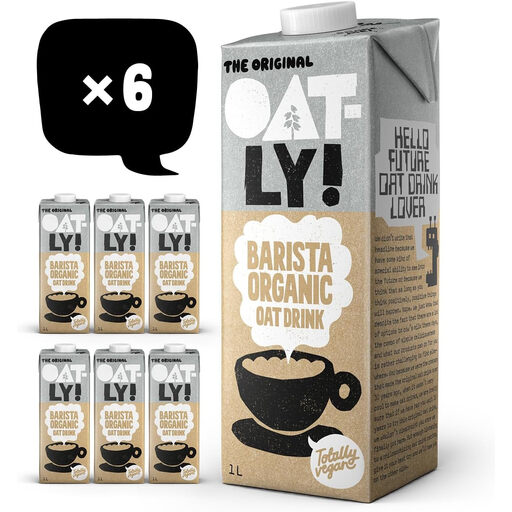
Six 1L cartons in an organic barista variant for household use. If choosing a regular drink for a child, check the exact carton’s age wording, fortification and allergens; do not use it to replace an infant milk feed.
Not if it would replace breast milk or first infant formula for a baby under 12 months. The NHS advises continuing breast milk or first infant formula until at least age 1; ask a clinician about feeding changes needed for an allergy.
Not necessarily. Sainsbury’s says its 1+ Years Oat Drink is not suitable as a main milk-drink alternative for children under 2, so read the exact product’s age and use statement before buying a multipack.
Compare the age statement, ingredients, allergens and stated calcium, iodine and vitamin content on the exact cartons. Seek appropriate professional advice if an allergy or restricted diet affects the choice.
No. Check for a specific gluten-free claim and read the full allergen statement. The Food Standards Agency identifies oats as an allergen, and M&S states that its Barista Oat Drink is not suitable for coeliacs.
Choose a small carton when an age-appropriate child or adult needs a portable portion; choose a 1L multipack when the drink will be shared at home. In either case, follow the individual carton’s storage instructions after opening.