For cereal and porridge, start with a standard oat drink whose ingredients and fortification suit your needs; choose a no-sugars variant if its nutrition panel matches your preference, or a barista variant if foamed coffee is a regular breakfast drink. If “large block” means buying several cartons, check the pack quantity, unopened storage instructions and how quickly you can use each carton after opening. The Tesco and Sainsbury’s long-life examples give different after-opening periods, so the pack you buy takes precedence.
Who is buying oat drink for breakfast?
Households using it most mornings
If oat drink goes on cereal or into porridge and smoothies, choose a formulation you will use across those breakfasts. A multi-carton pack is worth considering when you can store the unopened cartons as directed and finish each opened carton in time.
Breakfast coffee drinkers
If you regularly make lattes or cappuccinos, a barista variant may match that use: Minor Figures and M&S describe their cited barista drinks as coffee-oriented. Check the nutrition panel separately if the same carton will also go on cereal.
Shoppers comparing dairy alternatives
If oat drink regularly takes the place of dairy in your breakfast, compare fortification, protein and allergen statements on the exact variant. NHS North West guidance on plant-based alternatives for children aged 1+ identifies calcium, iodine, vitamin D and B12 as label details to check; that child-specific guidance does not establish nutritional equivalence for adults.
What should you check before choosing?
Choose the formulation for your usual breakfast first, then decide whether a single carton or a multi-carton pack fits your storage and rate of use.
| Priority | What to check | Your needs |
|---|
| Fortification | Read the exact carton for added calcium, iodine, vitamin D and B12. Check the nutrition information rather than assuming every variant is fortified. | I use oat drink regularly at breakfast and want to know which added nutrients this carton lists. M&S describes its Only 3 Ingredients drink as unfortified, while Tesco and Sainsbury’s list fortified long-life options. |
| Protein and nutrition | Compare protein on the same per-100ml basis where shown; check energy and fat on comparable label bases too. A product name does not establish nutritional equivalence. | If the drink frequently replaces dairy in my breakfast, I want to compare the actual nutrition panels rather than treat all oat drinks alike. |
| Sugars | Check sugars per 100ml and distinguish “no added sugars” from “no sugars”. Alpro UK lists 0.0g sugars per 100ml for its Oat No Sugars drink. | A no-sugars formulation matters to me, so I will check the named variant instead of assuming an Original carton has the same figures. |
| Breakfast use | Decide whether the carton is mainly for cereal and porridge or for foamed coffee. Treat foam descriptions as manufacturers’ product claims. | My usual breakfast is cereal, so coffee-specific features may be less relevant; if I make cappuccinos regularly, I will compare barista variants. |
| Allergens | Read the oat and gluten information, other allergen declarations and precautionary statements on the pack. Do not infer gluten-free suitability from “dairy-free”. | I need the exact carton to meet my household’s allergen requirements, not just to be labelled plant-based. |
| Pack and storage | Confirm the number and size of cartons, unopened storage conditions and the after-opening instructions. Tesco’s cited long-life drink says five days after opening; Sainsbury’s cited long-life drink says three days. | Several cartons could suit our weekday routine, but I need room to store them and a realistic plan to finish each opened carton as its label directs. |
What can make a carton the wrong fit?
-
Assuming all oat drinks have the same nutrition
Fortification and nutrition figures belong to specific formulations; a simple-ingredient drink need not match a fortified standard or barista variant.
Compare the ingredients and nutrition panel of the carton you intend to use, especially when it is a regular breakfast drink.
-
Buying several cartons without planning for opening them
A multi-carton pack gives you more unopened stock, but opening one carton still starts that product’s stated storage period.
Check the pack instructions against how much your household uses during the week.
An opened carton that cannot be used within its stated period may go to waste.
-
Reading “dairy-free” as an all-clear for allergens
Oats remain an allergen, including in gluten-free foods, according to the Food Standards Agency. Product-specific warnings can also cover other allergens or manufacturing methods.
Read the actual pack’s allergen and precautionary statements; where gluten-free suitability is required, look for an appropriate gluten-free label rather than relying on “plant-based”.
-
Choosing a barista carton for every breakfast use
A coffee-focused description tells you what the manufacturer intends the drink for, not whether its nutrition panel matches a standard carton.
If you mainly make cereal or porridge, compare a standard drink alongside barista options before choosing a multi-carton pack.
Which brands offer relevant options?
These examples describe particular drinks and ranges, not every carton carrying the brand name.
Oatly
Oatly describes its cited Chilled Oat Drink Semi as a multi-use drink for cooking, baking and hot drinks.
- The Semi product lists added calcium, iodine and vitamins D2, B2 and B12.
- That chilled product must not be stored at room temperature; check storage on other Oatly variants separately.
Alpro
Alpro has Original and No Sugars oat-drink variants relevant to everyday breakfasts.
- Alpro UK lists 0.0g sugars per 100ml for Oat No Sugars.
- The No Sugars figure does not describe Original or every other Alpro oat drink.
Minor Figures
Minor Figures lists Everyday Oat for uses including cereal and tea, and Barista Oat for coffee.
- The brand lists both cited products in 6 x 1L packs.
- Check the exact variant’s nutrition and storage instructions before treating the two formulations as interchangeable.
Tesco
Tesco lists a fortified Long Life Oat Original 1L drink for a standard-carton option.
- The cited product lists added calcium, iodine, B12, riboflavin and D2.
- Its label says to refrigerate after opening and consume within five days; its allergen statement also says it may contain peanuts and nuts.
Sainsbury’s
Sainsbury’s lists a fortified Long Life Oat Drink in a 1L carton.
- The cited carton lists calcium, iodine, vitamin D and B12.
- Its instructions say to refrigerate and use within three days of opening; its listing also warns that it is unsuitable for customers with a soya allergy because of manufacturing methods.
M&S
M&S lists both an Only 3 Ingredients oat drink and a fortified Barista Oat Drink.
- The three-ingredient product contains water, oats and sea salt; the barista product lists added calcium, iodine, B12 and vitamin D.
- The three-ingredient drink is not fortified. M&S labels its cited barista drink unsuitable for coeliacs or people with a milk allergy.
Joybuy oat-drink options
These are multi-carton Alpro and Oatly drinks for weekday breakfasts, covering no-sugars and Original formulations alongside coffee-oriented barista options. Choose the formulation before deciding whether a six- or eight-carton pack fits your routine.
 No image available
Alpro Oat No Sugars Long Life Drink 8 x 1L
Consider this eight-carton pack when a no-sugars oat drink is your preferred choice for weekday cereal or smoothies. Alpro UK lists 0.0g sugars per 100ml for Oat No Sugars; check the pack’s allergen and after-opening instructions.
 No image available
Alpro Oat Original Long Life Drink 8 x 1L
This eight-carton Original pack is an option when you use oat drink across cereal, smoothies and hot drinks. Tesco’s listing describes Alpro Oat Original as having no added sugars, which is not the same claim as the No Sugars variant; compare their nutrition panels.
 No image available
Oatly Long Life Barista Oat Drink 6 x 1L
This six-carton barista pack fits a breakfast routine centred on coffee. If it will also be your regular cereal drink, compare its nutrition and allergen information with a standard oat drink.
 No image available
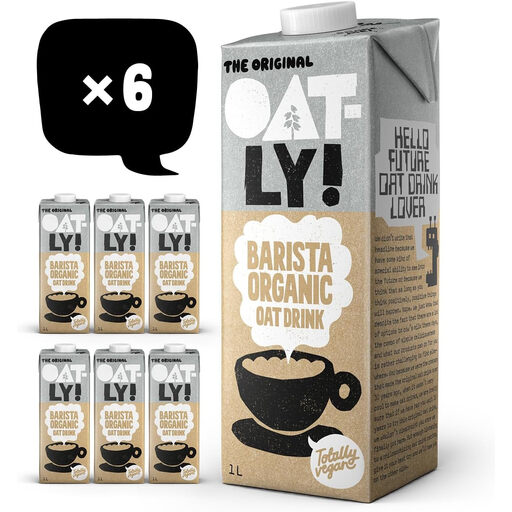
Oatly Organic Barista Oat Drink 6 x 1L
Consider this six-carton organic barista variant if coffee and hot drinks are your main uses. Check its own ingredients, fortification and after-opening instructions rather than applying details from another Oatly carton.
 No image available
Alpro Barista Oat Long Life Drink 8 x 1L
This eight-carton barista option is aimed at breakfasts that regularly include coffee drinks. If you also need an oat drink for cereal or porridge, compare its nutrition panel and intended uses with an everyday formulation.
Frequently asked questions
Is every oat drink suitable for someone with coeliac disease?
No. Do not infer gluten-free suitability from “oat”, “plant-based” or “dairy-free”. The Food Standards Agency says food labelled gluten-free must contain no more than 20mg/kg gluten as sold to consumers, while oats must still be identified as an allergen. Check the particular pack: M&S labels its cited Barista Oat Drink unsuitable for coeliacs.
Should I check fortification for an everyday breakfast drink?
Yes, if added nutrients matter to your choice: check the specific carton for calcium, iodine, vitamin D and B12. Tesco and Sainsbury’s list those nutrients for their cited long-life drinks, whereas M&S describes its Only 3 Ingredients Oat Drink as unfortified.
How long can I keep a carton after opening it?
Follow that carton’s storage instructions. The cited Sainsbury’s Long Life Oat Drink says to refrigerate and use within three days of opening; the cited Tesco Long Life Oat Original says to refrigerate and consume within five days. Do not apply either period to a different product without checking its label.
Does dairy-free mean an oat drink meets other allergy requirements?
No. Check the exact product’s allergen declaration and precautionary statements. Tesco says its cited long-life oat drink may contain peanuts and nuts; Sainsbury’s warns that its cited drink is unsuitable for customers with a soya allergy because of manufacturing methods; and M&S labels its cited barista drink unsuitable for people with a milk allergy.


