Families packing a drink for lunch
If the pupil will open the drink at school, an individual carton avoids carrying an opened family-size pack. Check that it can be stored unopened until lunchtime and that it fits the school’s packed-lunch policy.


For a drink to have with lunch, an unopened single-serve oat drink that can be stored at room temperature before opening is the more practical format; Oatly describes its 250ml carton as lunchbox-friendly. A fortified 1L carton makes more sense for household use or decanting if the school permits it and chilled storage is workable. Whatever the format, check the exact pack’s allergens and the school’s policy rather than assuming a plant-based drink suits every pupil.
If the pupil will open the drink at school, an individual carton avoids carrying an opened family-size pack. Check that it can be stored unopened until lunchtime and that it fits the school’s packed-lunch policy.
Compare fortification on the exact carton as well as its lunchbox format. Cambridge University Hospitals NHS Foundation Trust notes that calcium requirements are greatest during adolescence; oat drinks differ in whether they list added calcium and other nutrients.
Read the ingredients, allergen statement and precautionary wording for the product the pupil will actually drink. A plant-based description does not settle milk-allergy suitability, and the Food Standards Agency identifies oats as an allergen even when they are gluten-free.
Start with how the drink will get to school and be stored, then compare fortification and the exact pack’s allergen information.
| Priority | What to check | When it matters to me |
|---|---|---|
| Lunchbox format | Check the carton size and whether it can be stored at room temperature before opening. Oatly describes its 250ml oat drink as lunchbox-friendly. | I want a drink the pupil can carry unopened and finish with lunch, rather than a family-size carton to manage at school. |
| Regular milk replacement | Compare the nutrition panels for calcium, iodine and listed vitamins; fortification differs between products. Cambridge University Hospitals NHS Foundation Trust notes that calcium requirements are greatest during adolescence. | If oat drink is used regularly in place of milk, I want to know what the chosen carton contains, not rely on its plant-based label. |
| Allergen suitability | Read the current pack’s ingredients, highlighted allergens and precautionary statements. Marks & Spencer says its Plant Kitchen Semi Oat Drink is not suitable for people with a milk allergy; the Food Standards Agency states that oats remain an allergen even when gluten-free. | A milk-free-sounding name or gluten-free claim cannot answer every allergy question for the pupil who will drink it. |
| Product type | Distinguish an everyday drinking carton from a barista product. Minor Figures presents its Barista Oat chiefly for lattes and cappuccinos; check the nutrition panel if considering it as a lunch drink. | For a straightforward packed-lunch drink, I would choose by portion and ingredients rather than by a product’s coffee-making description. |
| School-day handling | If using a 1L carton, check the pack’s instructions after opening, how a portion will be carried and whether the school permits decanting. Check its packed-lunch and allergy policy too. | Decanting only works for us if the school accepts it and we can keep the drink appropriately chilled. |
Allergen advice is product-specific. Marks & Spencer says its Plant Kitchen Semi Oat Drink is not suitable for people with a milk allergy, despite its plant-based positioning.
Check the current physical pack’s ingredients, allergen statement and precautionary wording against the pupil’s requirements and the school’s allergy arrangements.
An opened household carton needs a storage and carrying plan; it does not offer the same ready-to-open format as an individual carton.
Consider an unopened single-serve carton for lunch. If decanting from a larger carton, check the school’s policy and arrange suitable chilled storage.
Terms such as barista or organic do not tell you which nutrients are added. Minor Figures presents Barista Oat for hot drinks, while the fortified ingredients listed on everyday oat drinks vary by product.
Compare the exact nutrition and ingredients panels, especially when oat drink is used regularly instead of milk.
The Food Standards Agency states that oats must still be identified as an allergen even when they are gluten-free or very low gluten.
Check gluten claims and oat-allergen suitability as separate questions for the pupil concerned.
These examples show why carton size, fortification and allergen statements need checking product by product; a brand reference does not establish that every drink in its range has the same properties.
Its 250ml Oat Drink is an individual-carton example; its Semi Oat Drink comes in a larger carton.
Alpro Oat Original is an example of a fortified, long-life drink in a 1L carton.
Its Long Life Oat Drink is a fortified 1L household-carton example.
Plant Kitchen Semi Oat Drink illustrates why fortification and allergen suitability must be assessed separately.
Its Barista Oat is presented for hot drinks rather than specifically for packed lunches.
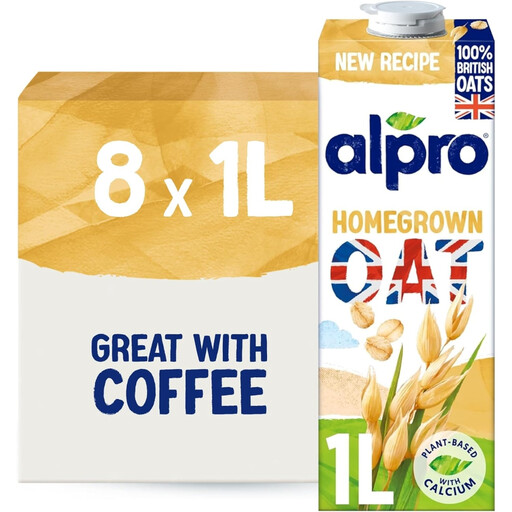
These Alpro 8 × 1L packs suit a household-carton approach. For a packed lunch, consider them only if decanting is permitted and the portion can be stored appropriately.
 No image available
This long-life household pack is an option for home use or school-permitted decanting, rather than an individual lunchbox carton. Sainsbury’s lists calcium, iodine and vitamins B2 and D2 for Alpro Oat Original. Check the current pack’s allergen wording and arrange appropriate storage for any portion taken to school.
 No image available
This is the No Sugars variant in a pack of eight long-life 1L cartons. Compare its current nutrition and allergen labels with the Original variant rather than assuming their ingredients are identical. For lunch, check whether the school permits decanting and plan how the portion will be kept chilled.
No. Marks & Spencer states that its plant-based Semi Oat Drink is not suitable for people with a milk allergy. Check the current pack’s ingredients and allergen warnings for the exact drink, alongside the pupil’s requirements and school arrangements.
No. The Food Standards Agency states that oats remain an allergen even when they are gluten-free or very low gluten. A gluten-free claim and suitability for someone with an oat allergy are separate questions.
Check it when oat drink is regularly used instead of milk. Cambridge University Hospitals NHS Foundation Trust notes that calcium requirements are greatest during adolescence, while product labels show whether a particular oat drink lists added calcium and other nutrients. One carton’s label does not describe the pupil’s overall diet.
The Department for Education’s school-food guidance concerns food and drink provided in state-funded schools in England; it does not, by itself, settle what a pupil may bring in a packed lunch. Check the individual school’s packed-lunch and allergy policy, including any rules relevant to decanting or storage.
It can be a practical household option if the school permits decanting and you can store the lunch portion appropriately. Follow the exact carton’s instructions after opening; otherwise, an unopened single-serve carton avoids that portioning step.