Organic-first lunch planners
If oat drink mainly goes into cereal, smoothies, tea or cooking, a simple organic recipe may fit your routine. Check fortification separately if you also rely on it as a dairy replacement.


For a working-from-home lunch, choose a simple organic oat drink if you mainly pour it over cereal or use it in tea and cooking; choose an organic barista drink if your lunch break centres on steamed coffee. If the drink is a regular dairy replacement and added nutrients matter to you, check its fortification rather than assuming organic status covers that need: Oatly describes its organic drink as unfortified, while the fortified Sainsbury’s examples are a different, non-organic route.
If oat drink mainly goes into cereal, smoothies, tea or cooking, a simple organic recipe may fit your routine. Check fortification separately if you also rely on it as a dairy replacement.
If lunch includes a latte or flat white, an organic barista formulation addresses a different use: Minor Figures describes its Organic Barista Oat as steaming for microfoam. Its ingredient list is longer than a simple oat-and-water recipe.
If oat drink regularly replaces dairy milk in your routine, compare the carton’s calcium, vitamin D, vitamin B12 and iodine information. NHS guidance on vegan diets identifies fortified foods and supplements as considerations for nutrients that can be harder to obtain.
Choose when: You want an organic drink with a short ingredient list for everyday pouring or cooking.
Trade-off: Oatly describes its Organic Oat Drink as unfortified, so check how it fits into the rest of your diet if you use it instead of dairy milk.
Choose when: Steamed coffee is a regular part of your lunch break; Minor Figures describes its organic barista drink as suitable for making microfoam.
Trade-off: Its recipe includes organic rapeseed oil and potassium carbonate, rather than just oats, water and salt.
Choose when: Added nutrients take priority over an organic label. Sainsbury’s standard Oat Drink lists calcium, iodine, vitamin D and vitamin B12.
Trade-off: The Sainsbury’s fortified examples are not presented as organic; their listed nutrients also differ between the standard and barista versions.
| Priority | What to check | Your needs |
|---|---|---|
| Organic status | Look for “organic” on the exact carton or listing. Check any certification information or control-body code shown for that product, rather than relying on the brand name. | I want the particular oat drink I buy to be labelled organic, not merely sold by a brand that also makes organic products. |
| Lunch use | For steamed coffee, check whether the product is a barista formulation. For cereal, tea or cooking, compare the ingredient list and intended uses. Tesco describes Minor Figures Organic Barista Oat as steaming for microfoam. | Some days I make a coffee at lunch; on others, I just need oat drink to pour over food or use in a recipe. |
| Added nutrients | Read the carton for added calcium, vitamin D, vitamin B12 and iodine; do not infer fortification from an organic label. Sainsbury’s standard and barista oat drinks list different added nutrients. | If this regularly replaces dairy milk for me, I need to know what it contributes alongside the rest of my diet. |
| Allergens and gluten | Check the exact carton’s allergen statement and any gluten-free claim. Minor Figures says its Organic Barista Oat may contain gluten. The Food Standards Agency defines “gluten-free” as no more than 20 mg/kg gluten in food sold to consumers. | For a gluten-related restriction or oat allergy, I cannot assume that every oat drink has the same suitability. |
| Storage and quantity | Compare the pack format with how quickly you use a carton. Follow the unopened-storage and after-opening instructions on the product you buy. | A multipack only fits my lunch routine if I can use its cartons within their stated storage guidance. |
Organic status does not tell you whether calcium or vitamins have been added. Oatly describes its organic drink as unfortified, whereas Sainsbury’s standard Oat Drink lists added calcium, iodine, vitamin D and vitamin B12.
If oat drink frequently replaces dairy milk for you, read its nutrition and ingredient information and consider what else your diet provides.
A formulation intended for steaming may include ingredients you would not choose if a short ingredient list is your main priority. Minor Figures Organic Barista Oat includes organic rapeseed oil and potassium carbonate.
Decide whether you need a drink for steamed coffee or mainly for cereal, tea and cooking, then compare the exact ingredient lists.
Minor Figures Organic Barista Oat says it may contain gluten. A product’s organic label does not establish that it is suitable for a gluten-related restriction or an oat allergy.
Check the exact carton’s allergen statement and any gluten-free labelling before choosing it for a dietary restriction.
Storage instructions differ between long-life and chilled drinks and can change after a carton is opened.
Check the pack’s refrigeration and after-opening instructions against how often you use oat drink at lunch.
Cartons left unused beyond their stated after-opening period may need to be discarded.
These examples show why the exact product matters: a brand or retailer can offer drinks with different ingredients, intended uses and fortification.
Oatly has organic oat-drink options for general use and a separately identified organic barista drink.
Minor Figures Organic Barista Oat is an organic option aimed at steamed coffee drinks.
Alpro is a reference point when comparing added calcium with an organic-first choice.
Sainsbury’s own-label standard and barista oat drinks illustrate two fortified options with different listed nutrients.
Tesco lists third-party organic oat drinks, including Oatly Organic and Minor Figures Organic Barista Oat.
M&S Only 3 Ingredients Oat Drink is a short-ingredient-list comparison, rather than an organic option established by its name.
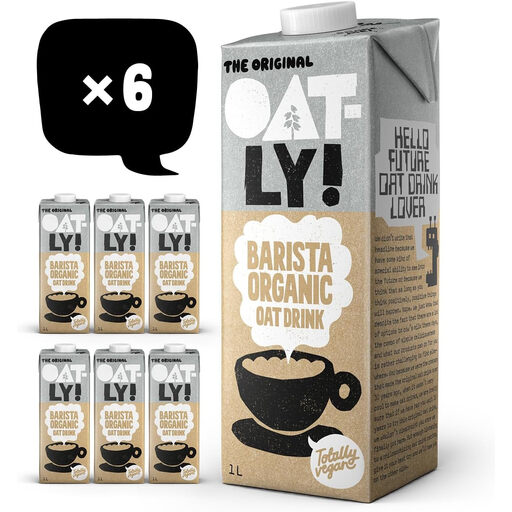
This Joybuy option covers the organic barista route for lunch-break coffee. Its six-carton format also makes after-opening storage worth checking against how often you use oat drink.
 No image available
An organic barista oat drink for a lunch-break coffee, supplied as six 1L cartons. The product information also describes use in tea, hot chocolate, cooking and baking. Refrigerate after opening and consume within five days; check the carton’s fortification and gluten information if either affects your choice.
No. Organic status and added nutrients are separate things to check: Oatly describes its Organic Oat Drink as unfortified. If you use oat drink regularly instead of dairy milk, read the carton for calcium, vitamin D, vitamin B12 and iodine; NHS guidance on vegan diets also discusses fortified foods and supplements as possible sources of key nutrients.
An organic barista formulation is the relevant option if steamed-coffee texture matters most. Tesco describes Minor Figures Organic Barista Oat as steaming for microfoam; its ingredients include organic rapeseed oil and potassium carbonate. For general pouring or cooking, you may prefer to compare simpler recipes instead.
No. Check the exact product’s gluten-free claim and allergen statement. Minor Figures says its Organic Barista Oat may contain gluten, and the Food Standards Agency defines “gluten-free” as no more than 20 mg/kg gluten in food sold to consumers; a gluten-free claim does not remove the need to check for an oat allergy.
Follow the instructions on the particular carton. Oatly Organic Long Life can be stored at room temperature while unopened; the Joybuy Oatly Organic Barista six-pack information says to refrigerate cartons after opening and consume them within five days. Check those instructions before choosing a multipack for occasional use.
Look for organic labelling on the exact drink you intend to buy, then check any certification information or control-body code shown on its pack or listing. Do not infer organic status from the brand, retailer or the fact that the drink is plant-based.