What should you check before buying?
Start with the carbohydrate in your intended serving, then decide whether a single carton or a case fits your routine.
| Priority | What to check | Your needs |
|---|
| Total carbohydrate |
Read carbohydrate as well as sugars on the exact nutrition panel. Compare products on the same declared quantity before working out your serving. |
I need to know whether the amount I pour fits my daily allowance; a 'no sugars' name does not answer that question. |
| Serving size |
Check the carton volume and calculate carbohydrate for the amount you will drink. A 1 L carton is not a pre-measured lunchbox serving. |
For a drink to take out, I want the carbohydrate figure for the whole portion, not just the figure printed per 100 ml. |
| Case and storage |
Check whether the cartons are long-life or chilled, then follow the exact product’s refrigeration and use instructions after opening. |
A case makes sense for my household only if we will finish opened cartons within the period on their labels. |
| Ingredients and fortification |
Compare the exact product’s allergen statement and listed nutrients, particularly if it is replacing dairy or gluten or wheat avoidance matters. |
I cannot assume two oat drinks have the same ingredients, added nutrients or allergen suitability. |
Oat drinks and brands to compare
Brand names alone do not establish carbohydrate content or lunchbox suitability; the distinctions below apply to the named drinks.
Alpro
Alpro Oat No Sugars is offered as a 1 L long-life drink, with an 8 × 1 L Joybuy listing.
- Alpro UK declares 0 g sugars and 6.4 g carbohydrate per 100 ml for the named drink.
- The 1 L cartons are not fixed 250 ml portions; measure what you pour if tracking carbohydrate.
Oatly
Oatly has a No Sugars 1 L drink and a separate portable 250 ml oat-drink product; do not assume they share a nutrition panel.
- Tesco lists 6.3 g carbohydrate and 0 g sugars per 100 ml for Oatly The Original No Sugars 1L.
- Check the exact 250 ml product’s panel before choosing it for a lunchbox; its portable format does not establish its carbohydrate suitability.
Minor Figures
Minor Figures lists Everyday Oat directly in a 6 × 1 L case.
- The brand declares 12.9 g carbohydrate per 200 ml serving.
- A case changes how much is on hand, not the carbohydrate in a serving; measure portions against your plan.
Tesco
Tesco Long Life Oat Original is a 1 L own-label option.
- Tesco declares 6.9 g carbohydrate per 100 ml and 17.3 g per 250 ml for this drink.
- Check the named variant’s panel rather than applying these figures to other Tesco oat drinks.
M&S
M&S Only 3 Ingredients Oat Drink is a chilled option whose nutrition is declared per 100 g, rather than per 100 ml.
- Marks & Spencer declares 5.7 g carbohydrate per 100 g for this product.
- Marks & Spencer states that it is not fortified and is unsuitable for coeliacs or people with a wheat allergy.
Joybuy oat-drink multipacks
These 1 L carton cases are options for regular household use or measured additions to drinks. They are not pre-portioned lunchbox cartons or default choices for a strict ketogenic plan.
 No image available
Alpro Oat No Sugars Long Life Drink, 8 × 1 L
An eight-carton case is suited to considering for regular household use, rather than as a ready-portioned lunchbox drink. Alpro UK declares 6.4 g carbohydrate and 0 g sugars per 100 ml for Oat No Sugars; a measured 250 ml amount works out at 16 g carbohydrate. Follow the carton’s instructions for storage after opening.
View on Joybuy
 No image available
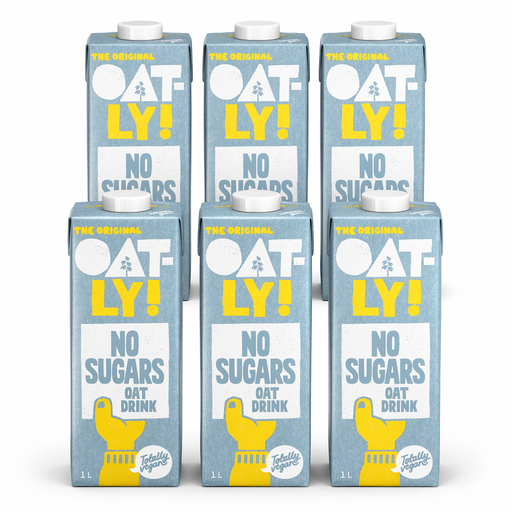
Oatly No Sugars Oat Drink, 6 × 1 L
This six-carton case is a household format, not a fixed single serving. Tesco lists 6.3 g carbohydrate and 0 g sugars per 100 ml for Oatly The Original No Sugars 1L, equivalent to 15.75 g carbohydrate in 250 ml. Its product instructions say to refrigerate after opening and use within approximately five days.
View on Joybuy
 No image available
Alpro Barista Oat Long Life Drink, 8 × 1 L
For a measured addition to coffee on a less restrictive eating plan, check this Barista variant’s own carbohydrate panel against the amount you pour. The long-life 8 × 1 L case is not a set of single-serve lunchbox cartons; follow each carton’s after-opening storage instructions.
View on Joybuy
Questions about portions and storage
Does ‘no sugars’ mean an oat drink has no carbohydrate?
No. Alpro UK declares 0 g sugars but 6.4 g carbohydrate per 100 ml for Alpro Oat No Sugars, while Tesco lists 0 g sugars and 6.3 g carbohydrate per 100 ml for Oatly The Original No Sugars. Use total carbohydrate and the amount you will drink when assessing either product.
What does a 250 ml serving mean for a keto allowance?
For Oatly The Original No Sugars, 250 ml contains 15.75 g carbohydrate when calculated from Tesco’s declared 6.3 g per 100 ml; Alpro Oat No Sugars works out at 16 g from Alpro UK’s 6.4 g per 100 ml. The British Dietetic Association describes very-low-carbohydrate ketogenic diets as allowing 20–50 g carbohydrate a day, so assess a serving alongside the rest of your plan rather than judging it by carton size.
Can I use a portable oat-drink carton as a keto lunchbox drink?
Check the exact carton’s carbohydrate per serving before deciding. Oatly offers a portable 250 ml oat drink, but its format does not establish its carbohydrate content or keto suitability; do not apply the nutrition figures for Oatly The Original No Sugars 1L to that separate product.
How should I plan for an opened 1 L carton?
Follow the instructions on the exact carton, even if it is long-life before opening. Tesco’s listing for Oatly The Original No Sugars 1L says to refrigerate it after opening and consume it within approximately five days.
What if my ketogenic diet is medically prescribed?
Discuss the exact drink and portion with the dietitian or clinical team responsible for your plan rather than adjusting it from general shopping advice. Cambridge University Hospitals NHS Foundation Trust describes ketogenic dietary therapy as a very-low-carbohydrate medical therapy for children and young people with drug-resistant epilepsy.


