Shoppers planning elevenses
If you want an oatcake instead of a sweet biscuit, compare total sugars on the oatcake label and on any topping. The amount you eat matters as much as a per-oatcake figure.


For a lower-sugar elevenses, compare plain oatcakes by total sugars per 100g, then consider how many you will eat and what you will put on them. A ‘no added sugar’ label does not show that an oatcake contains less sugar than another product; also check salt and, if you need a gluten-free option, the specific pack’s suitability statement.
If you want an oatcake instead of a sweet biscuit, compare total sugars on the oatcake label and on any topping. The amount you eat matters as much as a per-oatcake figure.
Look for an explicit gluten-free statement rather than relying on ‘pure oats’ or a wheat-free recipe. Coeliac UK notes that standard oats can be contaminated with wheat, barley or rye, and that a small number of people with coeliac disease are sensitive even to gluten-free oats.
Per-100g figures let you compare different packs on the same basis. Per-oatcake information then helps you assess the portion you plan to have, alongside fibre, salt and the ingredient list.
Start with comparable per-100g figures, then check the portion, topping and any dietary requirements that could change your choice.
| Priority | What to check | Your needs |
|---|---|---|
| Total sugars | Compare total sugars per 100g and, where shown, per oatcake. Read the ingredient list separately: ‘no added sugar’ does not tell you how a product compares with another oatcake. | I want a plain base for elevenses and need to compare packs without mistaking a front-of-pack phrase for a like-for-like sugar comparison. |
| Portion and topping | Check how many oatcakes you will eat and read the topping’s sugars information. The NHS notes that the portion printed by a manufacturer may differ from the amount eaten. | A plain oatcake is only part of my snack; I also need to account for the spread or other topping I plan to add. |
| Salt and fibre | Compare both figures per 100g when sugars are similar. Nairn’s lists 1.46g salt and 10.4g fibre per 100g for its Rough Oatcakes; Tesco lists 1.35g salt and 9.6g fibre per 100g for Scottish Rough Oatcakes. | If two oatcakes have similar sugar figures, I want to see their other label differences before choosing between them. |
| Gluten-free suitability | Check for explicit gluten-free labelling and read the current allergen statement. Coeliac UK says ‘100% oats’ and ‘pure oats’ do not establish gluten-free status. | I need an oatcake identified as gluten free, not an assumption based on the recipe or the word ‘oats’. |
‘No added sugar’ describes something different from a comparison with another product. It does not, on its own, tell you that the oatcake has less total sugar than a similar one.
Compare the total-sugars figures per 100g. If a comparative claim matters to you, look for the product and basis of comparison rather than assuming one from the wording.
The sugars figure for a plain oatcake does not include a spread, syrup, dried fruit or anything else added at elevenses.
Read the topping label and consider the quantity you will use alongside the number of oatcakes.
Coeliac UK warns that standard oats can be contaminated with wheat, barley or rye. It also notes that a small number of people with coeliac disease are sensitive to gluten-free oats.
Choose an oatcake explicitly labelled gluten free if that status is required, and check its current pack and allergen statement.
Plain oatcakes with similar sugars can differ in salt. Nairn’s lists 1.61g salt per 100g for Fine Milled Oatcakes, while Asda lists 1.1g per 100g for its Oatcakes. The NHS describes more than 1.5g salt per 100g as high for foods.
Read salt and fibre alongside sugars, then consider the amount you expect to eat.
These named products illustrate label and suitability differences; each pack’s current information is the check for the product you buy.
Nairn’s lists 0.7g sugars per 100g for both its Rough and Fine Milled Oatcakes. Its separate Gluten Free Original Oatcakes are listed by Sainsbury’s at 0.8g per 100g and described as certified by Coeliac UK.
Sainsbury’s lists 0.7g sugars and 10.4g fibre per 100g for its own-label Rough Oatcakes.
Tesco lists 0.8g sugars, 9.6g fibre and 1.35g salt per 100g for Scottish Rough Oatcakes.
Asda lists 0.8g sugars, 13g fibre and 1.1g salt per 100g for its Oatcakes.
M&S lists 3.0g sugars per 100g for Scottish Oatcakes and includes sugar and wheat flour in the ingredient list. The NHS describes 5g sugars or less per 100g as low for foods, so the figure alone does not place this product above that threshold.
This Joybuy option has a Marmite and cheese flavour rather than being a plain oatcake base. Compare its current pack information with your sugar, salt and ingredient requirements if you are choosing it for elevenses.
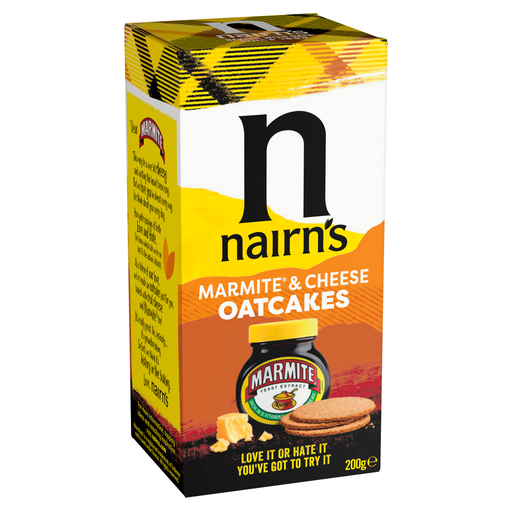 Image unavailable
The Marmite and cheese flavour makes this a savoury elevenses option rather than a neutral base for toppings. Check the pack’s sugars and salt per 100g and its allergen statement against your requirements.
No. ‘No added sugar’ does not establish a comparison with another oatcake. Read the total-sugars figure per 100g on both products and check their ingredient lists if the distinction matters to your choice.
The NHS describes 5g sugars or less per 100g as low for foods. For example, Nairn’s Rough Oatcakes are listed at 0.7g per 100g, while M&S Scottish Oatcakes are listed at 3.0g per 100g. Both figures fall below that NHS threshold, but they are not the same figure; compare the products and the topping you intend to use.
Do not assume so. Coeliac UK says standard oats may be contaminated with wheat, barley or rye, and that ‘pure oats’ does not establish gluten-free status. Look for an explicit gluten-free statement on the exact product; Sainsbury’s describes Nairn’s Gluten Free Original Oatcakes as gluten free and certified by Coeliac UK.
Use both figures where they are provided. Per 100g gives you a consistent basis across packs; per oatcake helps you work out what the number you plan to eat contributes. The NHS notes that a manufacturer’s stated portion may differ from the amount actually eaten.
The pack lets you check the ingredients, nutrition and allergen statement for the oatcakes in hand. This is especially important when you need a specifically gluten-free product or must avoid an ingredient identified in an allergen warning.