Parents with a baby under one
An oat drink bought for adults or family cooking is not an infant’s main milk feed. North East London NHS Foundation Trust distinguishes its use in weaning foods from replacing breast milk or formula before age one.


Choose oat drink by who will use it before deciding how much to buy. North East London NHS Foundation Trust says plant-based milks must not replace breast milk or formula as a baby’s main milk drink before age one; for an older child who needs a dairy-free alternative, check the exact carton’s age guidance and nutrients. For adult household use, compare carton quantities and storage instructions rather than assuming a six-carton case is one 6-pint bottle.
The child’s age and the drink’s intended use change which label details matter most.
An oat drink bought for adults or family cooking is not an infant’s main milk feed. North East London NHS Foundation Trust distinguishes its use in weaning foods from replacing breast milk or formula before age one.
Where a dairy-free alternative has been advised, check the intended age range and the exact carton’s nutrition information. A drink made for adults should not be treated as interchangeable with one labelled for young children.
For tea, coffee, cereal or cooking, the practical questions are how many cartons a pack contains, where unopened cartons can be kept and how quickly an opened carton must be used.
Settle who will drink it, then compare the carton label and the quantity you can use.
| Priority | What to check | Your needs |
|---|---|---|
| Child’s age | Read the stated age range and intended use. North East London NHS Foundation Trust says plant-based milks can be introduced in weaning from six months, but must not replace breast milk or formula as the main milk drink before age one. | If I’m feeding a baby under one, I need to keep their main milk feed separate from the oat drink bought for the household. |
| Carton nutrition | Compare the exact product’s age statement and nutrients per 100 ml, including any declared calcium, iodine and vitamins. Alpro’s Growing Up 1-3+ label differs from M&S’s unfortified Only 3 Ingredients drink, which M&S does not recommend as a dairy replacement under 36 months. | For a child over one who needs a dairy-free alternative, I want to check a child-facing carton rather than assume a standard oat drink has the same intended use. |
| Pack and storage | Check the number and size of cartons, unopened storage conditions and directions after opening. Tesco lists a 3 × 1.5L Oatly multipack; Minor Figures lists Everyday Oat as 6 × 1L. Neither format is a single 6-pint bottle. | We need enough for the household without opening more cartons than we can use within their labelled storage period. |
| Coffee and allergens | Check whether a carton is intended for coffee, then read its own ingredients and allergen statement. M&S describes its Barista Oat Drink as formulated for coffee and says it is unsuitable for coeliacs or people with a milk allergy. | If coffee is the main use, I may choose a barista carton, but I still need to assess any drink intended for a child or someone with an allergy separately. |
A large supply does not change the feeding boundary: North East London NHS Foundation Trust says plant-based milks must not replace breast milk or formula as the main milk drink before age one.
Keep the baby’s established feeding plan separate from oat drink used by adults or, where appropriate, in weaning foods.
Alpro labels its Growing Up drink for ages 1–3+, while M&S says its unfortified Only 3 Ingredients drink is not recommended as a dairy replacement for children under 36 months.
Read the age statement and nutrition panel on the exact carton instead of relying on the words “oat drink” or a short ingredient list.
Six 1L cartons contain six litres; six UK pints are approximately 3.408 litres. A case also means managing separate cartons and their after-opening instructions.
Check both the carton count and total volume before choosing a stock-up pack.
A barista formulation’s intended coffee use does not establish that it is appropriate as a young child’s main dairy alternative. The M&S Barista carton also carries specific allergen exclusions.
Choose for coffee use on its own terms, and check child-age and allergen information separately for anyone else who may drink it.
These examples illustrate label and format differences; suitability depends on the specific product, not the brand name alone.
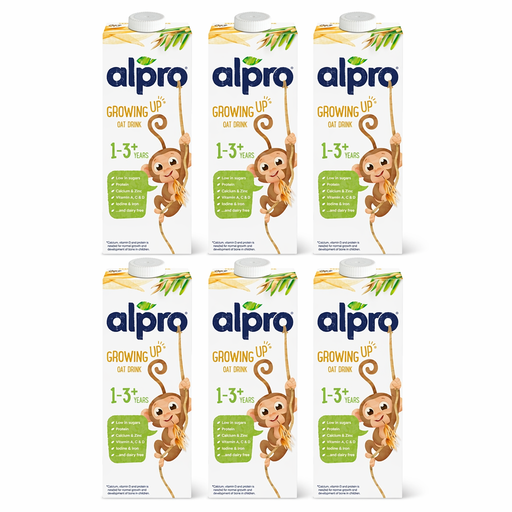
Alpro Oat Growing Up 1-3+ is an age-labelled option to examine when an alternative to cow’s-milk-based formula has been advised for a child in that age range.
Oatly’s Semi and Whole oat drinks provide adult household options in 1L cartons.
Everyday Oat is a six-carton format for household uses including cereal and tea, according to Minor Figures.
Sainsbury’s Long Life Oat Drink is a 1L fortified carton for comparison with other household drinks.
M&S provides a useful contrast between its coffee-focused Barista drink and its Only 3 Ingredients oat drink.
Tesco’s oat-drink listings provide a way to compare carton and multipack formats across product lines.
These options cover a growing-up drink, everyday household cartons and coffee-focused cartons. Check pack quantities carefully when stocking up: a multi-carton listing is not a single 6-pint bottle.
 No image available
Consider this age-labelled drink when a dairy-free alternative has been advised for a child aged 1–3+. The Alpro Growing Up product information lists calcium, iodine and iron; it is not an infant-feed substitute. Confirm how many 1L cartons the listing’s “6” denotes before ordering.
 No image available
An eight-carton format to consider for adult household use rather than a single large bottle. If a child will drink it, check the exact carton’s age guidance; the product name alone does not establish toddler-specific suitability. Follow its after-opening storage instructions.
 No image available
This eight-carton long-life pack is an option for stocking adult household oat drink. Check the carton’s nutrition and age statements separately if it may be used by a young child. “No added sugars” should not be read as “sugar-free”; compare the nutrition panel for the exact product.
 No image available
A coffee-focused option for adult household use. The listing describes both 6 × 1L and a one-litre pack, so confirm the quantity you would receive before ordering. Do not use it in place of breast milk or formula as an infant’s main milk drink.
 No image available
Consider this eight-carton pack when coffee is the household’s main oat-drink use. Its barista positioning does not establish suitability as a young child’s main dairy alternative. Check the exact carton for nutrients, allergens and storage directions if those details affect your choice.
No. North East London NHS Foundation Trust says plant-based milks may be introduced as part of weaning from six months, but must not replace breast milk or formula as the main milk drink until the child is one year old.
Check the exact drink’s age statement and nutrition information, particularly where a dairy-free alternative has been advised. Alpro labels Oat Growing Up for ages 1–3+ and lists calcium, iodine and iron; that does not make every oat drink suitable for the same use.
Not necessarily. Six UK pints are approximately 3.408 litres, whereas Minor Figures lists a 6 × 1L case and Tesco lists an Oatly 3 × 1.5L multipack. Check total volume and carton count rather than relying on the number in a listing title.
Follow the instructions on the exact carton, including refrigeration and its stated use-within period. Those directions matter more for a stock-up purchase than the storage conditions of unopened cartons alone.
Do not assume so. M&S says its Barista Oat Drink is formulated for coffee but is unsuitable for coeliacs and people with a milk allergy. Check the exact product’s allergen and age information for each person who may drink it.