The communal-tin organiser
If colleagues help themselves throughout the day, check whether each piece has its own wrapper or whether the tin needs a way to serve loose fudge. Keep the original pack nearby so people can read the ingredients.


Choose individually wrapped fudge if colleagues need to take a piece without handling loose sweets; choose loose fudge if the office has a suitable way to serve it and the original pack can stay available for ingredient checks. Start with a single pack that fits likely use, and consider a case only for regular refills. Check the exact product format rather than assuming a bag labelled ‘sharing’ contains wrapped pieces.
If colleagues help themselves throughout the day, check whether each piece has its own wrapper or whether the tin needs a way to serve loose fudge. Keep the original pack nearby so people can read the ingredients.
A single bag lets you see how quickly the team gets through it before buying more. Check its net weight and piece format: a bag of loose fudge and a pack of bars will be used differently.
A case can serve repeated refills, but it also means storing unopened bags and checking their best-before dates. It is a different commitment from buying one bag for the tin.
Choose when: Colleagues need to take one piece without touching loose fudge.
Bear in mind: A treat-size or multi-bar label alone does not confirm that every piece has its own wrapper; check the pack.
Choose when: The office can serve loose pieces and keep the ingredient label with the tin.
Bear in mind: A sharing bag does not give everyone a defined portion; check how the pieces will be taken.
Choose when: Regular use makes repeated refills worthwhile and there is space to store the bags.
Bear in mind: The Candy Company lists cases of 12 x 150g fudge bags, rather than a single bag for an occasional treat.
| Priority | What to check | Your needs |
|---|---|---|
| Serving format | Check whether pieces are individually wrapped or loose. If a defined serving matters, check the stated amount per piece; Sainsbury's lists a 13.5g serving for its Cadbury Fudge Treatsize bag. | I want colleagues to be able to take a piece without handling the rest of the fudge. |
| Pack quantity | Compare net weight with likely use, and distinguish a single pack from a case. Thorntons lists an 85g Vanilla Fudge Bag and a 300g assortment; The Candy Company lists 12 x 150g cases. | For an occasional treat, I would rather try one pack before finding space for repeat refills. |
| Ingredient information | Read the exact pack's ingredients, allergen statement and storage instructions. Keep its label accessible when moving fudge into a tin. | Anyone using the tin should be able to check what is in the fudge before taking a piece. |
| Flavour and suitability | Check the particular variant, including coatings and added pieces. Tesco's Buttermilk Cream Tea Fudge listing names milk, wheat and soya ingredients and carries a factory warning for peanuts and tree nuts. | A flavour that appeals to some colleagues may not meet everyone's ingredient or dietary requirements. |
A sharing bag may contain loose pieces. That affects how colleagues take fudge from the tin and whether a portion is stated for each piece.
Check the pack format before buying, particularly if separately handled pieces are important to your office.
Once fudge is tipped into a tin, colleagues may no longer be able to identify its ingredients, declared allergens or storage instructions.
Keep the current original pack beside the tin, or retain a legible copy of its label. Check that label again when buying a different variant or a new pack.
A wholesale case leaves more unopened fudge to store between refills than a single sharing bag.
Try one pack first if office demand is uncertain, then consider a case if refills become regular.
A case also calls for storage space and attention to the individual bags' best-before dates.
Added biscuits, coatings and other flavour ingredients can change what a particular fudge contains. Tesco's Buttermilk Cream Tea Fudge listing, for example, names milk, wheat and soya.
Check the exact variant's current ingredient and allergen statement before adding it to a shared tin.
These examples show how pack weights and fudge formats differ; check the exact product before using any of them to refill a shared tin.
Thorntons lists an 85g Vanilla Fudge Bag and a 300g Assorted Fudge option on its UK fudge page.
M&S lists a 135g Clotted Cream Fudge product and a separate All Butter Fudge Cubes product.
Waitrose lists Clotted Cream Fudge in 150g and 200g packs.
Tesco listings include a 97g Munchies Salted Caramel Fudge Sharing Bag and a 175g Buttermilk Cream Tea Fudge Grab Bag.
Sainsbury's lists a Cadbury 202g Fudge Treatsize Chocolate Bag with a stated 13.5g serving.
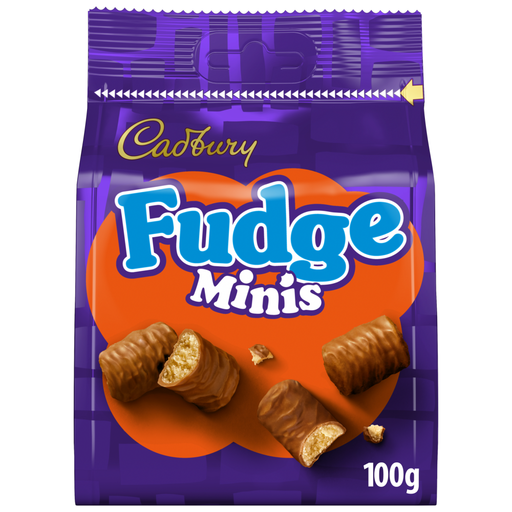
These Cadbury packs offer a 100g bag of minis or an 88g four-bar pack for an office treat. Check the packaging if individually wrapped portions are important: a piece count or a bag format does not settle that question.
 No image available
The 100g bag is an option for adding small fudge pieces to a shared tin. Check the pack to see whether the minis are individually wrapped and to read the current milk and soya allergen information before putting them out.
 No image available
Four bars give a small team a known piece count in an 88g pack. Check whether each bar has its own wrapper before using the pack for separately handled portions, and keep its current milk allergen information available.
Choose individually wrapped pieces if colleagues need to take one without handling the rest. Loose fudge can work where there is a suitable way to serve it and the original ingredient label stays available; check the pack, because ‘sharing bag’ does not confirm individual wrapping.
Start with a single pack and judge the next refill by how quickly it is used. Thorntons lists an 85g bag and a 300g assortment, while Waitrose lists 150g and 200g packs; a case of 12 x 150g bags is a separate choice for regular replenishment.
Keep the current product pack, or a legible copy of its ingredient and allergen label, where colleagues can consult it. Retain the storage and best-before information too, especially when moving loose fudge out of its bag.
No. Ingredients and statements vary by product and flavour: Tesco's Buttermilk Cream Tea Fudge listing names milk, wheat and soya and includes a factory warning for peanuts and tree nuts. Check the exact current pack, including any ‘may contain’ statement, before putting it in a communal tin.