Shared-kitchen convenience teams
Office managers and teams who want repeatable bottle refills, temperature options and a clear routine for replenishing and maintaining a powered dispenser.


For a shared-office bottle station, choose a powered countertop reverse-osmosis (RO) dispenser if temperature options and its treatment method justify electricity, feed-tank refills and filter maintenance. Choose a large non-electric filter tank when stored water for straightforward refills matters more than powered dispensing; a gravity-fed ceramic system suits a station that must work without electricity or permanent plumbing, provided the team can accommodate gravity-fed flow and cleaning.
Office managers and teams who want repeatable bottle refills, temperature options and a clear routine for replenishing and maintaining a powered dispenser.
Teams whose main need is a larger reserve of filtered water for reusable bottles, without RO treatment or powered temperature controls.
Small offices or temporary shared spaces that need a refill station without an electrical connection or permanent plumbing changes.
Choose when: The office wants selectable dispensing temperatures alongside RO treatment.
Allow for: Electricity, feed-water refills, filter changes and reject water from RO operation.
Choose when: Filling bottles from a stored supply of filtered water is the main job.
Allow for: Gravity-fed filling and a cartridge and cleaning routine, without powered heating, chilling or RO treatment.
Choose when: The station must work without electricity or permanent plumbing.
Allow for: Gravity-fed filtration, filter setup and cleaning rather than instant temperature-controlled dispensing.
| Concern | What to check | Who this matters to |
|---|---|---|
| Dispensing and temperature | Check the available settings, bottle clearance below the outlet and how purified water is dispensed. | In a busy shared kitchen, I want to fill my bottle conveniently and choose a suitable water temperature. Around 45% of consumers put controlled dispensing and temperature choice first. |
| Stored filtered-water capacity | Distinguish total tank capacity from filtered-water capacity, then check the tap and cartridge routine. | If several colleagues need drinking water, I care most about having a usable reserve for bottle refills. For around 33% of consumers, that straightforward filling capacity is the primary concern. |
| Operation without power | Check system capacity, worktop space and the filter setup and cleaning instructions. | Where a socket or permanent plumbing is impractical, I need the station to operate independently. That need comes first for around 22% of consumers. |
A tank-fed RO unit can need repeated refills during shared use. Waterdrop lists separate 4.7 L feed-water and 1.2 L portable purified-water tanks for its A2.
Estimate demand during the busiest refill period and check both capacities for the exact model.
Maintenance intervals differ by system: BRITA gives the Flow a four-week filter-change reminder, Doulton recommends changing Ultra Sterasyl elements after six months, and Waterdrop says its A2 filter is typically changed after 12 months, depending on use and local water quality.
Identify the correct replacement filter and assign someone to order it, clean the station and keep track of changes.
The routine also takes staff or facilities time.
RO adds operating considerations to bottle refills. Waterdrop states a 3:1 pure-to-drain ratio for its A2, whose powered dispensing also depends on electricity.
Decide whether the chosen model’s treatment approach and dispensing options address an office need; if simple refills are the priority, compare a non-electric tank or gravity-fed system too.
In Great Britain, the Workplace (Health, Safety and Welfare) Regulations 1992 require an adequate supply of wholesome drinking water for people at work. A countertop appliance does not remove that duty.
Choose an accessible location and maintain the station according to its instructions. For a workplace outside Great Britain or one using a private water supply, check the locally applicable requirements.
Its countertop range includes powered RO dispensers such as the A2, with temperature-controlled dispensing.
The Flow is a non-electric filter tank with a tap for dispensing water into bottles.
Its installation-free countertop RO range includes the Classic and Carafe.
The British Berkefeld Ultra Sterasyl range uses gravity-fed ceramic filtration without electricity.
These powered countertop RO models are relevant where a shared office wants temperature options as well as bottle refills. Compare the usable water reserve and outlet clearance against your busiest period of use.
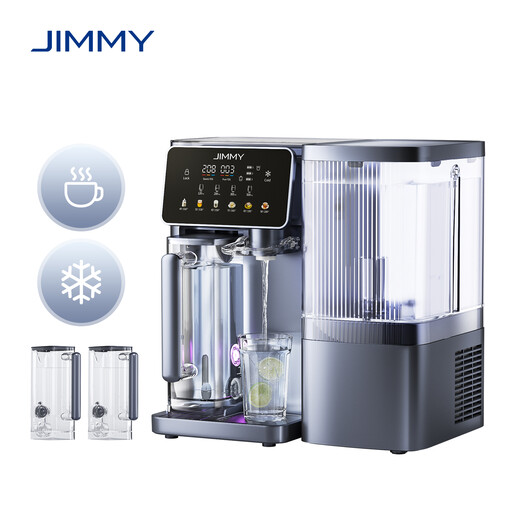 Image unavailable
A powered RO option for a shared station that wants hot and cold dispensing.
The listed 5.5 L tank and two 1 L pitchers do not establish how much purified water is ready for dispensing. Check the usable reserve, bottle clearance and filter-change routine before choosing it for peak office use.
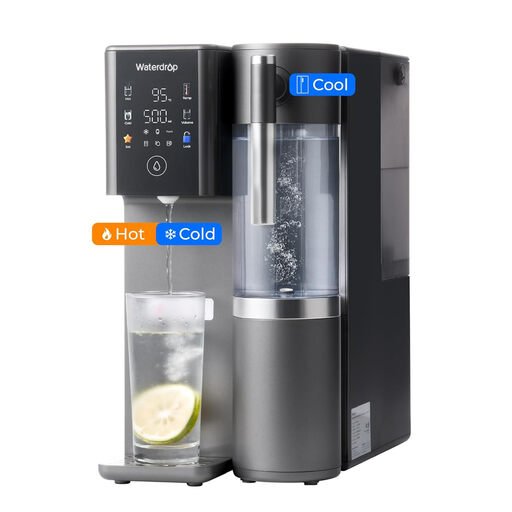 Image unavailable
A powered RO option for a shared refill point where a choice of water temperatures matters.
The title lists six temperature settings and a portable purified-water tank. Confirm the applicable temperatures, usable reserve, bottle clearance and filter-change routine for this WD-A2 variant.
No. In Great Britain, the Workplace (Health, Safety and Welfare) Regulations 1992 require an adequate supply of wholesome drinking water for people at work. A countertop unit can be part of how water is provided, but the employer still needs to provide suitable drinking water and maintain workplace equipment safely.
Not automatically. England’s Water Supply (Water Quality) Regulations 2016 govern water supplied by water undertakers and licensed suppliers; choosing a countertop device does not, by itself, indicate that mains water is unsafe. Decide whether a particular model’s dispensing functions or treatment approach meet the office’s needs.
Assign a person or facilities process before purchase. BRITA instructs users to clean its filter system before first use and whenever the filter is changed; follow the cleaning instructions for the exact model the office chooses rather than applying another brand’s schedule.
Use the interval for the exact system and its instructions. BRITA gives the Flow a four-week change reminder, Doulton recommends changing Ultra Sterasyl elements after six months, and Waterdrop says its A2 filter is typically changed after 12 months depending on use and local water quality. Check replacement-filter availability and who will manage the changes.