Kettle-only office snack areas
An instant-coffee jar suits a shared kitchen with hot water, mugs and spoons but no cafetière or filter brewer. Marks & Spencer describes instant granules as dissolving when hot water is added.


Choose an instant-coffee jar for an office snack area that has hot water but no coffee brewer: soluble coffee is not the same format as ground filter coffee. A refill makes sense when the office already has the compatible jar; choose ground coffee when staff want brewed coffee and a cafetière or filter brewer is available.
The equipment already in the snack area is the clearest starting point for choosing between soluble coffee and coffee that needs brewing.
An instant-coffee jar suits a shared kitchen with hot water, mugs and spoons but no cafetière or filter brewer. Marks & Spencer describes instant granules as dissolving when hot water is added.
A jar with stated serving guidance gives buyers a basis for planning how often to replenish it. For example, Sainsbury's lists 55 servings for its 200 g Gold Roast jar; actual use depends on how each cup is made.
Douwe Egberts describes its 150 g Pure Gold paper refill as intended for its stopper jar. Check that the office has the compatible container before choosing the refill instead of a jar.
Choose it when: The shared kitchen has hot water but no coffee brewer; soluble granules can be prepared in a mug.
Bear in mind: An instant jar does not make brewed filter coffee, and its bean type and decaf status depend on the product.
Choose it when: The office already has the container specified for that refill, such as the stopper jar named by Douwe Egberts.
Bear in mind: A refill is not a first-purchase jar and needs suitable storage once opened.
Choose it when: Staff want brewed coffee and the office can provide a cafetière or filter brewer.
Bear in mind: Ground coffee needs a brewing step and leaves used grounds; Taylors of Harrogate labels Flying Start for cafetière or filter preparation.
Once the preparation format is settled, compare the instructions and label details of the products under consideration.
| Priority | What to check | Your needs |
|---|---|---|
| Preparation | Check whether the pack says instant or soluble, or instead says ground coffee. Match ground coffee to a cafetière or filter brewer. | I need staff to make a cup with hot water and a mug, without setting up a brewer. |
| Servings | Check pack weight and the product's own serving instructions. Sainsbury's lists 55 servings for its 200 g Gold Roast jar; its Douwe Egberts refill listing gives 93 servings at a suggested 1.6 g per serving. | For a shared jar, I want a practical way to plan replenishment. I would compare stated servings alongside the suggested amount per cup. |
| Coffee choice | Read the exact product label for bean type, roast and decaf status rather than assuming all instant coffees share them. Marks & Spencer describes its Italian Style Instant Coffee as 100% arabica and freeze-dried. | Some colleagues may prefer decaf or want a stated bean type, so those details matter when choosing what to keep in the kitchen. |
| Storage and refills | Check storage instructions and whether a refill names a compatible jar. Sainsbury's says to replace the cap on its Gold Roast jar and store it in a cool, dry place. | Our coffee will sit on a shared shelf between cups. If we choose a refill, we need its specified container. |
Instant granules dissolve in hot water, while ground coffee needs a brewing method. Ground coffee will not serve the same purpose in a kettle-only snack area.
Read the format on the pack: choose instant or soluble coffee for mug preparation, and ground coffee when a suitable brewer is available.
Douwe Egberts specifies its stopper jar for the Pure Gold refill. The refill pack is not itself a reusable coffee jar.
Confirm that the office has the compatible jar, or choose a jar for the initial order.
The Sainsbury's Gold Roast jar lists 55 servings for 200 g, while its Douwe Egberts refill listing gives 93 servings for 150 g at a suggested 1.6 g per serving. Those figures follow the respective product guidance, not a shared cup recipe.
Read each pack's preparation instructions before using its stated servings to plan replenishment.
Marks & Spencer notes that ingredients, dietary, nutritional and allergen information for its products may change.
Check the current label when placing a repeat office order, particularly where colleagues have dietary requirements.
These examples show how product formats differ; a brand's inclusion does not mean every product in its range is an instant-coffee jar.
Its Pure Gold medium-roast instant refill is an option for an office that already has the specified stopper jar.
Marks & Spencer lists instant jars alongside decaf products and other coffee formats.
Its Gold Roast Instant Coffee is a 200 g jar with stated preparation and storage instructions.
Lavazza offers several coffee formats, including a business-facing soluble product.
Flying Start is a ground-coffee example for an office choosing to brew rather than use an instant jar.
Tesco's instant-coffee category lists jars, refills, decaf products and coffee bags.
These two NESCAFÉ decaf jars are instant-coffee options for an office using hot water rather than a filter brewer. Choose between their stated pack sizes according to how the shared kitchen will use and store the coffee.
 Image unavailable
This 300 g jar contains decaffeinated soluble coffee for an office choosing an instant-coffee format.
Store in a cool, dry place. Check the pack's serving instructions when planning how often to replenish the jar.
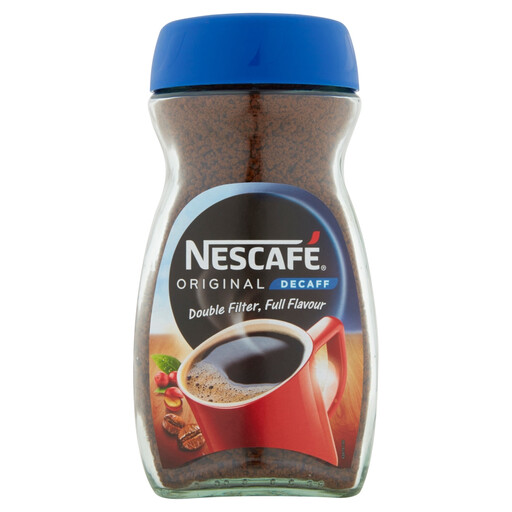 Image unavailable
This 200 g jar contains decaffeinated soluble coffee for a shared kitchen using hot water.
Store in a cool, dry place. Follow this jar's own serving instructions when planning replenishment.
No. Instant or soluble coffee is made to dissolve in hot water; ground filter coffee needs brewing equipment. Taylors of Harrogate's Flying Start ground coffee, for example, is labelled for cafetière or filter preparation.
Yes, if the office already has the compatible container. Douwe Egberts says its Pure Gold paper refill is intended for its stopper jar, so check the container before ordering the refill.
Follow the instructions for the product you choose. Sainsbury's Gold Roast says one teaspoon per cup, while the Douwe Egberts refill lists a suggested 1.6 g serving; actual use may differ with cup size and individual preference.
Follow its label. Sainsbury's instructs buyers to keep its Gold Roast jar in a cool, dry place and replace the cap after use; Marks & Spencer also specifies cool, dry storage for its Italian Style Instant Coffee.
Read the current product label, especially if ingredients or dietary details matter to colleagues. Marks & Spencer notes that ingredients, nutritional and allergen information may change, so an earlier listing should not replace the label on the product being purchased.