Office managers stocking a shared drinks area
Individual cans make portions straightforward to distribute. A shared bottle calls for fridge space and enough demand to finish it within its stated storage period after opening.


Choose individual cans when portions need to be easy to share or demand is irregular; consider a larger bottle when the team can refrigerate it and use it within the time stated on the label. Check the exact cola’s sugar declaration, caffeine status and sweeteners separately: a zero-sugar name does not establish that it is caffeine-free.
Individual cans make portions straightforward to distribute. A shared bottle calls for fridge space and enough demand to finish it within its stated storage period after opening.
Look for an explicitly named caffeine-free variant rather than relying on a zero-sugar label. Coca-Cola Zero Sugar Caffeine Free and Pepsi Max No Caffeine are separate variants from their standard colas; their ingredient lists still include sweeteners.
Keep school catering separate from an office drinks order. For state-funded schools in England, check the Department for Education’s school-food guidance before selecting drinks; requirements elsewhere in the UK need separate checking.
Start with the nutrition panel and ingredient list for the exact variant, then choose a pack format that fits how quickly the office uses it.
| Priority | What to check | Your needs |
|---|---|---|
| Declared sugars | Read sugars per 100ml and per serving on the exact product. Coca-Cola GB and Pepsi UK list 0g sugars per 100ml for their standard Zero Sugar and Max colas; Sainsbury’s lists less than 0.5g per 100ml for Cola Zero. | I want a cola that fits the office’s no-added-sugar brief, without assuming similarly named drinks have identical nutrition values. |
| Caffeine | Check the ingredients or an explicit caffeine-free variant name. Standard Coca-Cola Zero Sugar and Pepsi Max list caffeine; their named caffeine-free variants are different products. | Some colleagues avoid caffeine, so I need to know whether there is a separate cola choice for them. |
| Sweeteners | Read the current ingredient list and any phenylalanine warning. Coca-Cola GB lists sweeteners and a phenylalanine warning for standard Coca-Cola Zero Sugar; Pepsi UK lists sweeteners in Pepsi Max and its caffeine-free variant. | Colleagues need the label information to check ingredients against their own requirements, rather than treating “zero sugar” as “no sweeteners”. |
| Pack and storage | Compare can count and size with likely use. For its 2L Cola Zero bottle, Sainsbury’s says to refrigerate after opening and use within 3 days. | For occasional demand, I would rather open one can than leave a shared bottle unfinished. A bottle is practical if we have fridge space and will use it promptly. |
| Drinks throughout the day | Keep plain water available alongside cola. Wirral Community Health and Care NHS Foundation Trust notes that sugar-free and diet fizzy drinks can be acidic and cause tooth wear. | I want cola as an office drink option, not the only drink available at desks. |
Standard Coca-Cola Zero Sugar and Pepsi Max list caffeine, so stocking only those variants will not give colleagues a caffeine-free cola choice.
If that choice matters, order a variant explicitly labelled caffeine-free and check its exact name when restocking.
Zero-sugar and caffeine-free variants can still contain sweeteners. Coca-Cola GB also states that standard Coca-Cola Zero Sugar contains a source of phenylalanine.
Make the current label available for ingredient checks. The Food Standards Agency identifies undeclared aspartame as a possible risk for people with phenylketonuria (PKU).
Sainsbury’s instructs buyers to refrigerate its 2L Cola Zero after opening and use it within 3 days. That matters if only a few colleagues drink cola.
Match bottles to reliable turnover and available fridge space; use individual cans when demand is less predictable.
An unfinished open bottle may have to be discarded after its stated storage period.
Office snacks and drinks supplied in state-funded schools in England are different purchasing settings. The Department for Education provides a restricted permitted-drinks list for those schools.
Check that guidance before a school order, and check the relevant rules separately for Scotland, Wales or Northern Ireland.
These references describe particular cola lines and labels, not every product made or stocked by each brand or retailer.
Coca-Cola Zero Sugar has standard and Caffeine Free variants. Coca-Cola GB lists 0g sugars per 100ml for both.
Pepsi UK lists 0g sugars per 100ml and per 330ml for Pepsi Max and Pepsi Max No Caffeine.
Sainsbury’s Cola Zero is a 2L shared-bottle option listed with less than 0.5g sugars per 100ml.
Tesco describes its Diet Cola as a no-added-sugar cola with caffeine and sweeteners.
These canned cola options cover a caffeine-free variant, standard zero-sugar colas in different pack sizes and a cherry-flavoured alternative. Choose by the exact variant and pack, not the parent brand name alone.
 No image available
Individual cans for an office that wants a separately named caffeine-free cola choice. The pack contains 24 × 330ml cans; caffeine-free does not mean sweetener-free, so check the current ingredients and warnings.
 No image available
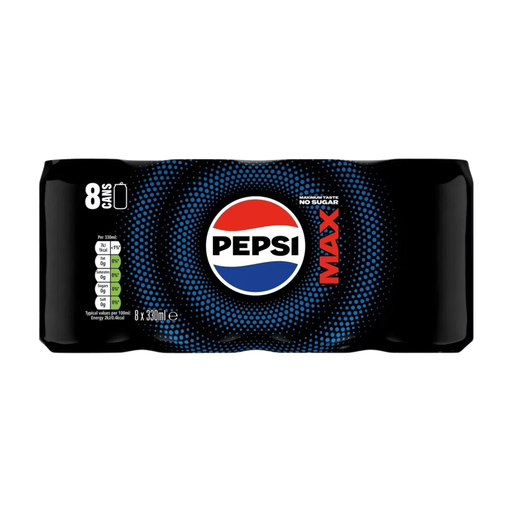
An eight-can format when the office wants individual standard-cola servings in a smaller case. Joybuy lists 0g sugars per 100ml and per 330ml can for this product; its ingredients include caffeine and sweeteners.
 No image available
A 24-can format for individually portioned office drinks. Joybuy lists 0g sugars per 100ml and per 330ml can for this product; the standard variant contains caffeine and sweeteners.
 No image available
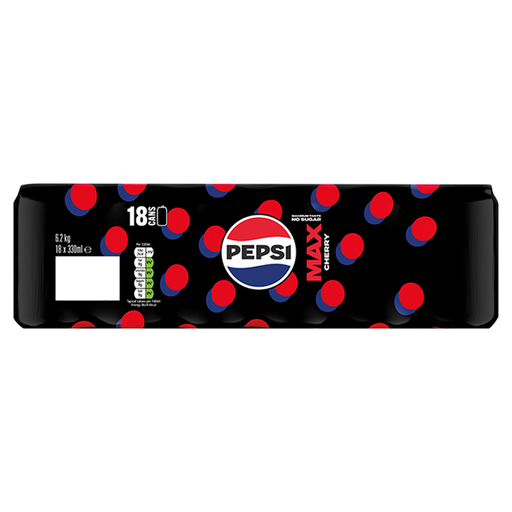
Cherry-flavoured individual cans for an office that wants an alternative to standard cola. This is an 18 × 330ml pack; check the current label for its sugar declaration, caffeine and sweeteners before adding it to a no-added-sugar order.
Do not use that phrase alone to determine the sugar amount; read the nutrition panel on the exact product. Coca-Cola GB and Pepsi UK list 0g sugars per 100ml for Coca-Cola Zero Sugar and Pepsi Max, while Sainsbury’s lists less than 0.5g per 100ml for Cola Zero.
Not necessarily. Standard Coca-Cola Zero Sugar and Pepsi Max list caffeine. If the office needs a caffeine-free choice, check for the exact Caffeine Free or No Caffeine variant rather than relying on the zero-sugar name.
Some aspartame-containing colas carry that warning, so colleagues who need to check ingredients should have access to the current label. The Food Standards Agency identifies undeclared aspartame as a possible risk for people with phenylketonuria (PKU).
Keep plain water available as well. Wirral Community Health and Care NHS Foundation Trust notes that sugar-free and diet fizzy drinks can be acidic and cause tooth wear; a zero-sugar declaration does not remove that consideration.
Check the school requirements separately rather than carrying over the office selection. For state-funded schools in England, the Department for Education’s school-food guidance sets out a restricted list of permitted drinks. Check the relevant rules separately for schools in Scotland, Wales and Northern Ireland.