
24/7 Customer Support

Free returns

Same-day & Next-day Delivery

Quality Guaranteed

Unlock Your Welcome Offers: FREE Delivery | Up to 80% OFF | Free 30-day JoyPlus trial
Download the APP
A tidy desk can transform your workday, but the path to an organised workspace is often cluttered with poor purchasing decisions. An ineffective office file organiser doesn't just fail to solve the problem; it adds to the chaos. As a Joybuy Product Recommendation Officer, my role is to help you see past the marketing and identify the practical features that truly matter. Before you buy, let's look at the common pitfalls that lead to wasted money and continued frustration.
Many organisers look promising online but fail in practice. Here are three frequent issues to watch for:
By understanding these design flaws, you can make a more informed choice and invest in a solution that provides lasting order.
To avoid the traps, focus on a few core parameters that determine an organiser's quality and longevity. These are the non-negotiable details to check before adding any item to your basket.
The material of your organiser is its most important feature. While basic plastic can suffice for very light use, it often becomes brittle over time. For durability, metal is a superior choice. However, not all metal is equal. Look for powder-coated steel. This finish provides a durable, protective layer that resists the rust, chipping and scratches common with daily use. Quality metal mesh desk accessories offer a good balance of strength, visibility of contents and a contemporary aesthetic that suits most home office storage setups.
Consider your available workspace. Do you have ample desk surface, or is every square centimetre precious?
Always check the internal dimensions of each slot to ensure they comfortably accommodate A4-sized folders and binders.
An organiser is only as good as its stability. For desktop models, look for non-slip rubber feet that protect your desk surface and prevent the unit from sliding. If you are considering a stackable paper tray, check that the units have a mechanism to lock or sit securely on top of one another. For any multi-tiered document sorter, a wider, heavier base is a positive indicator of a stable design that is less likely to tip over.
Based on these practical criteria, here are a few recommendations matched to different user needs.
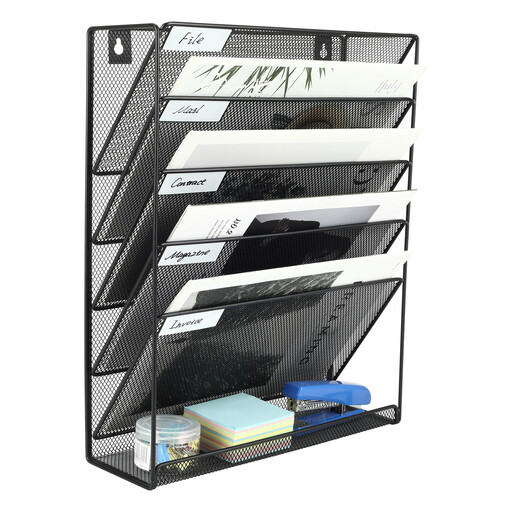
Why This Fits Their Persona: For those working from a compact home office or study nook in the UK, desk space is a premium. This wall-mounted unit moves all paper storage off the desk, freeing up the entire surface for active work.
By mounting directly to the wall, it completely eliminates the risk of tipping associated with unstable desktop units. Its powder-coated metal construction ensures it won't sag under the weight of files.
Maximises vertical space to keep desks clear. The six tiers allow for excellent categorisation of projects, bills and mail.
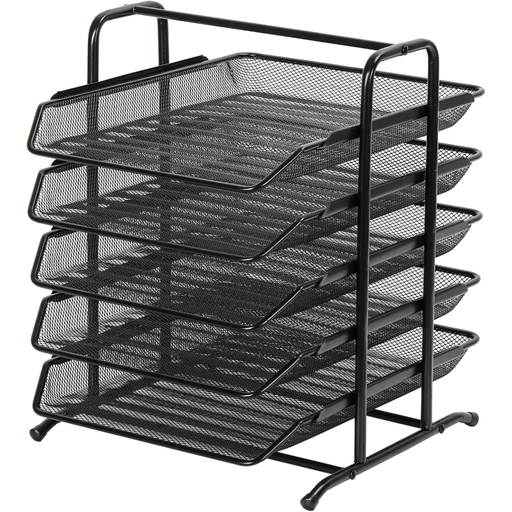
Why This Fits Their Persona: Ideal for office administrators, accountants or anyone managing multiple projects. This user needs high capacity and, crucially, easy access to all documents without having to unstack trays.
The pull-out tray design solves the problem of inaccessible lower tiers. Its sturdy metal frame and protective rubber feet provide the stability needed for a tall, high-capacity unit, preventing tipping.
Offers five spacious tiers with an easy-access pull-out function. The 37.5cm height provides significant storage volume on a standard desktop footprint.
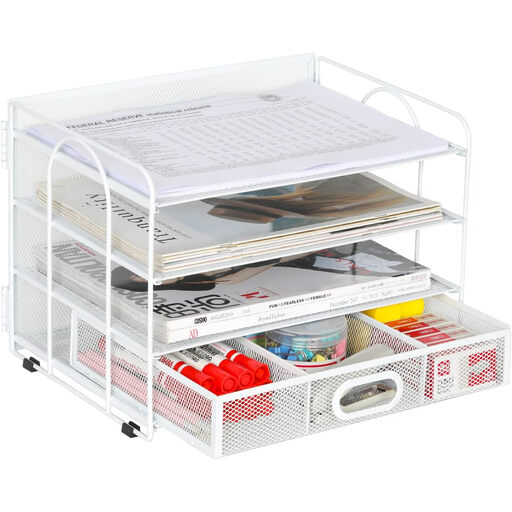
Why This Fits Their Persona: Perfect for students or professionals who need more than just a paper tray. This user wants a single unit to serve as a complete desk tidy organiser, holding files, notebooks, pens and other small stationery items.
This integrated unit is inherently more stable than using a separate file tray and pen pot. The anti-slip rubber feet prevent sliding and the robust metal construction with L-shaped supports prevents the shelves from bending.
Combines four A4 file trays with a built-in stationery drawer. It's a complete, space-efficient solution for total desk organisation.
We have compiled a complete, real-time list of products that fully satisfy these strict selection criteria and UK safety regulations.
How do I stop my stackable paper tray from sliding? The most effective solution is to choose a model designed with stability in mind. Look for trays that have an interlocking mechanism or deep grooves that allow them to sit securely. If you already own a sliding set, placing a thin, non-slip mat (like a piece of drawer liner) between each layer can provide the friction needed to keep them in place.
What is the difference between a file holder and a letter tray? While the terms are often used interchangeably, a "letter tray" typically refers to a single, horizontal tray for incoming or outgoing mail. A "file holder" or "document sorter" is usually a more complex unit with multiple vertical or horizontal compartments designed for categorising and storing various documents, folders and files.
Can a metal mesh desk organiser damage my wooden desk? This is a valid concern. A quality metal organiser will incorporate protective features to prevent this. Always check the product description for protective rubber feet or a smooth, coated base. These small details prevent the metal from scratching or scuffing wooden or other delicate surfaces. Avoid any metal organisers that have sharp, unfinished edges on their base.