Workers planning a fruit drink with lunch
A chilled smoothie may be convenient at work, but bottle size matters. The NHS advises a combined daily limit of 150ml for fruit juice and smoothies.


For an office snack, plan a measured smoothie portion rather than treating a whole bottle as one serving: the NHS advises limiting fruit juice and smoothies to a combined 150ml a day and having them with a meal. A “no added sugar” label does not mean zero sugar, so compare the sugars figure, bottle size, ingredients and storage instructions before choosing.
A chilled smoothie may be convenient at work, but bottle size matters. The NHS advises a combined daily limit of 150ml for fruit juice and smoothies.
“No added sugar” describes what has been added to a recipe, not its total sugar content. UK oral-health guidance counts sugars naturally present in smoothies as free sugars.
Recipes differ in fibre, bottle size and ingredients. Check the nutrition panel and allergens rather than assuming a thicker-looking blend will suit your snack plans.
Start with the portion you intend to drink, then compare the label and whether the bottle can be stored as directed at work.
| Priority | What to check | Your needs |
|---|---|---|
| Portion size | Compare bottle volume with the NHS combined 150ml daily guide for juice and smoothies. Check whether the pack describes more than one serving. | I want a portion I can plan alongside lunch, rather than assuming a 250ml or larger bottle is one recommended daily portion. |
| Sugar claims | Read “no added sugar” separately from the sugars figure per 100ml or per 100g. Check the ingredient list if added sweetening ingredients matter to you. | I want to know how much sugar the smoothie contains, regardless of the wording on the front. Waitrose lists 10g sugars per 100ml for its 250ml Innocent no-added-sugar example. |
| Label reading | Use traffic-light colours where shown, then read the numerical nutrition panel and bottle volume; the colours alone do not describe the amount in a whole bottle. | I use food labels to compare products, then check the smoothie’s own figures. In the Food Standards Agency and Ipsos Northern Ireland’s 2024 survey of 611 people interviewed in Northern Ireland, 49% actively used traffic-light labelling when shopping for food. |
| Fibre and ingredients | Compare fibre on the same per-100ml or per-100g basis. Read the ingredients and allergen information, particularly for blends containing oats or yoghurt. | For a snack with different ingredients from a fruit-only drink, I want to see what is actually in the blend. Marks & Spencer lists 3.6g fibre per 100g for M&S Revitalise and marks it unsuitable for coeliacs. |
| Office storage | Check the bottle’s refrigeration instructions and directions after opening. Decide whether you can measure and store any portion left over. | If I open a bottle at work, I need fridge access and a plan for the remainder. Marks & Spencer specifies refrigerated storage at 0°C to +5°C for M&S Revitalise. |
The two descriptions are not interchangeable: Waitrose lists 10g sugars per 100ml for its 250ml Innocent no-added-sugar smoothie.
Read the sugars line on the current nutrition label as well as the front-of-pack claim.
The NHS advises limiting juice and smoothies together to 150ml a day. Tesco describes a 250ml Innocent bottle as containing 1⅔ stated 150ml servings.
Measure the portion you plan to drink and account for any juice you also have that day.
Added vitamins or a “green” name do not tell you the sugar or fibre figures. Tesco lists Naked Green Machine at 8.8g sugars and 0g fibre per 100ml.
Compare the nutrition panel and ingredients on a consistent per-100ml or per-100g basis before considering bottle size.
Chilled bottles have product-specific storage directions, while blends can include ingredients such as oats. Marks & Spencer marks M&S Revitalise unsuitable for coeliacs.
Check the current bottle’s allergen, refrigeration and after-opening instructions before bringing it to work or sharing it.
These examples show why the individual recipe and bottle label matter more than a brand name alone.
Innocent describes its smoothie range as having no added sugar; individual recipes still need a nutrition-label check.
Tesco lists Naked Green Machine in a 750ml bottle.
Tesco’s cited listings include a 250ml Innocent smoothie and a 750ml Naked smoothie, making pack size worth checking alongside nutrition.
Sainsbury's lists a 250ml Innocent pineapple, banana and coconut smoothie.
Marks & Spencer lists smoothies in 350ml and 750ml formats, including blends made with ingredients such as oats or yoghurt.
Waitrose lists a 250ml Innocent mango, passionfruit and apple no-added-sugar smoothie.
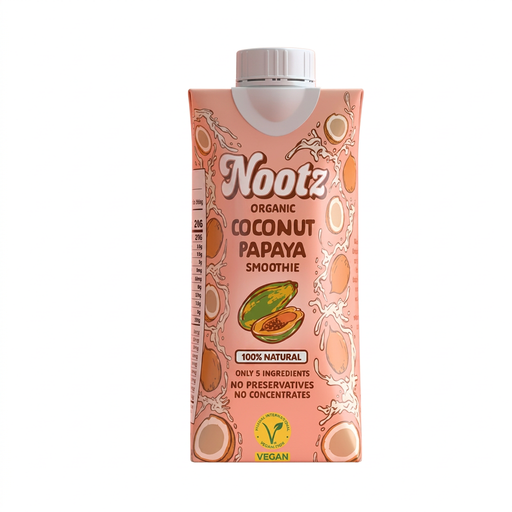
This papaya and coconut milk smoothie comes in a 180ml bottle. For an office snack, its bottle size makes portion planning particularly relevant.
 No image available
The 180ml bottle is an option for a planned office portion, but drinking it all would exceed the NHS combined 150ml daily guide for fruit juice and smoothies. Check the current label for sugars, ingredients and storage directions.
No. Waitrose lists 10g sugars per 100ml for its Innocent no-added-sugar smoothie. Check the sugars figure on the specific bottle rather than using the claim as a substitute for the nutrition panel.
The NHS advises limiting fruit juice and smoothies to a combined 150ml a day and having them with a meal. A 250ml bottle exceeds that guide if you drink it all, so check the volume and measure the portion you intend to have.
Yes. Guidance from the Department of Health and Social Care and other UK health bodies includes sugars naturally present in smoothies and fruit juices in its definition of free sugars.
Read the exact bottle’s refrigeration and after-opening directions, particularly if you plan to save a portion. Marks & Spencer specifies storage at 0°C to +5°C for M&S Revitalise; other products may have different instructions.
No. Vitamin information does not replace the sugars and fibre figures. Tesco lists Naked Green Machine at 8.8g sugars and 0g fibre per 100ml, so compare the full panel and the amount you plan to drink.