
24/7 Customer Support

Free returns

Same-day & Next-day Delivery

Quality Guaranteed

Unlock Your Welcome Offers: FREE Delivery | Up to 80% OFF | Free 30-day JoyPlus trial
Download the APP
Finding the right office stationery can feel like a simple task, but how often have you been let down by a pen that smudges or a notebook whose pages are too thin for your favourite ink? In the UK, we often find ourselves replacing school supplies and home office essentials far too frequently. This isn't just frustrating; it's a waste of money. Before you add another pack of disappointing pens to your basket, let's look at the common pitfalls and how to avoid them.
The most frequent complaints often stem from a few key issues:
Equipping your workspace, whether at home, in the office or for your studies, shouldn't be a gamble. By understanding a few core features, you can select stationery that performs reliably every time.
To avoid the common traps, focus on the specifications that directly impact performance. Marketing language can be misleading, but technical details tell the real story.
The type of ink and the design of the tip determine how a pen feels and performs.
The single most important factor for notebook paper quality is its weight, measured in GSM (Grams per Square Metre). Low-quality notebooks often use paper around 60-70 gsm, which is prone to ink bleeding and "ghosting" (where writing is visible from the other side).
For a reliable, all-purpose notebook like an A4 project book, look for a minimum of 80 gsm paper. This weight is substantial enough to handle most writing pens, including gel and rollerball types, without significant bleed-through, ensuring you can use both sides of every page.
For items you use daily, comfort and construction matter.
Instead of a one-size-fits-all approach, we've matched specific products to the people who will get the most out of them.
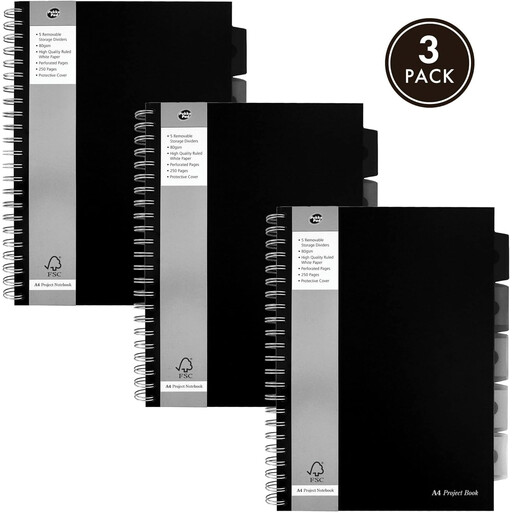
Why This Fits Their Persona: Perfect for managing multiple university modules or office projects. The repositionable dividers allow for easy organisation, while the durable, wipe-clean cover stands up to being carried in a backpack or briefcase all day.
It directly solves the bleed-through problem with high-quality 80 gsm paper, ensuring every page is usable. The robust polypropylene cover prevents the wear and tear common with cheaper notebooks.
Five colour-coded dividers with storage pockets for organising notes and loose papers. Pages are perforated for clean and easy removal.
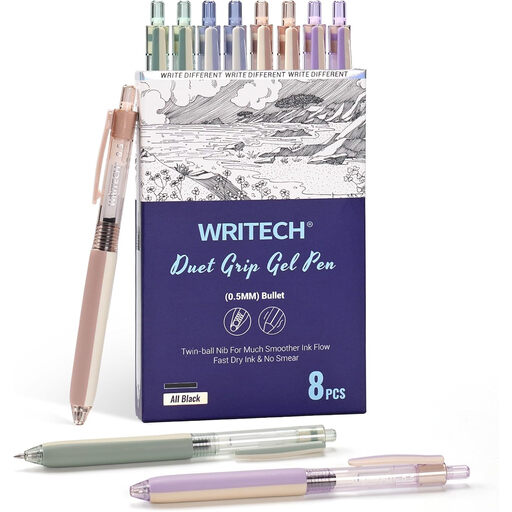
Why This Fits Their Persona: Ideal for quiet environments like open-plan offices or libraries. The silent clicker mechanism is non-disruptive, and the quick-dry ink is essential for signing documents or taking rapid notes without smearing.
The specially formulated quick-dry ink directly counters the smudging pitfall, making it reliable for left-handers. Its patented, durable mechanism avoids the failures of cheap multi-pack pens.
Features a patented silent clicker and a triangular barrel for an ergonomic grip. The 0.5mm fine point allows for precise, clean lines.
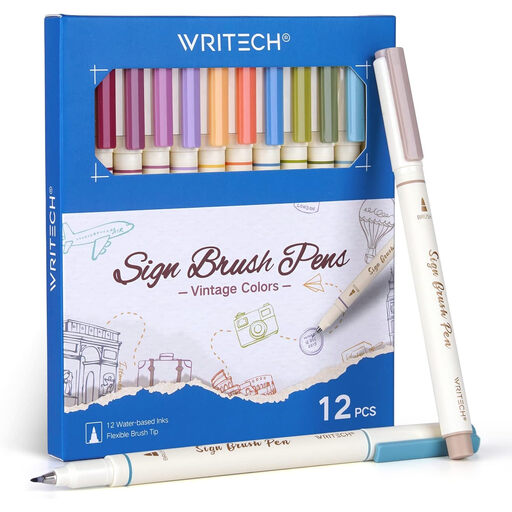
Why This Fits Their Persona: This set is for those who use their stationery for more than just writing. The flexible brush tips are perfect for modern calligraphy, hand-lettering and illustration in journals or sketchbooks. The unique vintage colour palette sets creative work apart.
This is a specialised tool, not a generic pen. It avoids the trap of using standard pens for artistic work, which often results in inconsistent lines and poor colour blending. The felt tip is designed to be wear-resistant.
Features a pressure-sensitive soft brush tip for creating variable line widths. The water-based ink is blendable, allowing for a range of artistic effects.
1. What is the main difference between gel pens and ballpoint pens? The primary difference is the ink. Gel pens use a water-based gel that produces a bold, vivid line but can be more prone to smudging if not formulated to be quick-drying. Ballpoint pens use a thick, oil-based ink that is naturally smear-resistant and long-lasting, though traditionally less smooth than gel. Modern low-viscosity ballpoints, however, offer a much smoother writing experience.
2. How can I stop my pens from smudging? The best way is to choose a pen with ink specifically designed to be quick-drying. This is especially important for gel and liquid ink pens. For left-handed writers, a quick-drying gel pen or a smooth-flowing ballpoint is often the most reliable choice. Also, ensure your paper is absorbent enough; very glossy paper can increase drying time for any ink.
3. What does 80 gsm paper mean for a notebook?GSM stands for "Grams per Square Metre" and indicates the weight and thickness of the paper. Standard printer paper is often 80 gsm. For notebooks, 80 gsm is a good quality standard that provides enough thickness to prevent most inks from bleeding through to the other side, making it a reliable choice for students and professionals who use a variety of writing pens.