Weekly lunch planners
If you pack lunch several times a week, separate tins let you take one unopened portion at a time. Compare the number of tins, their size and whether one tin fits the sandwich, salad or other lunch you plan to make.


For several office lunches, a multipack of separate tins makes portion planning straightforward; check whether one tin suits each lunch. Choose a no-drain format if you prepare food where draining is awkward. A larger single tin makes more sense when you can refrigerate and use its contents after opening.
If you pack lunch several times a week, separate tins let you take one unopened portion at a time. Compare the number of tins, their size and whether one tin fits the sandwich, salad or other lunch you plan to make.
If a sink or food-preparation area is inconvenient, consider a product explicitly labelled no-drain. John West describes its No Drain spring-water tuna as ready to use; check that the particular pack has this format.
Look at the current tin for an MSC label or a product-specific catch-method statement. A retailer’s wider sourcing commitment is useful context, but check that it applies to the pack you are buying.
Start with the number and size of sealed tins you will use, then consider where you will prepare lunch and what will happen to any leftovers.
| Priority | What to check | Your needs |
|---|---|---|
| Portions | Check both tin count and size: a 4 x 145g pack has four separate tins, while a 3 x 100g pack has three smaller ones. Look for drained weight when judging the tuna portion. | I pack lunch on several days and want to know whether one sealed tin will suit each meal. |
| Preparation | Check whether the exact product says no-drain or requires draining. John West describes its No Drain spring-water format as ready to use. | There is nowhere convenient to drain a conventional tin when I assemble lunch at work. |
| Packing liquid | Read the ingredient and nutrition labels for the exact tin. Princes lists tuna and spring water for its spring-water chunks; brine and sunflower-oil products have different packing liquids. | I want a packing liquid that works with my lunch recipe, and I need to check the label for any nutrition or allergen details that matter to me. |
| Leftovers | Read the pack’s instructions before choosing a large single tin. Marks & Spencer says to move unused spring-water tuna to a non-metallic container, refrigerate it and eat it within two days. | If I open more than I need for one lunch, I need a way to chill and use the remainder within the stated period. |
| Fishery sourcing | Check the current pack for an MSC label or applicable sourcing details. Sainsbury’s described its own-label canned tuna as MSC-certified and pole-and-line caught in May 2023; Tesco says it met its MSC-certified tuna commitment across Tesco UK and Booker by the end of 2025. | I want sourcing information that applies to the particular tuna I buy, not just a general statement about a brand or retailer. |
Four tins do not always provide the same amount of tuna: the packs here include both 125g and 145g cans, and packed weight may differ from drained weight.
Check the size of each tin and any stated drained weight against the portion you would use for one lunch.
A large tin creates a storage task if one lunch uses only part of it. Marks & Spencer instructs shoppers to transfer unused spring-water tuna to a non-metallic container, refrigerate it and eat it within two days.
Choose separate tins for solo lunches unless you can follow the exact product’s storage instructions for the remainder.
A multipack can provide convenient sealed portions without making each tin ready to use straight from the can.
If draining at work would be difficult, check for an explicit no-drain statement on the exact product rather than relying on pack size or brand.
UK pregnancy guidance limits tuna intake. The NHS advises no more than four cans of tuna or two tuna steaks a week during pregnancy.
When planning a week of lunches, account for tuna eaten in other meals as well and refer to current NHS pregnancy food guidance.
Tesco lists own-label 4 x 145g tuna chunks in both spring water and brine, formats suited to taking separate tins for several lunches.
Sainsbury's lists own-label 4 x 145g spring-water and brine tuna multipacks for separately packed lunches.
John West offers a No Drain spring-water tuna format for lunches assembled where draining a tin is inconvenient.
Princes lists spring-water tuna chunks in several sizes, including 3 x 80g, 4 x 145g, 6 x 145g and 8 x 145g.
M&S provides product-level storage instructions for its tuna chunks in spring water, relevant when preparing more than one portion from a tin.
These options include separate tins for repeated lunches, a No Drain three-pack and a larger case of four-tin packs. Check the tin size and preparation format of each product rather than treating the packs as interchangeable.
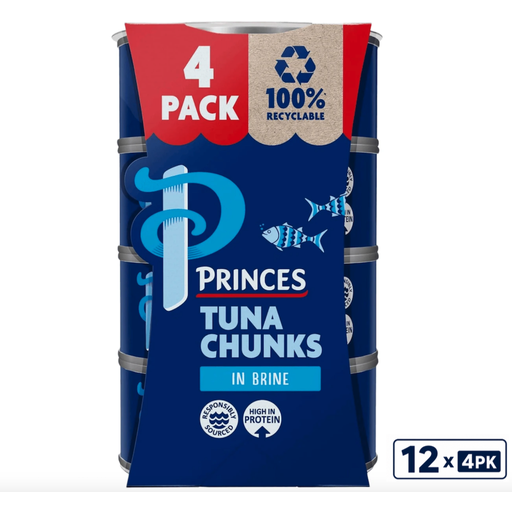 No image available
This larger quantity suits lunch planning that will use many separately sealed tins. The title specifies 12 packs of four 145g tins in brine; check that you have space for the full quantity. After opening a tin, follow its instructions for storing and using any leftovers.
 No image available
Six separate tins allow you to take an unopened portion on different lunch days. Each tin is labelled 145g and packed in spring water; check whether that size suits your usual recipe. Follow the product’s refrigeration instructions if you leave a tin partly used.
 No image available
The stated No Drain format suits lunch assembled where draining a tin is awkward. This pack contains three separate 100g tins, so check whether that portion size and tin count fit your week.
No image available
Four separate tins can cover several packed lunches if one 145g tin suits each meal. This product is packed in sunflower oil; check that the liquid works with your recipe and read the exact pack’s nutrition label.
 No image available
Four separate tins suit a plan to take one unopened tin on each of four lunch days. At 125g per tin, this is a different size from a 4 x 145g pack. If draining at work matters, check the exact pack’s preparation instructions rather than assuming it is No Drain.
Yes, if one 145g tin suits each lunch: the pack gives you four separately sealed tins. Check any stated drained weight when deciding whether one tin makes the portion you want.
Choose by the packing liquid you want in your recipe and by the exact product label. Princes lists tuna and spring water for its spring-water chunks; check the ingredients and per-100g nutrition for brine or oil-packed alternatives rather than assuming their contents are the same.
Follow the storage instructions on the exact tin. For its spring-water tuna chunks, Marks & Spencer instructs shoppers to transfer unused contents to a non-metallic container, refrigerate them and eat them within two days.
It makes sense when you assemble lunch somewhere that draining a conventional tin is inconvenient. John West describes its No Drain spring-water tuna as ready to use; check the tin count and size too, because its 3 x 100g pack provides three portions rather than four.
NHS pregnancy guidance advises no more than four cans of tuna or two tuna steaks a week. A multipack does not change that weekly guidance, so tuna eaten in other meals matters when planning repeated lunches.