Kettle-only office snack areas
If colleagues make coffee with a kettle and mugs, soluble instant decaf avoids the need for separate brewing equipment. Check the serving directions so the shared jar is straightforward to use.


Choose instant decaf if the office snack area has a kettle but no coffee brewer; choose ground coffee if staff can brew and clean up, or beans if there is a compatible grinder or bean-to-cup machine. Blend descriptions can help narrow the choice, but taste is personal, and decaf should not be treated as caffeine-free.
If colleagues make coffee with a kettle and mugs, soluble instant decaf avoids the need for separate brewing equipment. Check the serving directions so the shared jar is straightforward to use.
For a jar serving different tastes, compare the suppliers’ balanced, rounded or medium descriptions as starting points. A more distinctive flavour description is worth considering if colleagues already know what they prefer; none guarantees a shared favourite.
A cafetière or filter brewer makes ground decaf an option. Whole beans call for a compatible grinder or bean-to-cup machine, along with someone to manage preparation and cleaning.
Start with the equipment people will use, then compare the blend description and pack information for the format that fits.
| Priority | What to check | Your needs |
|---|---|---|
| Preparation | For a kettle-only area, look for soluble instant coffee and read the hot-water directions. Ground coffee needs a compatible brewer; beans need grinding or a bean-to-cup machine. | When breaks are short, I want a cup colleagues can prepare with the equipment already in the kitchen. |
| Blend description | Compare stated flavour and intensity within the format you plan to buy. Tesco lists Kenco Decaf 190g as balanced and rounded with intensity 7; Taylors describes its ground Decaffé with caramel and malt notes. | If one pack serves several people, I would start with a familiar-sounding profile, while recognising that a supplier’s description cannot predict everyone’s taste. |
| Caffeine | Check the decaffeinated designation, but do not read it as a zero-caffeine guarantee. NESCAFÉ UK & IE explains that decaf has most, rather than all, of its caffeine removed. | I want a reduced-caffeine option and need colleagues to understand what “decaf” does—and does not—mean. |
| Shared supply | Check pack size, serving directions and storage guidance on the current pack. Compare like-for-like unit prices when ordering, rather than relying on an earlier promotion. | For a regularly used kitchen, I need a pack and preparation routine that staff can manage and replenish. |
| Product information | Read the current ingredients and allergen information where dietary requirements matter. Retailer product details can change, so check the physical pack before serving. | Before putting coffee in a shared area, I want the information colleagues rely on to match the product they will actually use. |
Unlike instant coffee, ground coffee needs brewing equipment and whole beans need a compatible grinding setup. Neither can simply be stirred into hot water as a substitute for instant.
Check the kitchen equipment before choosing a format, and establish who will handle brewing and cleaning.
Adding a brewer or grinder also adds equipment and cleaning tasks to the snack-area routine.
NESCAFÉ UK & IE explains that decaffeination removes most caffeine, not necessarily all of it.
Describe the office option as decaf rather than caffeine-free. Anyone who must avoid caffeine completely should not assume a decaf coffee meets that requirement.
Retailer promotions and store-specific listings do not establish what the same pack will cost on a later order.
Compare current unit prices on the same basis when placing each order, particularly if switching between pack sizes or formats.
Ingredients, allergen information, serving directions and other product details can change.
Check the listing when ordering and the physical label before putting a pack into a shared kitchen, especially where colleagues have dietary requirements.
These examples show how instant, ground and bean formats are described; a brand name alone does not establish which blend colleagues will prefer.
Gold Blend Decaf is a freeze-dried instant option for a kettle-based office.
Kenco Decaf offers a freeze-dried instant route.
Taylors offers ground Decaffé for brewing, as well as a decaf bean format for compatible equipment.
Tesco’s own-label decaf listings include instant coffee in distinct 200g packs.
Gold Roast Decaffeinated Instant Coffee is a 200g freeze-dried option described as medium, smooth and well rounded.
M&S Gold Decaf is a freeze-dried instant coffee described as medium roast.
These options include decaf packs for kettle-based snack breaks and one ground coffee for an office with brewing equipment. Match the format to the kitchen setup before comparing pack sizes or blend descriptions.
 No image available
A 190g instant decaf option for a kettle-based snack area. NESCAFÉ describes Gold Blend Decaf as an Arabica-and-Robusta blend with a smooth, rounded flavour; check the pack directions for serving.
 No image available
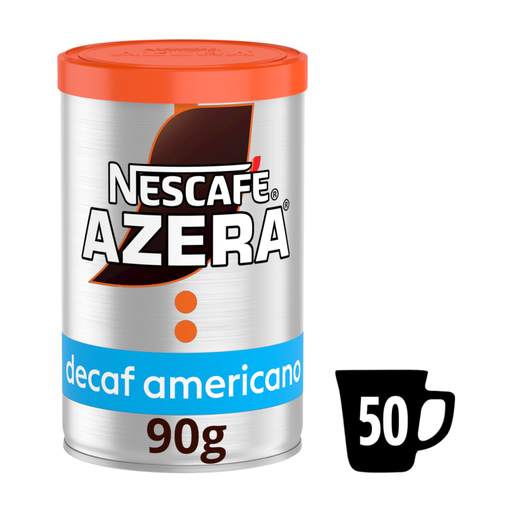
A 90g decaf Americano option to consider for short snack breaks. Check the tin’s preparation directions and whether colleagues want this style rather than a general shared blend.
 No image available
This 100g instant decaf fits a kettle-based preparation routine. Check its own serving directions; the intensity rating given for a different 190g Kenco listing should not be assumed for this pack.
 No image available
This 200g ground decaf is for an office with a compatible brewer, not a kettle-only kitchen. Taylors describes its Decaffé ground coffee with caramel and malt notes and its Pure Water Process; brewing and cleaning take additional steps.
 No image available
A 300g decaf jar to consider when planning shared office supply. Confirm the pack’s preparation directions so colleagues can make cups consistently, and check that the format suits the kitchen equipment.
No. NESCAFÉ UK & IE explains that decaf coffee has most of its caffeine removed but is not necessarily caffeine-free. Do not use a decaf label as a zero-caffeine guarantee.
Instant decaf is the appropriate format when colleagues have a kettle and mugs but no brewer. Ground coffee calls for a cafetière, filter brewer or other compatible equipment, plus time for brewing and cleaning.
Compare descriptions within the format your office can prepare: balanced or rounded instant blends offer one starting point, while Taylors describes its ground Decaffé with caramel and malt notes. These are supplier descriptions, not a promise that everyone will perceive or prefer the same flavour.
Yes, particularly when colleagues have dietary requirements. Check the current listing when ordering and the physical pack before serving, because retailers warn that product details can change.