What matters when choosing?
Choose an output range that makes sense for the measured room, then check whether the radiator and its lead can be placed safely; decide whether a timer adds value after those checks. A fan heater is also worth comparing if your main aim is a brief burst of warmth: Which? describes the heat from an oil-filled radiator as more gradual and longer-lasting.
Compact, lower-output radiator
Consider it when: Floor space is tight and you want occasional supplementary warmth in a reasonably insulated room.
Trade-off: Lower maximum output may be less suitable if the room is persistently chilly or draughty; check the exact model’s dimensions as well as its wattage.
Mechanical 1.5 kW radiator
Consider it when: You use one chilly room regularly and are content to adjust its heat settings and thermostat yourself.
Trade-off: A 1.5 kW rating does not establish that any particular room will become warm enough; insulation and draughts still matter.
Timed or digital 1.5 kW radiator
Consider it when: Your room-use times are predictable and you would use scheduling or digital controls.
Trade-off: A timer does not make it appropriate to leave a portable heater running while you are out or asleep.
| Concern |
What to check |
Who it matters to |
| Enough heat for the room |
Measure the room and compare exact-model output settings and capacity claims, allowing for insulation and draughts. De’Longhi UK states 45 m³ for TRRS0715; Dunelm describes a Russell Hobbs model as suitable for up to 15 m². The two measures are not interchangeable sizing rules. |
If my room stays chilly despite its small floor area, I need to judge whether the heater can address its heat loss. Around 33% of consumers would put room-heating capacity first. |
| Footprint and movement |
Check dimensions, weight, castors or a handle, and cable reach for the exact model. Plan a stable position that leaves walkways clear. |
When there is little spare floor space, I need a place to use and store the radiator without blocking my route through the flat; roughly 20% of consumers would make physical fit their main concern. |
| Controls and scheduling |
Compare thermostat and heat settings; check the manual for timer operation if scheduled use matters to you. |
If I occupy the room at predictable times, I want controls that suit that routine rather than features I will not use. Around 20% of consumers would prioritise control and scheduling. |
| Safe placement and use |
Read the exact manual for clearance, stable-surface and location restrictions. Check the stated safeguards, but keep the heater uncovered and sockets free from overload. |
With furnishings close by or children at home, I need a position where the heater can operate without contact or obstruction; approximately 27% of consumers would put safe use first. |
Oil-filled radiators on Joybuy
These oil-filled radiators offer timed or adjustable-control options alongside higher-output models. Compare each one with the space available and the heating needs of your room; a higher maximum wattage or more fins alone does not settle the choice.
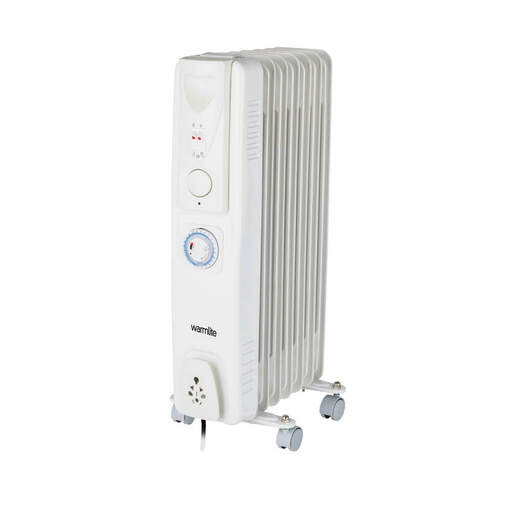 Image unavailable
Warmlite WL43003YTW 1,500 W seven-fin radiator
Consider this model if scheduled use and a choice of heat settings matter in your room.
Its listed features include three heat settings, an adjustable thermostat, a 24-hour timer, castors, and overheat and tip-over protection. Check that its footprint and required clearances fit your intended position.
View on Joybuy
 Image unavailable
DAEWOO HEA1976GE 1,500 W seven-fin radiator
This is another option to assess if you want timed heating with an adjustable thermostat.
The product name specifies a 24-hour timer, tip-over and overheat protection, and a black finish. Check its physical fit and the manual’s placement instructions before choosing a spot in a small room.
View on Joybuy
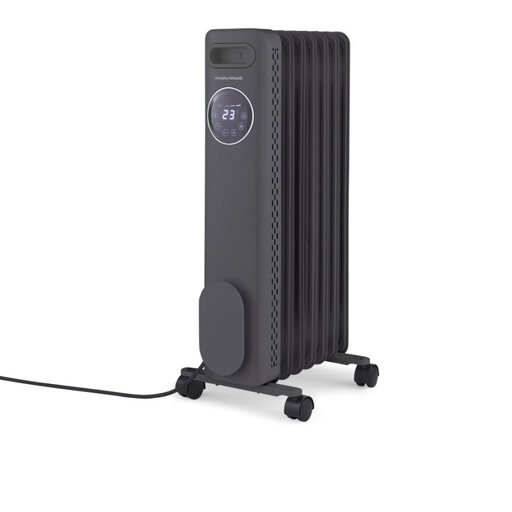 Image unavailable
Morphy Richards HeatFlux 827502 1.5 kW digital radiator
Consider this model if digital operation and a remote control suit the way you use the room.
Its product name identifies a 1.5 kW oil-filled radiator with remote control. Check the space needed around it and the exact operating instructions; remote operation does not change the precautions for leaving home or going to bed.
View on Joybuy
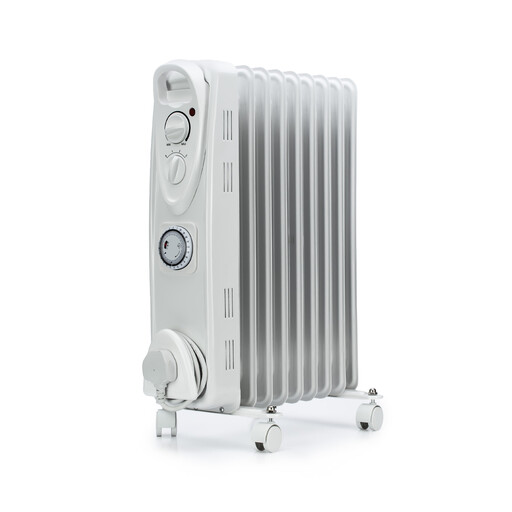 Image unavailable
Status 2,000 W nine-fin oil-filled radiator
Assess this higher-maximum-output option if your room needs more heat, but measure the intended position before deciding it fits a small flat.
The product name lists three heat settings, an adjustable thermostat and a timer. Its 2,000 W maximum does not by itself establish suitability for your room.
View on Joybuy
 Image unavailable
Benross 46769 2,500 W eleven-fin radiator
Consider this higher-output model only after checking whether its size and output suit the room you actually need to heat.
The product name identifies an eleven-fin, 2,500 W oil-filled radiator in black. Check its dimensions, placement requirements and available socket position before choosing it for a compact room.
View on Joybuy
Common questions
How much radiator output does a chilly room need?
Start with the exact model’s stated capacity, then compare it with your measured room and its insulation and draughts. De’Longhi UK lists 45 m³ for TRRS0715, whereas Dunelm describes a Russell Hobbs 1.5 kW model as suitable for up to 15 m²; neither figure is a sizing rule for every room or radiator.
Can I leave an oil-filled radiator on while I sleep or go out?
No: Home Office fire-safety guidance says to unplug electric heaters when going out or going to bed. Follow the exact model’s instructions, keep it clear of curtains and furniture, and never use it to dry clothes.
Can I use a portable oil-filled radiator in a bathroom?
Do not assume it is suitable for bathroom use. Dimplex’s OFXE instructions prohibit using that heater in a bathroom or immediately around a bath, shower or swimming pool; check the restrictions for the exact model you are considering.
Which product marking should I check in Great Britain?
Check the marking requirements that apply to the exact heater rather than assuming one mark is required in every case. In guidance updated in August 2026, the Department for Business and Trade says Great Britain continues to recognise CE marking alongside or instead of UKCA where the relevant regulatory requirements permit it. That guidance concerns England, Scotland and Wales; arrangements differ in Northern Ireland.
What should I check before using a radiator in a rented flat?
Choose a safe socket and cable route, and do not overload an outlet or extension lead, as Electrical Safety First advises. GOV.UK states that a private landlord must ensure the electrical system and any appliances they supply are safe; report damaged fixed electrical equipment to your landlord or agent and follow the instructions for a heater you buy yourself.


