Dark-scene immersion seekers
You play shadow-heavy games in subdued lighting and care more about contrast in dark rooms and corridors than the highest refresh-rate figure.


A 27-inch QHD monitor is a practical starting point for survival horror in a student room. Consider OLED or QD-OLED if dark-scene contrast matters most; consider QHD IPS if the same screen will spend long periods showing coursework and other static content. Check the exact HDR certification, your PC’s frame rates and, for OLED, the model’s panel-care and warranty terms before choosing.
You play shadow-heavy games in subdued lighting and care more about contrast in dark rooms and corridors than the highest refresh-rate figure.
Your screen must serve horror games, coursework and everyday PC use. Desk space, connections and time spent displaying static content all affect the choice.
You want to consider 4K for detailed games and desktop use, and can check whether your PC delivers the frame rates you want at that resolution.
Decide whether dark-scene presentation, a shared study-and-gaming setup or long-session ownership is your main concern; then compare the panel and resolution routes against that need.
Consider it when: Dark-scene contrast is your priority in a subdued room; Dell Technologies and LG Electronics UK list 27-inch QHD models with DisplayHDR True Black 400 certification.
Trade-off: Regular static desktop use makes the exact panel-care guidance and burn-in warranty terms important.
Consider it when: One screen will also show lecture notes and browser windows for long periods; Dell Technologies lists the 27-inch QHD Fast IPS AW2725DM at up to 180Hz.
Trade-off: Its HDR400 designation should not be treated as equivalent to an OLED model’s DisplayHDR True Black certification.
Consider it when: You also want 4K detail and your PC can run your games at the settings and frame rates you intend to use. Dell Technologies lists the AW2725Q as a 4K QD-OLED model rated at 240Hz.
Trade-off: High-frame-rate 4K gaming asks more of the PC than QHD, while OLED panel-care checks still apply.
| Concern | What to check | Who this matters to |
|---|---|---|
| Dark-scene contrast | Check the exact panel type and VESA DisplayHDR tier, then whether your games and connection can use the intended HDR mode. | If dark corridors are central to the games I play, I want to judge contrast rather than rely on an HDR label alone. Around 42% of consumers put that dark-scene need first. |
| Desk and PC fit | Check your PC’s frame rates at the screen’s native resolution and the connections and stand adjustment your desk requires. | When one desk has to handle study and gaming, I need a screen that fits the space and works with my PC. This is the primary concern for roughly 33% of consumers. |
| Long-session ownership | For OLED, read the exact panel-care instructions and warranty wording, including whether burn-in is expressly covered. | If coursework keeps static windows on screen for hours, I want to understand the care involved before committing to OLED. Around 25% of consumers place that ownership concern first. |
A 240Hz or 360Hz screen cannot display game frames that the PC has not produced. Joybuy’s monitor buying guidance distinguishes monitor refresh rate from PC frame rate.
Check frame rates for your PC or GPU at the resolution and game settings you plan to use before prioritising a higher refresh-rate specification.
VESA’s DisplayHDR programme has distinct certification tiers. A generic HDR description does not establish the same dark-scene characteristics as a model carrying DisplayHDR True Black certification.
Check the exact certification and panel technology for the model, particularly if you expect to play HDR-capable games in subdued lighting.
Alienware advertises burn-in cover for a specified OLED model, while ASUS describes care features on specified models. Neither provision automatically applies to another monitor.
Before buying, read the warranty for the exact model and seller, confirm whether burn-in is named and follow the manufacturer’s panel-care guidance.
A reference point for comparing QHD QD-OLED, QHD Fast IPS and 4K QD-OLED models within one monitor line.
Offers model-specific QHD OLED and Nano IPS options to compare for gaming and everyday desktop use.
Relevant when comparing high-refresh OLED models and their stated panel-care provisions.
These QHD OLED and QD-OLED choices suit readers considering a compact screen for horror gaming and everyday desk use. Compare their stated refresh rates with your PC’s output, and check model-specific HDR certification and OLED warranty terms where those affect your decision.
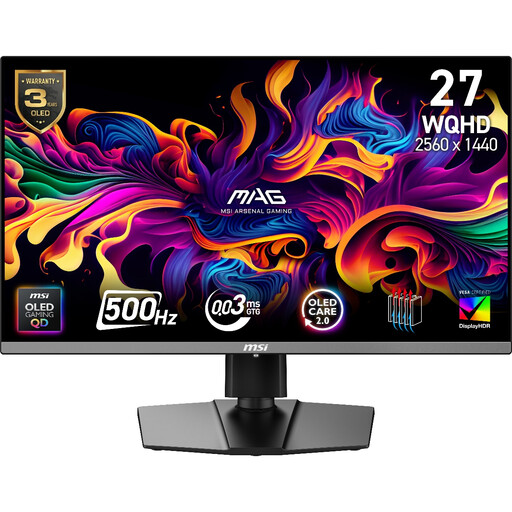 No image available
Consider this QD-OLED option if dark-scene gaming is your priority and your PC can make use of a high refresh rate.
The product name specifies 2560 × 1440 resolution, 500Hz, a quoted 0.03ms response time and AMD FreeSync. Check the exact UK burn-in warranty terms before buying.
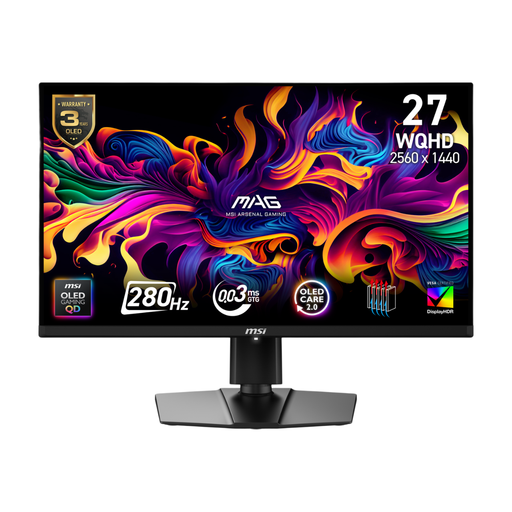 No image available
This QD-OLED model is worth considering for QHD horror gaming on a desk also used for study.
The product name specifies 280Hz and a quoted 0.03ms response time. Check your PC’s frame rates at QHD and confirm the exact warranty and burn-in terms.
 No image available
Consider this QD-OLED model if you want QHD gaming and plan to check OLED ownership terms for a screen also used for coursework.
The product name specifies 2560 × 1440 resolution, 240Hz, a quoted 0.03ms response time and Adaptive-Sync. If certified True Black HDR matters to you, confirm the exact certification; also check the seller’s burn-in warranty wording.
 No image available
This QHD OLED model is an option for a student-room screen shared between horror games and desktop tasks.
The product name specifies 240Hz and a quoted 0.03ms response time. Check the exact HDR certification and UK burn-in warranty terms if either is central to your choice.
 No image available
Consider this compact QHD QD-OLED model if its stated gaming connections and refresh rate fit your PC setup.
The product name specifies 2560 × 1440 resolution, a quoted 0.03ms response time, HDR10, FreeSync Premium Pro and G-SYNC compatibility. HDR10 does not itself establish DisplayHDR True Black certification; check that separately, along with panel-care and warranty terms.
No: check the monitor’s exact HDR certification and panel type. VESA distinguishes DisplayHDR tiers, including DisplayHDR True Black; the result you see will also depend on the game’s HDR implementation and the monitor mode you use.
Not automatically, but long periods of static desktop content make panel-care guidance and the exact warranty worth reading. ASUS describes OLED-care functions for specified models, and Dell Technologies advertises burn-in cover for a specified Alienware model; neither applies to every OLED screen.
Contact the seller promptly and keep your order evidence; a faulty monitor may give you a statutory remedy. Coventry City Council Trading Standards says a refund is normally available for faulty goods within 30 days, but the remedy depends on the circumstances of the fault. This is distinct from a change-of-mind return or a voluntary retailer policy.
Check your local council’s electrical-waste collection or recycling arrangements, or an eligible retailer take-back route, rather than treating the monitor as ordinary household waste. GOV.UK identifies the Waste Electrical and Electronic Equipment Regulations 2013 as the UK framework for electrical equipment waste.