For dark-room zoo-building, consider a QHD OLED monitor if contrast in dark scenes matters most, or a QHD IPS monitor if you prefer a conventional LCD with practical desktop and multi-device features. A very high refresh rate matters more if you also play fast competitive games; whichever route you choose, check the exact model’s HDR credentials, connections and, for OLED, care and warranty terms.
Who is this for?
Dark-room habitat builders
You spend long sessions designing habitats and want to assess how shadows and night scenes look. Compare the exact monitor’s panel and named HDR certification rather than relying on its refresh rate alone. Valve’s Planet Zoo description identifies habitat construction and zoo management as central activities.
Practical QHD zoo managers
You want room for building menus and management panels alongside regular desktop use. A QHD screen, suitable inputs and a stand that fits your desk may matter more to you than the highest advertised refresh rate.
Zoo builders who also play fast games
You alternate between simulation and competitive games. Check your graphics output, cable and the monitor’s supported modes before choosing a screen chiefly for its high refresh-rate specification.
What matters when choosing?
For a dark-room virtual-zoo setup, settle the panel choice before comparing headline speed: OLED and IPS meet different preferences, while high refresh rate is a separate consideration for other games.
QHD OLED
Consider it when: Contrast in dark habitats and night scenes is your priority.
Trade-off: Check the exact model’s HDR certification, OLED-care guidance and warranty terms; a protection feature is not a guarantee against image retention.
QHD IPS
Consider it when: You prefer a conventional LCD for building menus, desktop use and potentially useful multi-device connections.
Trade-off: The IPS models described by LG and BenQ have different stated contrast characteristics from the named OLED models; judge HDR by the exact model’s certification, not an HDR label alone.
| Concern |
What to check |
Who this matters to |
| Dark-room contrast and HDR |
Check the exact model’s named VESA DisplayHDR tier and whether its screen finish suits your room. VESA says displays must meet its specifications to carry the DisplayHDR logo. |
When I spend a session shaping habitats after dark, I want to judge the look of shadowed scenes rather than choose by an HDR label alone. Around 42% of consumers put dark-room contrast and HDR first. |
| QHD building workspace |
Compare the exact model’s resolution, stand adjustment and inputs; check whether features such as USB-C or KVM switching suit the devices you use. |
If I regularly move between construction menus, management panels and desktop tasks, I want a screen layout that works for all three. Roughly 33% of consumers prioritise a practical QHD workspace. |
| Refresh rate and connections |
Check the refresh rate available through your chosen port and whether your graphics card and cable support that mode. LG specifies a DisplayPort 1.4-capable card and cable for the 27GS85Q-B’s 200Hz overclocked mode. |
I also play fast games, so I care whether my PC can use the monitor’s higher refresh mode, not just whether that number appears on the box. About 25% of consumers put high-refresh readiness first. |
Buying pitfalls
-
Treating every HDR label as equivalent
An unspecified HDR claim does not establish a particular performance tier. VESA says a display must meet its DisplayHDR specification to carry the corresponding logo.
Compare the named certification for the exact monitor model, rather than treating the word HDR in a listing as a substitute.
-
Assuming the advertised overclock works through any cable
LG states that the 27GS85Q-B’s 200Hz overclocked mode requires both a DisplayPort 1.4-capable graphics card and a DisplayPort 1.4 cable.
Check your PC output, the monitor’s limits for each port and the cable you intend to use before counting on that mode.
-
Choosing OLED for speed without considering long sessions
ASUS and Samsung describe protection measures for their named OLED monitors, but those manufacturer claims do not guarantee that image retention cannot occur.
If you expect static game-interface or desktop elements to remain on screen for long periods, read the exact model’s care guidance and the applicable seller warranty terms.
Brands to consider
LG UltraGear
LG’s named UK models illustrate both a QHD OLED route and a QHD Nano IPS route for this decision.
- LG lists the 27GS95QE-B as a QHD OLED model with DisplayHDR True Black and 240Hz.
- LG lists the 27GS85Q-B’s 200Hz mode as overclocked and specifies a DisplayPort 1.4-capable graphics card and cable for it.
ASUS ROG
The ROG Swift OLED PG27AQDM is an ASUS QHD OLED option for buyers assessing contrast alongside panel care.
- ASUS specifies a 26.5-inch QHD OLED panel and 240Hz refresh rate for the PG27AQDM.
- ASUS says its heatsink and voltage optimisation are intended to reduce burn-in risk; check the exact model’s care guidance and seller warranty rather than treating that claim as a guarantee.
Samsung Odyssey
Samsung’s Odyssey OLED G60SD is a separate QHD OLED example for consumers who also value very high refresh rate.
- Samsung lists a 27-inch QHD QD-OLED panel, 360Hz refresh rate and matte screen finish for the G60SD.
- Samsung’s OLED Safeguard+ descriptions are manufacturer claims about the G60SD, not a guarantee against image retention or specifications for other Odyssey variants.
BenQ MOBIUZ
BenQ’s EX271Q illustrates a QHD IPS choice when connections and switching between devices matter more than choosing OLED.
- BenQ lists a 27-inch QHD IPS panel, 180Hz through DisplayPort, USB-C with 65W power delivery and KVM switching for the EX271Q.
- The EX271Q is an IPS model; do not assume its HDR label or contrast characteristics match those of a named OLED model.
Joybuy monitor choices
These monitors cover QHD OLED choices for dark-room zoo-building and a larger OLED format for consumers considering a wider screen. The high-refresh models are also relevant if you play fast games; compare their exact HDR credentials and connections before choosing by refresh rate.
 No image available
MAG 274QP QD-OLED X24, 27-inch QHD
Consider this for a QHD OLED zoo-building screen when you also want a high-refresh option for other games.
The product name specifies a 2560 × 1440 QD-OLED display, 240Hz, 0.03ms and Adaptive-Sync.
If a named DisplayHDR tier or burn-in cover affects your decision, confirm the exact model’s certification, care instructions and applicable warranty terms.
View on Joybuy
 No image available
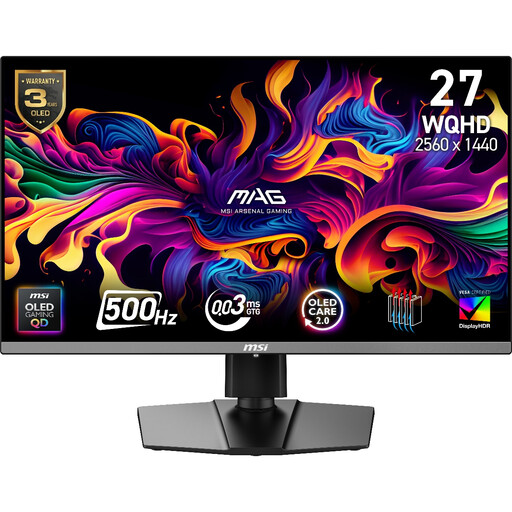
MAG 272QP QD-OLED X50, 27-inch QHD
This QHD OLED option is most relevant if zoo-building shares your gaming time with titles for which you want a very high refresh mode.
The product name specifies 2560 × 1440, 500Hz, 0.03ms and AMD FreeSync.
Check whether your PC and chosen connection can use the mode you want. Confirm any named DisplayHDR certification and the seller’s OLED warranty terms for this exact model.
View on Joybuy
 No image available
Samsung Odyssey G6 S27DG612, 27-inch QHD OLED
Consider this S27DG612 variant if you want a QHD OLED screen for the dark-room setup and may also use its high refresh rate in faster games.
The product name specifies 240Hz and 0.03ms.
Check HDR certification, OLED-care guidance and warranty terms for the S27DG612 itself; specifications for other Odyssey G6 variants should not be assumed to apply.
View on Joybuy
 No image available
LG UltraGear 34GX900A-B, 34-inch OLED WQHD
This is the larger-screen OLED option to consider if you want more physical screen width for habitat-building and have space for it on your desk.
The product name specifies a 34-inch WQHD display and 240Hz; it is not the same screen format as a conventional 27-inch QHD model.
Check the exact resolution and screen dimensions against your desk and preferred layout, along with the model’s HDR certification, care guidance and warranty terms.
View on Joybuy
 No image available
Acer X Predator X27U W3, 26.5-inch QD-OLED
Consider this for a QHD OLED zoo-building setup if its stated gaming modes also fit the other games you play.
The product name specifies 2560 × 1440, 240Hz, 0.03ms, HDR10, FreeSync Premium Pro and G-Sync Compatible.
HDR10 is not itself a named VESA DisplayHDR tier. Check any required certification, stand adjustments, OLED-care guidance and seller warranty for the exact X27U W3 variant.
View on Joybuy
Frequently asked questions
Does an HDR label mean a monitor will suit a dark room?
No: an HDR label alone does not establish a particular performance tier. VESA says a display must meet its specifications to carry the DisplayHDR logo, so check the named tier for the exact model you are considering.
Will any cable support a monitor’s overclocked refresh rate?
Not necessarily: LG specifies a DisplayPort 1.4-capable graphics card and DisplayPort 1.4 cable for the 27GS85Q-B’s 200Hz overclocked mode. Check the requirements for your exact monitor and the limits of the port you plan to use.
Can I cancel a UK online monitor order if it does not suit my setup?
For an eligible UK distance purchase, GOV.UK says you can tell the seller you want to cancel within 14 days of receiving the item, then have another 14 days to return it. Check the seller’s return instructions and any deductions for handling beyond normal inspection; remedies for faulty or misdescribed goods are a separate issue.
What should I do with an old monitor when replacing it?
Check an appropriate electrical-equipment take-back or recycling option rather than putting the monitor in general waste. GOV.UK describes the UK Waste Electrical and Electronic Equipment framework and its obligations for businesses involved in supplying electrical products; ask your retailer what arrangements apply to your replacement purchase.


