Off-centre tournament players
If you play or watch from the side, the picture needs to remain usable away from the central seat. RTINGS identifies viewing angle as important for wide seating arrangements.


For fighting games played from a side seat, consider an OLED gaming TV with independently tested wide viewing angles when off-centre picture consistency comes first. A Mini LED model is worth considering for a bright venue or prolonged use with static game displays, but its side-seat picture needs checking on the exact model. Either way, compare Game Mode input lag and confirm that your console or PC signal works through the intended HDMI port.
If you play or watch from the side, the picture needs to remain usable away from the central seat. RTINGS identifies viewing angle as important for wide seating arrangements.
If display delay matters to your play, look for measured input lag in Game Mode rather than relying on a refresh-rate figure. RTINGS highlights quick reactions as a particular consideration in fighting games.
If the room is bright or a fixed game display stays on screen through repeated sessions, consider those conditions alongside the side-seat view. RTINGS has documented permanent OLED burn-in after prolonged static-content exposure; each alternative TV still needs its own viewing-angle check.
Consider it when: The side seat is central to play and the exact model has independently tested wide viewing angles, as RTINGS found with the LG C5.
Trade-off: Extensive repeated static content can pose a permanent burn-in risk, as shown in RTINGS’ long-duration OLED test.
Consider it when: A bright tournament room makes a brightness-oriented model worth assessing; TCL lists gaming inputs and features for its Q9BK range.
Trade-off: Mini LED and gaming specifications do not establish how that particular screen looks from your side seat.
| Concern | What to check | Who this matters to |
|---|---|---|
| Off-centre picture | Check independent horizontal viewing-angle results, or inspect the screen from your intended seat with dark scenes and colourful game interfaces. | If I play from the side, I need the picture to remain clear and consistent rather than changing as I move away from the centre. Around 50% of consumers put that side-seat picture need first. |
| Response and input signal | Compare measured Game Mode input lag and confirm the refresh rate, VRR and HDMI port supported for your console or PC signal. | When reaction timing takes priority, I want a responsive display and an input that accepts the signal I use. For around 30% of consumers, that is the primary concern. |
| Venue and static displays | Assess room lighting and how long the same HUD or menu remains visible; check any Mini LED candidate’s side-seat picture separately. | If I run long sessions in a bright room, I need a screen suited to the lighting while taking repeated static displays into account. That practical need comes first for around 20% of consumers. |
A refresh-rate figure does not establish input lag or show which signal formats work on each HDMI port. RTINGS treats input lag as a separate test for reaction-based games.
Check Game Mode latency results where available, then match the exact TV’s refresh-rate and VRR inputs to your console or PC.
LCD viewing-angle behaviour varies. RTINGS notes that IPS panels generally retain picture accuracy better off-centre than VA panels, but the panel label alone does not establish an individual TV’s result.
Look for a model-specific viewing-angle review or inspect the screen from your planned playing position.
RTINGS observed permanent burn-in following extensive static-content exposure in its long-duration OLED test; varied content presented a lower-risk pattern in that test.
For repeated, lengthy sessions with a fixed interface, weigh a Mini LED alternative or vary content and use the OLED’s panel-care features.
Gaming features can be port-specific. Sony lists VRR on HDMI 3 and 4 for its 55-inch K-55XR80 BRAVIA 8, while ALLM is listed on all four inputs.
Before play begins, connect through a port that supports your intended signal and check the active refresh rate and VRR status in the TV menu.
LG’s C5 OLED range is a reference point for comparing an off-centre gaming setup. LG lists UK C5E sizes from 42 to 83 inches.
Samsung lists the S90F OLED as a UK gaming-TV option, with sizes from 42 to 83 inches.
Sony’s published specifications for the 55-inch K-55XR80 BRAVIA 8 OLED make its console input allocation clear.
TCL’s Q9BK QD-Mini LED range offers a brightness-oriented route to assess for a lit tournament venue.
These choices include two Mini LED TVs and a smaller Direct LED option. Compare each one against your side-seat position and intended game signal; a gaming feature in a product name is not a viewing-angle or latency test.
 No image available
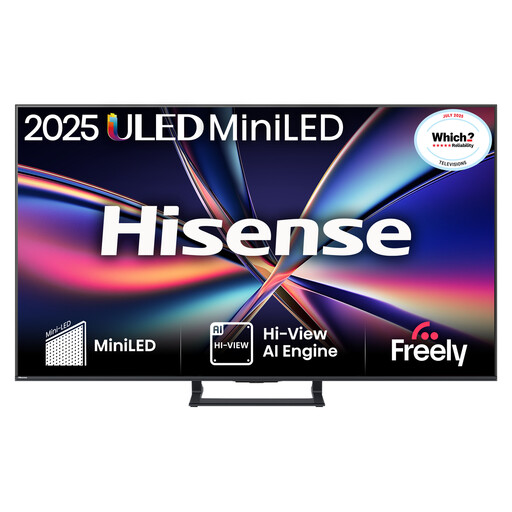
Consider this 55-inch model if a Mini LED tournament screen fits your space, while checking its picture from the actual side seat.
The product name specifies 4K, VIDAA OS, 144Hz Game Mode PRO and a built-in subwoofer.
Confirm Game Mode response and the HDMI port and source-signal combination you plan to use.
 No image available
This 75-inch model is an option to assess for a larger tournament station, provided its viewing distance and side-seat picture work for your room.
The product name specifies 4K HDR, Google TV, up to 2048 local dimming zones and a 144Hz native refresh rate.
Check independent off-centre picture and Game Mode latency results, along with the input format required by your source.
 No image available
This smaller screen is worth assessing for a compact station if its picture remains usable from your playing position.
The product name specifies 4K HDR, Google TV and a 120Hz Game Accelerator at FHD.
Do not treat that FHD feature as confirmation of 4K at 120Hz; check the required input format and Game Mode response before choosing it.
Not unless your intended source signal can use that refresh rate through the TV’s supported input. A 4K120 setup may also fit: Sony lists 4K120 for the 55-inch K-55XR80 BRAVIA 8, while the LG C5 and TCL Q9BK materials describe support up to 144Hz. Check the exact model, port and source together.
Use Game Mode or the equivalent low-latency setting, then connect your console or PC to an HDMI port that supports the refresh rate and VRR you intend to use. Check the active signal in the TV menu: Sony’s 55-inch K-55XR80 BRAVIA 8, for example, lists VRR on HDMI 3 and 4 rather than on every input.
Repeated, prolonged static content is a risk to weigh before choosing OLED. RTINGS observed permanent burn-in after extensive static exposure in its long-duration test, while varied content presented a lower-risk pattern. Consider how your station is used, vary content where practical and use the TV’s panel-care features.
Playing a console game by itself is not the viewing activity for which TV Licensing says a licence is needed. TV Licensing says you need one to watch live TV on any channel or streaming service, or to use BBC iPlayer; check those rules if the tournament screen will also show broadcasts.
Contact the seller about the fault and keep your purchase record. For goods bought from a trader in the UK, the Consumer Rights Act 2015 provides remedies for faulty goods; GOV.UK says repair or replacement can be sought when a fault is discovered more than 30 days after purchase or delivery. The appropriate remedy depends on the circumstances.