For short films watched in a genuinely dark room, start by considering OLED: its individually lit pixels make black depth a relevant strength, as described in guidance from LG UK and Samsung UK. If the same TV is often used in a brighter room, compare Mini LED or Neo QLED as well; whichever display you choose, check the exact model’s HDR formats, size and audio connections against your setup.
Who is this choice for?
Dark-room film viewers
If you mostly watch after dark, compare how TVs render black areas and dim scenes. LG UK and Samsung UK describe individually lit OLED pixels as a route to deep blacks, but the exact TV still needs to suit your room and sources.
Viewers using several film sources
If you switch between apps, discs or an external player, check the HDR formats and picture modes on the exact model. If you plan to add a sound system, check its HDMI and eARC connections too.
Households using one TV day and night
If the room is bright during the day as well as dark for films, compare OLED with Mini LED or Neo QLED under lighting like your own. Samsung UK positions its Neo QLED range around higher brightness and backlight control; that does not establish a winner for every room.
What matters when choosing?
Compare OLED and Mini LED or Neo QLED against your room lighting before narrowing the choice by film sources, screen fit and sound. Samsung UK describes OLED in terms of true blacks and Neo QLED in terms of brightness and finer backlight control; these are technology descriptions, not a comparison of the particular TVs below.
OLED TV
Consider it when: You usually dim the lights and put black depth ahead of daytime brightness.
Bear in mind: Strong reflections still matter, and prolonged static images call for the model’s panel-care guidance, as Sony UK advises.
Mini LED or Neo QLED TV
Consider it when: The same screen must serve a brighter room and backlight control and brightness are important to you.
Bear in mind: It uses a backlight rather than individually lit OLED pixels, so assess dark scenes as well as bright-room viewing.
| Concern | What to check | Who this matters to |
|---|
| Black depth |
Compare a dark scene with the room dimmed; check the exact TV’s panel type and cinema-oriented picture modes. |
If dim scenes and fades matter most to me, I want black areas to remain convincing in my viewing room. Around 46% of consumers put black depth first. |
| Film-source compatibility |
Match your apps or player to the model’s HDR formats and picture modes; check eARC if you plan external audio. |
When I use several film sources, I do not want to choose a TV before checking the formats and connections they need. For around 36% of consumers, compatibility is the primary concern. |
| Room fit and sound |
Measure the screen and stand space; check speaker and soundbar arrangements for the exact size. |
If the TV must fit my furniture and work with my sound setup, installation takes priority over a panel label. Room fit and sound come first for around 18% of consumers. |
What is easy to overlook?
-
Assuming every OLED suits the same setup
OLED’s relevance to dark-room viewing does not establish a particular TV’s HDR formats, connections, dimensions or stand arrangement.
Choose the panel type as a starting point, then check the exact model against your film sources and available space.
-
Reading “HDR” as a complete format list
Format support varies by model: Panasonic UK lists Dolby Vision IQ and HDR10+ Adaptive for the TX-42Z90B, while LG UK lists Dolby Vision for the cited C4 model.
Check which formats your apps or player use and compare them with the specification for the TV you intend to buy.
-
Forgetting OLED panel care
Sony UK notes that an image can remain after static content has been displayed for a prolonged period.
Avoid leaving paused menus or other fixed images on screen for long periods, and follow the TV’s panel-care instructions.
-
Assuming the TV purchase covers viewing services
Content access is separate from the television. TV Licensing states that downloading or watching BBC iPlayer requires TV Licence cover.
Check the requirements for the services you intend to use before settling on your viewing setup.
Selected streaming services may also require separate subscriptions.
Brands to consider
LG
LG’s OLED range is relevant if dark-room black depth is your starting criterion.
- LG UK describes its OLED evo pixels as self-lit, and lists Dolby Vision for the OLED77C44LA C4.
- Check the year, screen size and exact model before treating a C4 feature as a feature of another LG TV.
Panasonic
The 42-inch TX-42Z90B is a model-specific reference for checking film formats and audio connections.
- Panasonic UK lists OLED, Dolby Vision IQ, HDR10+ Adaptive, Filmmaker Mode and eARC for the TX-42Z90B.
- That combination should not be assumed for other Panasonic models.
Sony
Sony’s BRAVIA 8A provides an example of an OLED TV to assess alongside a planned soundbar.
- Sony UK lists Dolby Vision, Acoustic Surface Audio+ and Dolby Atmos for the BRAVIA 8A.
- Stand arrangements and compatibility with selected Sony soundbars depend on screen size and stand position.
Samsung
Samsung’s OLED and Neo QLED descriptions can help frame a dark-room versus brighter-room choice.
- Samsung UK describes OLED in terms of true blacks and its Neo QLED technology in terms of brightness and finer backlight control.
- These brand descriptions are not independent performance measurements of particular models.
OLED TVs on Joybuy
These TV choices are for readers considering the OLED route for dark-room short films. Compare their stated sizes and features with your room and film sources; the Mini LED or Neo QLED alternative remains worth considering if brighter-room use is important.
 No image available
Samsung S85F QE83S85FAE 83-inch 4K UHD TV
Consider this size if you have space for a large screen in your dark-room setup. The title specifies an 83-inch 4K UHD smart TV with Wi-Fi; check its panel type, required HDR formats and installation dimensions before choosing it for film viewing.
View on Joybuy
 No image available
Samsung S90F 55-inch OLED 4K Vision AI TV (2025)
The stated OLED panel makes this a model to assess for dark-room films if a 55-inch screen fits your seating and furniture. Check the HDR formats your sources require and the stand dimensions for this variant.
View on Joybuy
 No image available
Sony BRAVIA A90 XR42A90K 42-inch OLED TV
Consider the 42-inch size if it suits your viewing position and available space. The product title states 4K HDR, Google TV, Dolby Vision and Dolby Atmos; confirm any picture mode or external-audio connection your setup requires.
View on Joybuy
 No image available
Sony BRAVIA 8 K65XR80BP 65-inch OLED TV
This 65-inch OLED is a choice to assess when you want a larger screen for dark-room films. Its title states 4K HDR, Google TV, Dolby Vision and Dolby Atmos; check its full HDR-format list, audio connections and installation dimensions against your plans.
View on Joybuy
 No image available
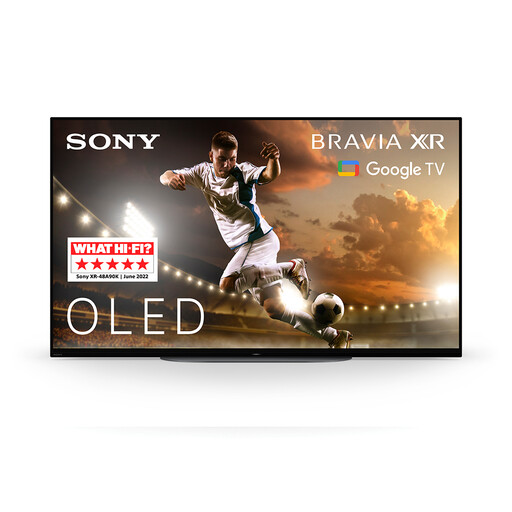
Sony BRAVIA A90 XR48A90K 48-inch OLED TV
Consider this 48-inch OLED if that screen size works better for your room. The title states 4K HDR, Google TV, Dolby Vision and Dolby Atmos; verify any other HDR formats, picture modes, audio connections and dimensions you need.
View on Joybuy
Frequently asked questions
Is OLED the right starting point for short films in a dark room?
Yes, if black depth is your main concern: LG UK and Samsung UK describe OLED’s individually lit pixels as a way to produce true blacks. Compare exact models for the formats, size and connections you need, and consider Mini LED or Neo QLED too if the room is often bright.
Do HDR formats matter if I mainly stream short films?
They matter when your chosen content and playback source use a particular format. Check those sources against the exact TV specification; for instance, Panasonic UK lists Dolby Vision IQ and HDR10+ Adaptive for the TX-42Z90B, but that does not establish support on another model.
Do I need a soundbar for short films?
Not necessarily; decide whether the TV’s sound meets your dialogue and soundtrack needs. If you expect to add a soundbar or AV receiver, check the TV’s connections and the physical arrangement: Panasonic UK lists eARC for the TX-42Z90B, while Sony UK notes size- and stand-position conditions for selected soundbars with the BRAVIA 8A.
Does buying a TV mean I need a TV Licence?
The purchase alone does not determine the requirement; what you watch matters. TV Licensing states that you must be covered by a TV Licence to download or watch BBC iPlayer on any device. Check its guidance against your other intended viewing activities too.


