Timing-focused rhythm competitors
Players who put motion clarity and steady frame delivery first, and can check whether their PC connection supports the QHD refresh mode they want.


Choose a refresh mode your PC and rhythm game can sustain, then assess screen reflections and OLED care for your room and playing habits. A QHD 240Hz OLED can suit players who do not need a higher refresh ceiling; QHD 480–500Hz models put more emphasis on refresh headroom, while a dual-mode model trades resolution for its fastest mode. Manufacturer response-time figures alone do not establish how a monitor will feel in play.
Players who put motion clarity and steady frame delivery first, and can check whether their PC connection supports the QHD refresh mode they want.
Players who care more about dark scenes and distracting reflections in a dim room than about reaching the highest refresh-rate tier.
Players whose rhythm games keep lanes, scores or other interface elements in place for extended sessions, making panel-care instructions and warranty terms important checks.
For rhythm games in a dark room, start with the refresh mode your setup can use; the screen finish and your tolerance for prolonged fixed interface elements may then change which OLED route makes sense.
Consider it when: OLED image characteristics matter to you, but 480Hz-plus operation is not a priority.
Trade-off: It has a lower refresh ceiling than the QHD 480–500Hz routes; check the exact model’s finish against lights in your room.
Consider it when: High-refresh competitive play is your priority and your PC, connection and game can use the intended mode.
Trade-off: These are advertised refresh modes, not guarantees of lower end-to-end input latency. LG UK also qualifies the QHD 480Hz DisplayPort 2.1 mode of its 27GX790A-B in relation to next-generation GPU support.
Consider it when: You want separate QHD and lower-resolution high-refresh modes. LG UK lists the 27GX790B-B at QHD 540Hz or HD 720Hz.
Trade-off: Its 720Hz mode uses HD rather than QHD, so the fastest mode does not retain the same image detail.
| Concern | What to check | Who this matters to |
|---|---|---|
| Timing clarity | Check the refresh mode at the intended resolution and whether the PC, cable and game can sustain it. Treat quoted grey-to-grey response times as pixel-transition ratings, not input-lag measurements. | When note patterns move quickly, I want clear motion without choosing a mode my setup cannot use. Around 42% of consumers would put timing clarity first. |
| Dark-room image and reflections | Compare the exact screen finish with the positions of lamps, LEDs and windows; assess HDR specifications under their stated conditions. | If a nearby light reflects in the screen, I need a finish that works in my room without losing sight of dark scenes. For around 33% of consumers, this would be the primary concern. |
| OLED care during long sessions | Read the model-specific care instructions and warranty terms, particularly if game interface elements remain fixed for long periods. | With lanes and score areas staying in place through lengthy sessions, I want to understand the maintenance routine and ownership terms. OLED care would come first for around 25% of consumers. |
The maximum mode may depend on the GPU, output port, cable and game settings. LG UK specifically qualifies the QHD 480Hz DisplayPort 2.1 mode of its 27GX790A-B in relation to next-generation GPU support.
Check the chosen monitor’s required connection and your PC’s supported output at its intended resolution before committing to a 480Hz-plus mode.
A grey-to-grey rating describes pixel transitions, not the entire input chain. RTINGS.com explains that response behaviour can affect blur or inverse ghosting.
If motion handling is decisive, compare independent tests of the exact model alongside its stated specifications.
LG and Samsung list different finishes across the named models. A lamp or LED can still reflect on the screen even when the room is otherwise dim.
Check where light sources sit relative to your screen and compare the finish of the exact model you plan to buy.
ASUS and Samsung describe features intended to reduce burn-in risk, but neither is a guarantee against image retention. Samsung’s guidance on OLED TVs also cautions against displaying fixed gaming elements for prolonged periods; it is a technology-use warning, not a test of these monitors.
Follow the chosen monitor’s care instructions, allow maintenance routines to run as directed and review its warranty conditions.
LG UK lists QHD OLED models covering 240Hz, 480Hz and a 540Hz QHD/720Hz HD dual-mode option.
Samsung UK lists the Odyssey OLED G6 G60SF as a QHD 500Hz model with Glare Free treatment.
ASUS ROG UK lists the Swift OLED PG27AQDP as a QHD 480Hz option with named OLED-care features.
These Joybuy choices cover 240Hz OLED models in several screen sizes and formats for dark-room rhythm gaming. If you are considering the QHD 480–500Hz or QHD/HD dual-mode routes discussed above, use their connection and resolution requirements to assess those routes separately.
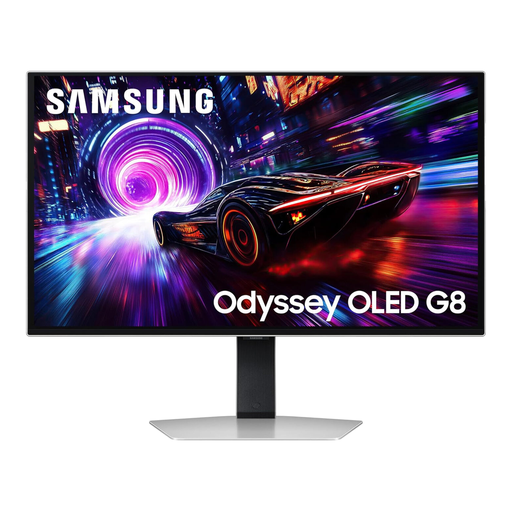 No image available
Consider this 32-inch model if you want to assess a larger screen for your dark-room setup. Confirm the exact unit’s connection options and supported display modes before choosing it for a particular refresh setting.
For lengthy sessions with fixed game elements, check its OLED-care instructions and warranty terms.
 No image available
This QHD model suits a player considering the 240Hz route rather than buying primarily for a 480Hz-plus refresh ceiling.
Its stated 0.03ms grey-to-grey response time is a pixel-transition rating, not an independent input-lag result. Check that your PC and connection support the intended mode, as well as the model’s OLED-care and warranty terms.
 No image available
Consider its 32:9 format only after checking how your rhythm game displays on an ultrawide screen and whether the monitor fits your desk.
The listed specifications include an 1800R curve, Double Quad HD resolution, 240Hz, 0.03ms response time, AMD FreeSync Premium and DisplayHDR 400 True Black. Confirm the supported connection mode and model-specific OLED-care terms.
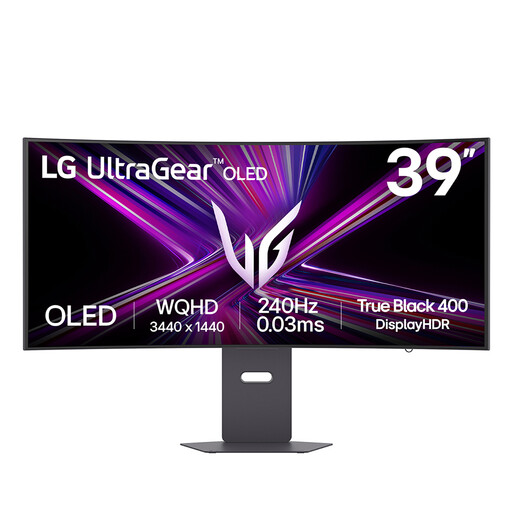 No image available
This larger OLED option is worth considering if its curved, wide format works with your rhythm game and available desk space.
Its stated 240Hz mode should be checked against your PC and connection. Review the exact model’s OLED-care instructions and warranty terms for long sessions with fixed interface elements.
 No image available
Consider this 32-inch Ultra HD model if that screen format suits your setup, but confirm the resolution and refresh mode your PC can deliver for your rhythm game.
Check the exact model’s screen finish, OLED-care instructions and warranty conditions before choosing it for repeated dark-room sessions.
No. A QHD 240Hz OLED can suit players who do not need a higher refresh ceiling. Consider QHD 480–500Hz when high-refresh play is your priority and your PC, connection and game can deliver the intended mode; the advertised rate alone does not establish end-to-end latency.
It can, provided the exact monitor’s screen finish also works with the light sources in your room. Samsung UK lists Glare Free treatment on the Odyssey OLED G6 G60SF, LG UK lists anti-glare and low reflection on the 27GX790A-B, and LG UK describes the 27GX704A-B as a glare-panel model.
Yes, particularly if lanes or score areas stay in place through long sessions. Samsung’s OLED TV guidance identifies prolonged fixed gaming elements as a burn-in concern; it does not establish the outcome for a particular monitor. Check the chosen monitor’s care routine and warranty conditions.
No. Check the monitor’s documentation for the intended resolution and refresh rate alongside your GPU and cable. LG UK lists DisplayPort 2.1 for the 27GX790A-B’s QHD 480Hz route, while ASUS ROG UK lists DisplayPort 1.4 with DSC and HDMI 2.1 for the PG27AQDP; a port name alone does not establish every supported mode.