Dark-room arcade-sports players
If you usually play sports, racing or other fast arcade games after dark, black levels and visible detail in darker scenes may shape your panel choice alongside motion and responsiveness.


For arcade sports played mainly in a dark room, start by comparing 4K OLED TVs with the console gaming features you need: pixel-level blacks suit low-light viewing, while Game Mode, variable refresh rate (VRR) and supported 120Hz output matter for fast play. Consider Mini LED if the TV also sees substantial daytime use or brightness is a higher priority. With either panel type, confirm the exact model’s HDMI inputs, settings and supported signal from your console before buying.
If you usually play sports, racing or other fast arcade games after dark, black levels and visible detail in darker scenes may shape your panel choice alongside motion and responsiveness.
If you use a PS5 or Xbox Series X, check that the TV, selected HDMI input and game can use the output modes you want, rather than choosing by the advertised refresh rate alone. PlayStation and Xbox both make display compatibility a condition of 120Hz play.
If the same TV is used after dark and during brighter daytime hours, compare an OLED with a Mini LED alternative rather than choosing solely for night-time viewing.
Choose the panel route for the room first, then check the gaming signal your console, game and TV can actually use. OLED and Mini LED have different dark-scene and brighter-room trade-offs; neither label confirms a particular model’s HDMI features.
Consider it when: play is mainly after dark and pixel-level black presentation is the priority; LG UK and Philips UK describe this characteristic for their respective OLED models.
Accept the trade-off: long sessions with static scoreboards or game displays call for attention to the chosen model’s panel-care guidance.
Consider it when: the TV also needs to serve a brighter room, or a high-brightness specification is important to you.
Accept the trade-off: local-dimming backlights behave differently from OLED pixels in dark scenes, so assess the exact model if shadow detail or blooming will decide the purchase.
| Concern | What to check | Who this matters to |
|---|---|---|
| Dark-room contrast | Compare the exact panel type and how dark game scenes look in Game Mode; do not infer shadow detail from the brand alone. | If I play mostly after dark, I want to distinguish darker parts of the action without making daytime brightness my main criterion. Around 31% of consumers put dark-room contrast first. |
| Responsive play | Check Game Mode or automatic low-latency mode (ALLM), VRR and supported refresh modes for the exact TV; use model-specific input-lag tests if timing is decisive. | When a fast exchange depends on my input, I care most about control delay and stable motion. Responsive play is the primary concern for around 31% of consumers. |
| Console compatibility | Confirm the console’s intended output, the TV’s compatible HDMI input and settings, and the required cable or intervening equipment. | I already have a console and need its supported video modes to reach the screen through my actual setup. Around 25% of consumers place connection compatibility above their other concerns. |
| Ownership and energy information | For OLED, read the model’s static-image care guidance; compare available energy information and the seller’s after-sales terms separately. | If long sessions leave a scoreboard on screen, I want to understand panel care and ongoing use before choosing. For around 13% of consumers, these ownership considerations come first. |
A high advertised rate does not mean every console game can output at that rate. Samsung UK limits its stated 4K rates above 120Hz to compatible PC games and graphics cards.
For PS5 or Xbox Series X, check the exact model’s 4K/120Hz, VRR and ALLM support on the input you intend to use.
The port, input setting, cable and any device between the console and TV can affect the available video features. Xbox Support warns that an AV receiver or soundbar in the signal path can affect video features and quality.
Set up the console directly with the TV first, using the cable required for the intended mode. Confirm that mode works before adding an AV receiver or soundbar.
If existing equipment cannot pass the intended signal, using that setup may require a suitable replacement cable or compatible intervening device.
Scoreboards and other persistent game elements matter to OLED panel care. LG Support describes logo-brightness adjustment and Pixel Cleaning as measures intended to reduce image-retention risk, not guarantees against it.
Read the exact model’s care instructions, use its protective features as directed and consider whether extended static displays suit your routine.
An energy label describes energy performance, not picture quality or responsiveness. GOV.UK guidance covers labels for televisions within its scope.
Compare the available label information for the screen sizes you are considering alongside, rather than instead of, their gaming features.
These brands offer relevant display or gaming-feature routes, but features differ by model, size and HDMI input.
An OLED route for shoppers prioritising dark-room viewing and gaming features.
An OLED and Neo QLED/Mini LED range for comparing panel routes.
A BRAVIA route for console players checking Game Mode, VRR and 4K/120Hz setup.
A QD-Mini LED route to examine when brighter-room viewing matters as well as night-time play.
These OLED and Mini LED TVs provide two panel routes to consider for arcade sports in a dark room. Match the screen size to your space, then confirm the gaming modes and HDMI connection you need on the exact model.
 No image available
Consider this OLED route if a 42-inch screen suits your dark-room setup. Before relying on a particular console mode, confirm the compatible HDMI input and its settings; read the model’s panel-care guidance if static scoreboards are common in your games.
 No image available
This is an OLED option if your room and viewing distance call for an 83-inch screen. Check which HDMI input and settings support your intended console signal, and review the model’s care guidance for prolonged static game imagery.
 No image available
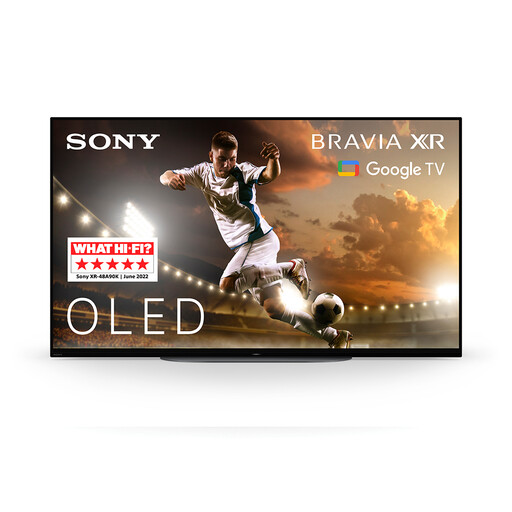
Choose this OLED route to compare a 48-inch screen with the other sizes here. Confirm VRR, ALLM and the required HDMI input for your console before purchase, and check the model’s guidance if you regularly leave static game elements on screen.
 No image available
Consider this 50-inch QD-Mini LED model if the TV will also be used in brighter conditions. Its product title claims a 144Hz native refresh rate; confirm the modes available to your console on the chosen input, and assess model-specific dark-scene behaviour if that will decide your choice.
 No image available
This 55-inch Mini LED option is worth comparing if the room is not always dark. Check its actual console refresh modes and compatible HDMI input rather than treating the gaming-rate wording in its title as a console guarantee; look for model-specific dark-scene evidence if shadow detail matters most.
No, not for every game; look for 120Hz support if you want to use games and console modes that offer it. PlayStation says PS5 120Hz output depends on a compatible TV and game, while Xbox Support sets out additional equipment requirements for 4K gaming at 120Hz on Xbox Series X.
Do not assume it will. Samsung UK says its stated 4K rates above 120Hz depend on compatible PC games and graphics cards; check the exact TV’s console-compatible modes and HDMI input instead.
Check the TV’s Game Mode, supported VRR setting and high-bandwidth HDMI input mode, then inspect the console’s video-output settings. Sony UK notes that relevant BRAVIA inputs can require Enhanced Format for 4K/120Hz, so use the instructions for your exact TV.
Yes, if it passes the video features you intend to use. Xbox Support cautions that an intervening soundbar or receiver can affect those features; connect the console directly to the TV first if a mode is not working, then check the other device’s pass-through support.