Start with an OLED TV if you usually sit to one side and dark skies are the main test: LG describes OLED as offering wide viewing angles, true blacks and high contrast. If daylight or reflections are the bigger obstacle, consider a Mini LED or Neo QLED TV instead, but check the exact model from your usual seat; Samsung says its viewing-angle and anti-reflection features apply to certain Neo QLED models, not the whole range.
Who this choice affects
Off-centre dark-scene viewers
If your usual seat is to the side, compare how dark skies and small bright objects look from there, not just from directly in front. LG describes its OLED panels as offering wide viewing angles, true blacks and high contrast; the result still needs checking on the TV you choose.
Bright-room astronomy viewers
If windows or lamps are prominent while you watch, reflection handling may matter as much as the side-seat view. Samsung says some Neo QLED models have viewing-angle and anti-reflection features, so check whether the particular model has them.
BBC iPlayer and live-TV viewers
If you plan to watch astronomy programmes on BBC iPlayer or live TV in the UK, account for how you will access them as well as which screen you buy. TV Licensing states that watching BBC iPlayer or live TV requires a TV Licence, regardless of the device.
What matters when choosing
OLED TV
Consider it when: Your usual side seat and dark astronomy scenes matter more than daytime room brightness; LG associates OLED with wide viewing angles and true blacks.
Keep in mind: The technology label does not tell you how reflections or the view from your particular seat will look on every model.
Mini LED or Neo QLED LCD TV
Consider it when: Daylight or lamps are the stronger constraint; Samsung describes its Neo QLED Mini LEDs as providing finer light control and higher brightness.
Keep in mind: Samsung limits its viewing-angle and anti-reflection claims to certain Neo QLED models, so do not assume either feature is present.
| Concern |
What to check |
Who this matters to |
| Side-seat picture and dark scenes |
View a dark scene from your intended seat, and check whether the TV can be positioned towards it. |
If I sit off centre, I want star fields and shadowed scenes to remain clear without moving seats. Around 50% of consumers put that picture requirement first. |
| Room light and reflections |
Check the exact model’s screen features and compare it under lighting similar to your room. |
When a window or lamp faces the screen, I need to see the programme without distracting reflections. For around 30% of consumers, room-light handling is the primary concern. |
| Programme access and setup |
Check your intended service, any required TV inputs and whether your viewing requires a TV Licence. |
I need the TV to work with the service or external device I will use for astronomy programmes. Access and setup come first for around 20% of consumers. |
Buying pitfalls
-
Assuming a display label guarantees the side-seat view
Viewing-angle and reflection behaviour depend on the particular TV. Samsung describes its Ultra Viewing Angle and anti-reflection features as available on many Neo QLED models, rather than all of them.
Check the exact model’s features and, if possible, watch a dark scene from your usual seat with the room lights as you would normally use them.
-
Choosing on dark-scene contrast alone
A TV that interests you for dark skies still has to work in your room. Samsung positions Neo QLED around brightness and finer light control, while LG highlights OLED’s true blacks and wide viewing angles.
Decide whether the side-seat view or persistent daylight and reflections are the stronger constraint, then compare individual TVs under those conditions.
-
Assuming a smart-TV app settles the licence question
In the UK, the requirement depends on what you watch, not whether you use an app or a connected device. TV Licensing states that watching BBC iPlayer or live TV requires a TV Licence.
Before watching through BBC iPlayer or a live-TV service, check that your household is covered.
Brands to consider
LG
LG’s UK OLED range is relevant if a side-seat view of dark astronomy scenes is your main concern.
- LG says its individually controlled OLED pixels provide true blacks, high contrast and wide viewing angles.
- Compare the specific screen from your seat and in your room rather than assuming identical results across LG OLED models.
Samsung
Samsung’s OLED and Neo QLED ranges give you models to consider on either side of the dark-room versus bright-room decision.
- Samsung says Neo QLED’s Quantum Mini LEDs allow finer light control and higher brightness.
- Samsung says viewing-angle and anti-reflection features appear on certain Neo QLED models; check the model rather than the range name.
Sony
Sony’s BRAVIA OLED line is worth considering if you also need to check HDR formats and connections for your programme sources.
- Sony lists HDR10, HLG, Dolby Vision and four HDMI inputs for its UK BRAVIA 8 K-65XR80.
- Those specifications are model-specific; assess the view from your own side seat separately.
Joybuy product choices
These TVs include OLED choices for investigating side-seat, dark-scene viewing and Mini LED choices to consider when room light is a greater concern. Check each model from your intended seat before deciding.
 No image available
Samsung S85F QE83S85FAE 83-inch 4K Smart TV
Consider this large-screen option if you can place it for your usual side seat; compare dark scenes and reflections on the actual screen.
The product title specifies an 83-inch 4K Smart TV with Wi-Fi.
View on Joybuy
 No image available
Sony BRAVIA 8 K65XR80BP 65-inch OLED 4K HDR Google TV
This OLED model is an option to investigate for dark programmes viewed off centre; check its picture and reflections from your seat.
The product title identifies a 65-inch 4K HDR Google TV and lists Dolby Vision and Google Cast.
View on Joybuy
 No image available
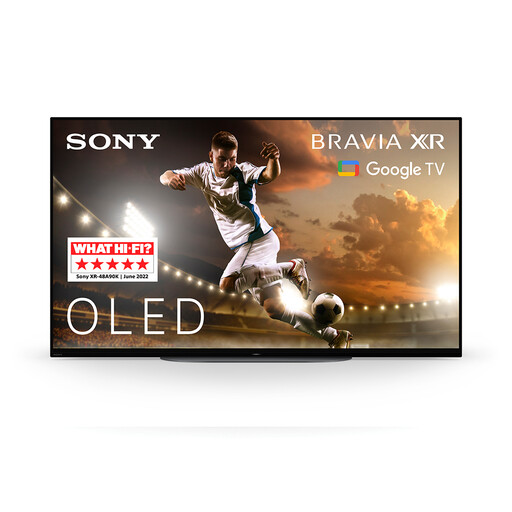
Sony BRAVIA A90 XR48A90K 48-inch OLED 4K HDR Google TV
Consider this 48-inch OLED if that screen size suits your seating arrangement, then inspect dark scenes from the side seat.
The product title specifies 4K HDR Google TV and lists Google Cast and Dolby Vision.
View on Joybuy
 No image available
Hisense U7Q Pro 55U7QTUK Pro 55-inch Mini LED 4K HDR VIDAA TV
This Mini LED option is worth considering if room lighting is a priority; assess both reflections and dark scenes from your side seat.
The product title identifies a 55-inch 4K HDR Smart TV with VIDAA OS. A stated viewing-angle figure alone cannot establish how consistent the picture will look from your seat.
View on Joybuy
 No image available
TCL Q6C 75Q6C 75-inch QD-Mini LED 4K HDR Google TV
Consider this QD-Mini LED model if you want a 75-inch screen and room lighting influences your choice; inspect the side-seat view before buying.
The product title specifies 4K HDR Google TV. Its dimming and brightness claims do not establish how it will handle reflections in your room.
View on Joybuy
Common questions
Should I choose OLED or Mini LED if I watch from one side?
Start with OLED if the side-seat view of dark astronomy scenes is your priority: LG describes OLED as offering wide viewing angles, true blacks and high contrast. If daylight and reflections matter more, compare Mini LED or Neo QLED TVs too, checking the viewing-angle and screen features of each model.
Can a wall mount improve the view from a side seat?
A mount may help if it lets you aim the screen towards your usual seat, but it cannot change the panel’s viewing-angle behaviour. Check the TV’s mounting pattern and weight against the mount’s stated compatibility before choosing that setup.
Do I need a TV Licence for astronomy programmes on BBC iPlayer?
Yes. TV Licensing states that watching programmes on BBC iPlayer requires a TV Licence, whichever device you use; the same applies when you watch live TV.


