Dark-room astronomy viewers
You usually watch at night or with the room darkened and want stars and other bright details to remain distinct against black backgrounds.


For astronomy programmes in a light-controlled home cinema, start with OLED if clean black backgrounds and minimal haloing around bright objects matter most. Consider a Mini LED LCD if you regularly watch with the lights on or want a particularly large screen, but check dark-scene reviews of the exact model and size. Whichever route you take, confirm that your programmes, source devices and audio connections work with the TV.
You usually watch at night or with the room darkened and want stars and other bright details to remain distinct against black backgrounds.
You want a cinema-scale picture but also use the room in daylight or with lamps on, so screen size and performance in ambient light both affect your choice.
You use a UHD/HDR service, external player, soundbar or AV receiver and need the TV and the rest of the playback chain to work together.
Choose between OLED and Mini LED according to your room lighting and screen-size needs; treat HDR and connection checks as part of either choice.
Choose when: You can darken the room and want bright stars or subtitles against black without local-dimming-zone halos.
Consider: RTINGS identifies prolonged use with fixed graphics or interfaces as a continuing OLED burn-in consideration.
Choose when: Regular ambient light or a very large screen matters more to your setup.
Consider: RTINGS notes that poorly controlled local dimming can produce blooming around bright objects in dark scenes.
| Concern | What to check | Who this matters to |
|---|---|---|
| Black levels and halos | Look for exact-model observations of black uniformity and blooming around small bright objects. | If stars against a dark sky are the reason I am upgrading, visible halos would distract me most. Around 36% of consumers put black levels and halo control first. |
| Screen size and room light | Measure the installation space and compare the exact screen size in lighting like yours. | I want a large picture that remains practical when the room is not fully dark. For around 29% of consumers, size and mixed-light viewing are the primary concern. |
| HDR and connections | Confirm your programmes and devices support the formats you need; check the HDMI path and audio return connection. | If I watch through a Sky box or external player, I need the picture and sound to reach the TV and audio system correctly. Compatibility comes first for around 21% of consumers. |
| Long-term use and replacement | Consider prolonged fixed-image use and ask how the retailer handles old-TV take-back. | My TV may also show fixed graphics for long periods, and replacing a large set takes planning. Around 14% of consumers prioritise those ownership considerations. |
Local dimming can improve contrast, but RTINGS notes that imprecise control may create blooming around bright objects in dark scenes.
Check reviews of blooming and local-dimming transitions for the exact model and screen size, rather than relying on the Mini LED label.
Moving programmes are not the same use pattern as leaving fixed news graphics, desktop interfaces or game displays on screen for prolonged periods. RTINGS identifies the latter as a burn-in consideration.
Base the OLED-versus-LCD choice on everything the household will display, particularly if fixed elements will appear for thousands of hours.
HDR viewing also depends on the programme, service, source device and connections. A TV’s supported format does not make every astronomy programme available in that format.
List your devices before ordering and confirm the required formats and HDMI pass-through for each part of the chain. Sky Help specifies 3840 × 2160 at 50 frames per second and HDCP 2.2 for its UHD setup.
A large replacement TV needs an old-TV disposal plan. GOV.UK says sellers of electrical equipment must provide a way for customers to dispose of an old household item when selling a new version of the same item.
Ask the retailer how its take-back service works for your TV and whether home collection carries a transport charge.
LG’s UK OLED evo range includes a 77-inch C6 model relevant to a large, dark-room setup.
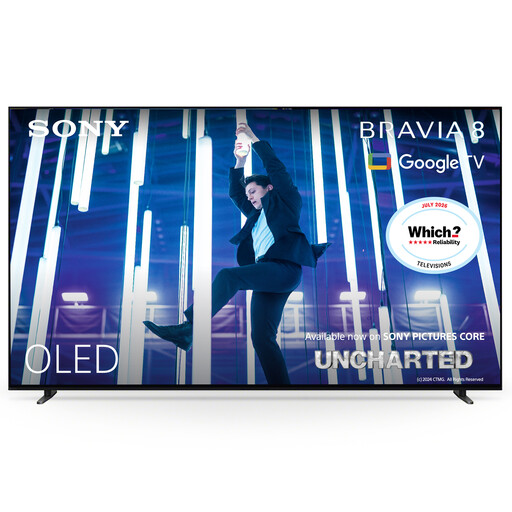
Sony positions the BRAVIA 8 II as a QD-OLED home-cinema TV; the UK range includes 55- and 65-inch sizes.
Samsung’s UK QN80H is a Neo QLED Mini LED option to consider when a large screen and mixed-light viewing matter.
Panasonic’s TV-42Z90B is a smaller OLED option for viewers considering HDR format support and a movie-oriented picture mode.
These OLED and Mini LED TVs offer different screen sizes for the dark-room and mixed-light choices discussed above. Measure your installation space and check exact-model dark-scene performance before deciding.
 No image available
For a large-screen home cinema, measure the wall space and delivery route before choosing this 83-inch set.
4K Ultra HD; confirm the panel type and check independent dark-scene observations for the exact model.
 No image available
Consider this 42-inch OLED where a larger screen would not suit the room; check its black uniformity in exact-model reviews.
4K HDR and Dolby Vision are named in the product information. Confirm the audio connection your soundbar or receiver needs.
 No image available
This 65-inch OLED is a dark-room option if its size suits your seating and installation space; compare exact-model black-uniformity results.
4K HDR and Dolby Vision are named in the product information. Check the HDMI and audio connections required by your other equipment.
 No image available
Choose between this 55-inch variant and a larger screen by measuring the room, then check exact-model dark-scene results.
OLED, 4K HDR and Dolby Vision are named in the product information. Confirm HDMI and audio compatibility with your source devices.
 No image available
This 55-inch Mini LED offers an LCD route if the room is not always dark; check independent blooming and local-dimming observations before choosing it for star fields.
4K HDR is named in the product information. Confirm the connections needed for your receiver or soundbar.
No. OLED is a useful starting point for a dark room because it avoids local-dimming-zone halos, but a Mini LED LCD may suit regular ambient-light viewing or a different screen-size requirement. Check blooming reviews for the exact Mini LED model rather than assuming all such TVs perform alike.
Check the Sky service and equipment, the programme’s availability and the complete HDMI connection. Sky Help specifies a TV supporting 3840 × 2160 at 50 frames per second and HDCP 2.2 for its UHD setup; confirm the requirements of any receiver or soundbar in the signal path too.
They matter when the programme and playback equipment supply a compatible format. Check the exact TV’s supported formats and picture modes, then consider independent observations of dark-scene contrast and blooming rather than choosing by a list of HDR logos alone.
GOV.UK says an electrical-equipment seller must provide a way to dispose of an old household item when selling a new version of the same item. Ask your retailer which take-back arrangement applies to a large TV and whether home collection involves a transport charge.