Repeated batch cooks
If olives are one ingredient among several you prepare for meals, sauces, salads or fillings, a full food processor may serve more of your prep routine. Check its working capacity against the quantity you handle at one time.


For smaller batches of pitted olives, a compact chopper with pulse control gives you a way to stop and inspect the texture. If chopping olives is one step in wider batch cooking, a full food processor may be more useful, but it takes more space. Size either format against the quantity you prepare at once, checking working capacity rather than relying on the headline bowl figure.
If olives are one ingredient among several you prepare for meals, sauces, salads or fillings, a full food processor may serve more of your prep routine. Check its working capacity against the quantity you handle at one time.
If you want recognisable olive pieces rather than a paste, look for pulse control so you can stop and inspect the chop between bursts.
For smaller batches, consider whether a compact chopper will be easier to store and clean between uses than a full processor with multiple accessories.
Decide how much you need to chop in one session, then whether the same appliance must handle other batch-prep jobs. For either format, check the controls and cleaning instructions for the exact model.
Choose it when: Chopped olives and other small ingredients are the main jobs.
Trade-off: A smaller bowl can mean repeat runs, and a chopper does not provide the wider preparation functions of a full processor.
Choose it when: Olive chopping is one stage of a broader batch-cooking routine that also calls for other preparation functions.
Trade-off: A larger machine and its accessories need more storage space; its total bowl capacity may differ from its working capacity.
| Concern | What to check | Who this matters to |
|---|---|---|
| Batch size | Compare the intended olive quantity with the model’s stated working capacity, where given; do not treat total bowl capacity as a task-specific limit. | If I prepare olives alongside ingredients for several meals, I need a bowl suited to the amount I make at once. Around 40% of consumers would put batch capacity first. |
| Chop texture | Look for pulse control and a suitable chopping blade; check the result between short bursts. | For a coarse chop, I want to stop before the olives become a paste. Roughly 30% of consumers would make texture control their main concern. |
| Storage and cleaning | Check the appliance’s dimensions and whether the bowl, lid and blade can be removed and cleaned as the manual directs. | With limited storage and oily ingredients to clean up afterwards, I need an appliance I can put away and maintain routinely. Around 30% of consumers would put storage and cleaning first. |
Magimix lists the 4200XL at 3L total capacity but 1.3L working capacity. The larger figure is not the amount to assume for every task.
Compare like-for-like capacity figures and consult the exact model’s manual for quantity guidance.
KitchenAid’s 1.19L chopper has two speeds and pulse action, while its 3.1L processor is a broader preparation format with accessories.
Choose a full processor for its additional functions only if you expect to use them in your batch-cooking routine.
Pulse control lets you interrupt processing and inspect the pieces; the control alone does not establish how a particular model will chop olives.
Follow the manual and try a small batch of pitted olives before processing a full recipe quantity.
Oily residue can remain on a bowl, lid or blade. The Food Standards Agency’s guidance for food businesses emphasises equipment that can be adequately cleaned; for home use, the practical question is whether you can clean the parts after each job.
Check how the exact model comes apart and follow its cleaning instructions, particularly before using it with different ingredients.
Its UK food-processor range includes the 2.6L 3160 and the 4200XL, which Magimix lists at 3L total capacity.
Its UK range includes a 1.19L chopper and a 3.1L food processor.
Braun offers compact chopper and food-processor lines, including MultiPractic 3 and PurEase.
These choices cover a food chopper for focused chopping and a food processor with functions for wider batch preparation. Check the exact model’s controls and usable quantity against the texture and batch size you need.
 Image unavailable
Consider this chopper if you mainly want a dedicated appliance for chopping ingredients during batch prep. Its listed specifications include a 2L bowl, 300W power, two speeds and 304 stainless-steel blades.
Check whether its controls include pulse action and what quantity the manual permits for olives. Its operating instructions limit continuous use to 40 seconds, followed by at least two minutes’ rest; after three consecutive cycles, they call for a 15-minute cooldown.
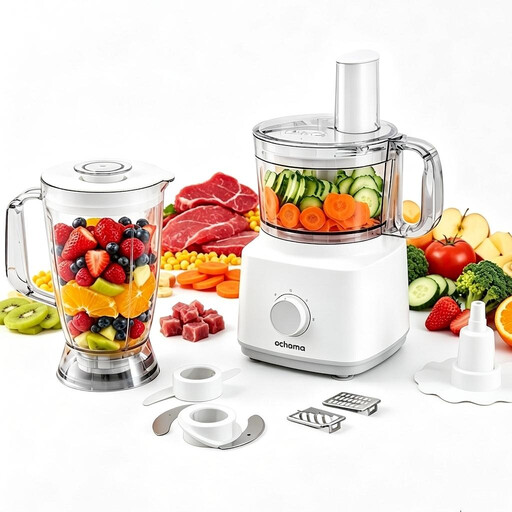 Image unavailable
Consider this model if chopping olives is part of a routine that also calls for slicing or grating. Its listing names a 1.8L bowl, 750W power, blender and grater discs, as well as detachable parts.
Before choosing it for a particular olive texture or batch quantity, check the exact model’s controls, usable working capacity and cleaning instructions.
Choose against the quantity you prepare at one time, not the largest advertised bowl figure. KitchenAid lists a 1.19L compact chopper and a 3.1L processor for different preparation needs; Magimix distinguishes the 4200XL’s 3L total capacity from its 1.3L working capacity. Check the manual for guidance on your intended quantity.
Use short pulses and inspect the pieces between bursts rather than processing continuously. KitchenAid specifies pulse action on its 1.19L chopper, but that feature does not guarantee a particular result with olives; start with a small batch and follow the model’s instructions.
Clean the bowl, lid, blade and other food-contact surfaces according to the model’s instructions, especially before switching ingredients. The Food Standards Agency’s guidance for food businesses calls for food-contact equipment that can be adequately cleaned; it is a useful hygiene consideration here, not a statement of domestic licensing rules.