Opera-focused stereo listeners
You want space for a left and right speaker when playing recordings with solo voices, chorus and orchestra. You can accommodate two speaker positions in the lounge.


If opera is your main listening and you have room to position two speakers apart, start with a powered stereo pair; it gives you a conventional left-right layout without a separate amplifier. A compact networked pair suits streaming alongside TV or computer use, while a single Wi-Fi speaker makes more sense when one-speaker placement matters more than separated stereo. In a shared lounge, check source connections and plan for considerate speaker placement, bass and listening levels.
You want space for a left and right speaker when playing recordings with solo voices, chorus and orchestra. You can accommodate two speaker positions in the lounge.
You need to listen at moderate levels without unnecessarily disturbing other occupants or neighbours. Placement and accessible bass adjustment matter to your choice.
You want straightforward playback and may also need to connect a TV, computer or another existing source, without assembling a separate hi-fi system.
For opera in a shared lounge, establish whether two speaker positions will work, then match the inputs to your recordings and consider how sound may travel beyond the room.
| Concern | What to check | Who this matters to |
|---|---|---|
| Stereo presentation | Check whether the product includes two speakers and whether you can position them apart. Audition familiar opera passages if possible. | If opera is my main listening, I want a left-right layout for voices and orchestra rather than choosing by wattage alone; around 42% of consumers put that arrangement first. |
| Considerate listening | Plan positions away from shared boundaries where feasible, and check for accessible volume and bass controls. | When sound can reach other occupants or neighbours, I need to keep bass and listening levels manageable; avoiding disturbance comes first for around 33% of consumers. |
| Source connections | List the sources you use and match their outputs to the speaker inputs. Check any setup or adapter requirements. | I may switch between streamed recordings and an existing TV, computer or music player without adding unnecessary equipment; around 25% of consumers prioritise that straightforward access. |
An output rating does not tell you whether a speaker arrangement fits the lounge or how it will sound with familiar vocal and orchestral passages at your usual listening level.
Check the layout and connections first, then audition recordings you know if you have the opportunity.
Music, particularly bass, can disturb people outside the lounge. Westmorland and Furness Council advises placing speakers away from neighbours’ walls, floors and ceilings.
Plan where speakers can sit before buying, keep bass controlled and consider whether adding a subwoofer would suit the shared space.
A turntable’s output and a speaker’s available analogue input need to work together; an input described for another source does not settle that question.
Check whether your turntable has a built-in phono preamp and confirm the speaker’s exact input path.
A separate phono stage or, for analogue line-in on a Sonos Era 300, the appropriate Sonos adapter may be needed.
Sonos Support says the Era 300 must first be set up on Wi-Fi before it can be used over Bluetooth.
If you are considering that model, check that you can complete its initial network setup. If you need direct Bluetooth and physical inputs instead, compare the requirements of a powered speaker system.
KEF’s LSX II LT is a compact active stereo pair to consider when opera listening shares the room with network streaming, TV or computer playback.
The Q Acoustics M20 is a powered bookshelf pair for listeners who want conventional stereo placement and connections for existing sources without a separate amplifier.
The Sonos Era 300 is a single-speaker option when compact placement and app-based playback take priority over a physically separated stereo pair.
These Edifier speakers offer different starting points for lounge playback: consider the single S300 where one tabletop cabinet suits the room, or assess the M60 for a compact arrangement with Bluetooth and wired inputs. Confirm the speaker configuration you need before choosing either for stereo opera listening.
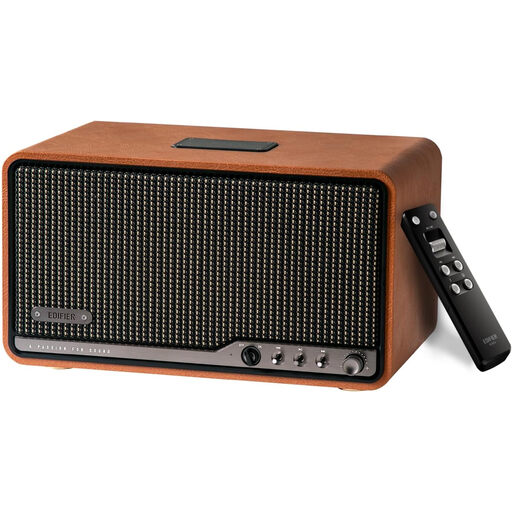 Image unavailable
Consider this single tabletop speaker if one cabinet is easier to place in the lounge. For a separated left-right arrangement, check the pairing requirements for a second S300; also confirm that its connections and bass adjustments suit your sources and shared space.
 Image unavailable
Consider the M60 if a compact speaker arrangement and Bluetooth, USB-C or AUX playback match your sources. Its title lists 66 W RMS, a 3-inch mid-bass driver and a 1-inch tweeter; those figures do not establish how opera will sound in your room. Confirm the included speaker count, left-right stereo operation and available bass adjustments before buying for a shared lounge.
Choose a stereo pair if you can position its speakers apart and want a conventional left-right presentation. A single all-in-one speaker is an alternative when one-speaker placement and app-based playback matter more; check what is included rather than assuming any single-speaker product provides a separated stereo layout.
Yes, if the speaker has a compatible input and the source provides the signal it needs. Q Acoustics lists turntable and CD-player connections for the M20, while a Sonos Era 300 needs a compatible adapter for analogue line-in. Check whether your turntable has a built-in phono preamp; otherwise, a suitable phono stage may be needed.
Start by placing speakers away from neighbours’ walls, floors and ceilings where feasible, then keep bass and listening levels considerate. Westmorland and Furness Council recommends attention to placement for music noise; no particular speaker position can guarantee that sound will not disturb someone else.
Not without regard to its effect on others. In England, GOV.UK says councils must investigate noise complaints that could amount to a statutory nuisance; whether particular music creates a problem depends on the circumstances. Check your local council’s guidance and any tenancy or lease conditions, especially if you live elsewhere in the UK.